

Softgel Fill–Shell Compatibility: What Brands Should Check Before Scale-Up
Date: 2026-08-21 Categories: Supplement Blog Hits: 301
A softgel can look flawless when the sample arrives and still fail as a commercial product. The real test is whether the fill, shell, seam, drying process, package, and storage environment remain compatible over time.
Buyer Answer
Softgel stability is not a shell-only issue. Fill viscosity, suspended-particle size, water and volatile content, reactive compounds, pH, seam formation, drying, temperature, humidity, and packaging all influence how the finished capsule behaves over time.
For a commercial project, color and capsule shape are only the beginning. The fill, shell, seam, drying process, package, and stability criteria all need to work together.
What Is Softgel Fill–Shell Compatibility?
Softgel fill–shell compatibility is the ability of a liquid, suspension, or semisolid fill to remain suitable inside a sealed flexible shell without causing unacceptable physical or chemical change.
The shell is commonly based on gelatin, water, and a plasticizer, although other shell technologies may use different polymers. The fill may be an oil solution, suspension, emulsion, hydrophilic system, or semisolid. Components can interact or migrate between fill and shell during encapsulation, drying, and storage.
A useful development review asks two questions:
Can the product be encapsulated and sealed consistently on the intended process?
Will the filled and packaged softgel maintain the required attributes through the proposed shelf life?
Common Softgel Fill Types
| Fill Type | Potential Advantage | Main Compatibility Questions |
|---|---|---|
| Oil solution | Active is dissolved in a lipophilic vehicle | Solubility, oxidation, precipitation, viscosity, and shell interaction |
| Oil suspension | Insoluble particles are dispersed in oil | Particle size, settling, rheology, pump dosing, seam interference, and uniformity |
| Hydrophilic solution or suspension | May support ingredients that do not fit an oil system | Water, low-molecular-weight solvents, migration, shell plasticization, and leakage risk |
| Semisolid fill | May help suspend ingredients and reduce settling | Pumping temperature, viscosity, recrystallization, and fill-weight control |
The right route depends on the ingredient, target amount, stability, capsule size, equipment, package, and cost.
The Commercial Softgel Manufacturing Path
1. Develop the fill
The formulator evaluates carrier system, solubility, dispersibility, oxidation sensitivity, viscosity, particle size, and chemical compatibility. If the product is a suspension, it must remain sufficiently uniform during the filling operation.
If a suspension settles too quickly, fill composition can shift across the run even when the average batch composition is correct.
2. Prepare the shell system
The shell system must produce ribbons with suitable strength, elasticity, thickness, and sealing behavior. Gelatin source and properties, plasticizer type and ratio, water, colorants, opacifiers, and other permitted components can influence the process.
Changing shell color, opacity, or claim direction late in development can trigger more than an artwork revision because the shell itself is part of the manufacturing system.
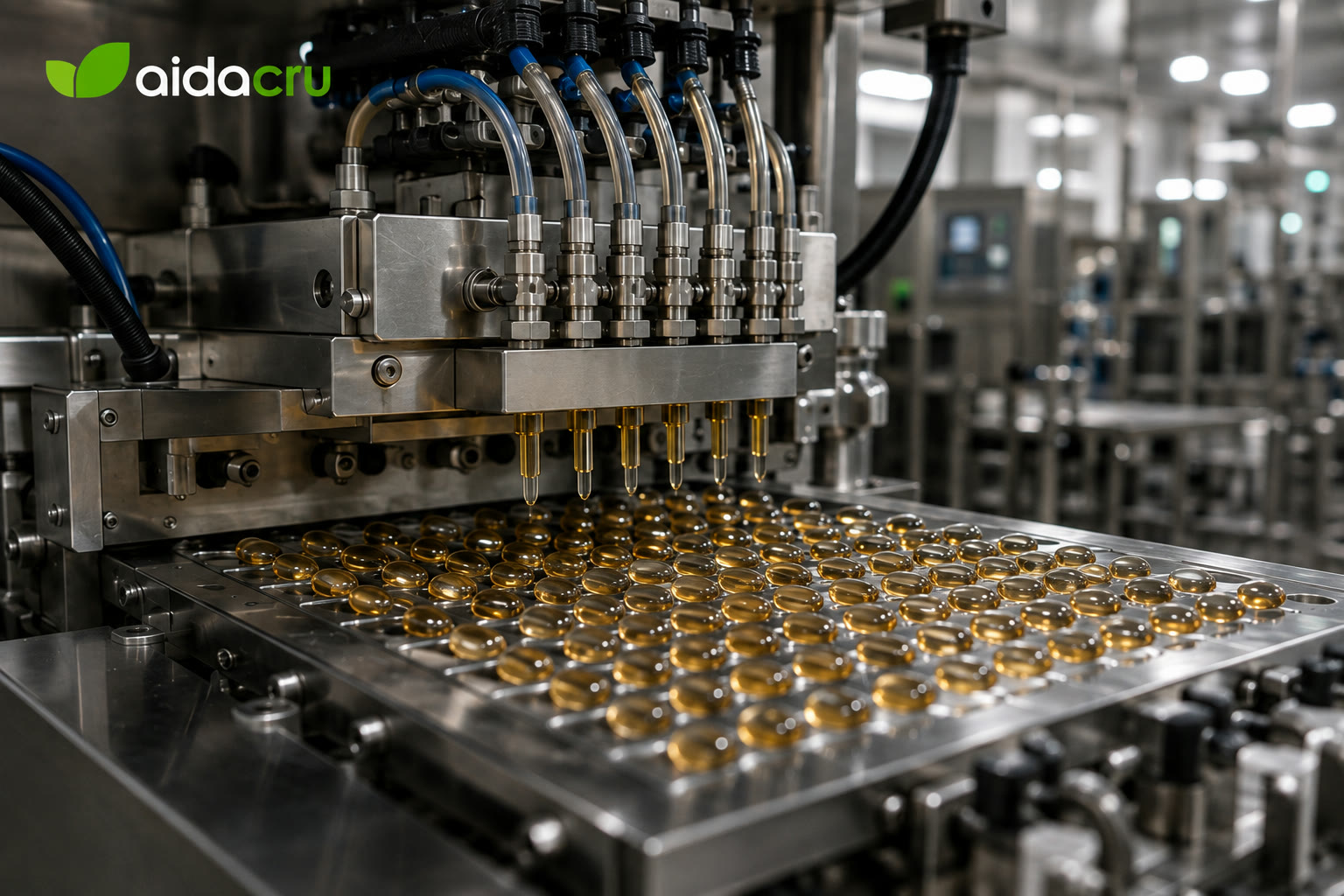
3. Encapsulate and form the seam
In a rotary-die process, two shell ribbons move through opposing dies while the fill is metered through a heated wedge. The capsule is formed, filled, cut, and sealed in one continuous operation.
Variables may include ribbon thickness, wedge temperature, fill temperature, pump accuracy, die alignment, seam formation, and machine speed. The workable ranges are product- and equipment-specific.
A hand-prepared fill sample can show concept feasibility, but it does not prove reliable commercial encapsulation on the intended line.
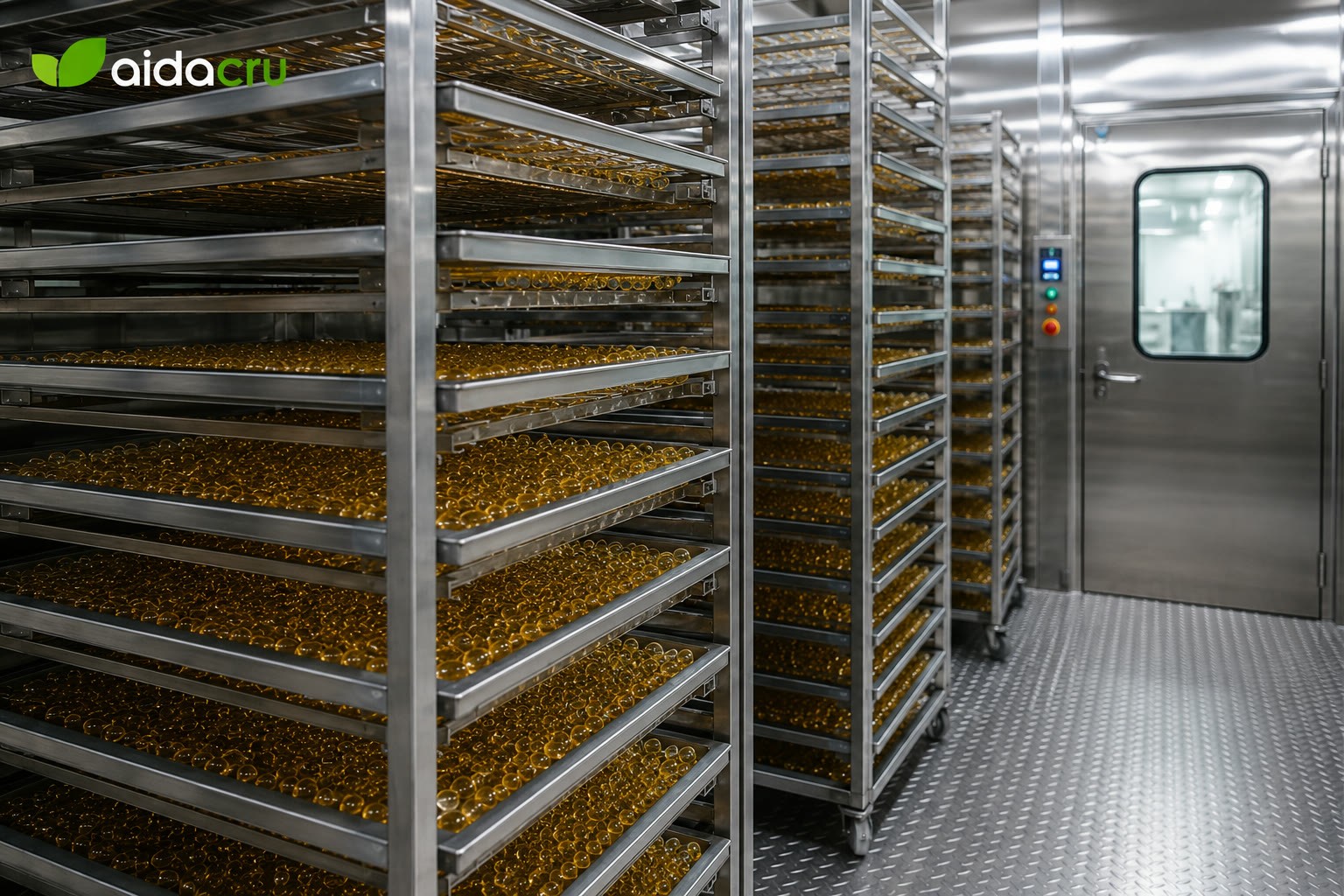
4. Dry and condition the capsule
Newly formed softgels contain more water and are mechanically sensitive. Drying and conditioning bring the shell toward an appropriate state for handling, inspection, packaging, and storage.
Too little drying can contribute to softness, sticking, or leakage. Too aggressive a drying process can contribute to brittleness or deformation. Fill components may also migrate during this stage.
Drying is not just time on a rack. It is part of the product’s formulation, mechanical performance, and stability control.
5. Inspect and package the finished softgel
Inspection may address appearance, seam defects, leakage, deformation, and other physical criteria. The softgels are then placed into the selected bottle, blister, pouch, or other package.
Package count, headspace, closure, oxygen or moisture exposure, and distribution climate can change the final product environment.
Why Softgels Leak
Leakage is not always caused by one visible puncture. It can originate in formulation, encapsulation, drying, storage, or packaging.
Seam formation problems
Ribbon thickness, temperature, die alignment, fill volume, or particles at the sealing area can interfere with seam formation and create weak points.
Fill viscosity outside the process window
A very thin fill may move through the system and seam differently from a high-viscosity suspension. A thick or stringing fill can affect pump dosing and clean sealing.
Suspended particles
Particles can settle, abrade equipment, or enter the seam. The acceptable particle-size distribution depends on the formula, machine, die, and wedge. A universal particle-size limit should not be presented as an Aidacru standard without line-specific confirmation.
Fill migration or shell plasticization
Water, low-molecular-weight hydrophilic solvents, and other mobile components may interact with or migrate into the gelatin shell and change its mechanical properties. Volatile components may also move during drying.
Storage stress
Heat and humidity can soften the shell, increase sticking, or contribute to leakage. Low humidity and an unsuitable package can also alter shell flexibility.
Why Softgels Stick or Deform
Sticking often indicates that the shell surface has become too soft or tacky. Possible contributors include incomplete drying, excessive moisture, high storage temperature, humid distribution, plasticizer balance, or migration from the fill.
Deformation can occur when the shell cannot maintain the capsule shape under handling or storage conditions. Bottle packing, capsule size, headspace, and compression during shipping may add mechanical stress.
For buyer approval, evaluate appearance and handling in the final retail package, not only as loose capsules stored under ideal conditions.
What Is Gelatin Cross-Linking?
Cross-linking creates stronger chemical bonds between gelatin chains. Reactive aldehydes, carbonyl compounds, some degradation products, heat, humidity, and other conditions may promote the process.
The shell may develop a less soluble membrane, sometimes described as a pellicle, which can affect rupture or dissolution behavior. Cross-linking should be treated as a formulation and stability risk rather than a desirable process feature.
USP methods may allow a second-stage dissolution approach using enzymes when gelatin cross-linking is demonstrated under specified conditions. That does not mean enzymes should be used to compensate for a poorly designed formula or package. Method selection belongs in the product’s documented test strategy.
Fill Variables That Need Compatibility Review
Water and hydrophilic solvents
Water, glycerin, propylene glycol, polyethylene glycols, ethanol, and related materials may interact with or move between the fill and shell depending on concentration, molecular size, shell system, drying, and storage.
pH and reactive chemistry
Strongly acidic or alkaline fills can affect gelatin. Aldehydes or reactive carbonyl compounds may promote cross-linking, while oxidation products from some ingredients or excipients may also create interaction risk.
Particle size and settling
Suspensions need a particle distribution and rheology that support pump dosing, seam integrity, and finished-unit consistency. Milling may improve one attribute while creating another risk, such as oxidation or changed dissolution behavior.
Oxidation sensitivity
Oil-based fills may require review of oxygen exposure, antioxidants, headspace, light, packaging, and relevant oxidation specifications. Fish-oil products may require a separate oxidation and retail-packaging assessment.

Building the Softgel Stability Plan
A risk-based stability plan may evaluate:
Appearance, deformation, sticking, and leakage.
Shell moisture or other physical attributes.
Fill appearance, precipitation, settling, or odor.
Assay and relevant degradation or oxidation markers.
Disintegration, rupture, or dissolution where appropriate.
Microbiological specifications when relevant.
Package integrity and closure performance.
Performance under intended storage and distribution conditions.
The final protocol, methods, time points, and acceptance criteria require product-specific confirmation.
What to Send Before a Softgel Feasibility Review
A useful softgel review starts with:
Active ingredients, grades, and target amounts.
Oil solution, suspension, hydrophilic, or semisolid direction.
Proposed carrier and excipient system.
Fill amount, capsule size, shape, color, and opacity.
Animal-origin, vegetarian, or other shell requirement.
Known water, solvent, aldehyde, carbonyl, pH, or oxidation risks.
Bottle, blister, pouch, closure, and count direction.
Target market and distribution climate.
Required tests, documents, and shelf-life expectations.
Forecast, launch quantity, and replenishment plan.
FAQ
What causes softgel leakage?
Potential causes include weak seams, unsuitable encapsulation conditions, fill viscosity, particles at the seam, fill–shell migration, incomplete drying, storage stress, and package conditions.
Why do softgels stick together?
Sticking can occur when shells become too soft or tacky because of moisture, heat, incomplete drying, plasticizer balance, fill migration, or storage and packaging conditions.
What causes gelatin cross-linking?
Reactive aldehydes, carbonyl compounds, some degradation products, heat, humidity, and other chemical conditions can form stronger bonds between gelatin chains and change dissolution behavior.
Can every oil be filled into a softgel?
No. Solubility, oxidation, viscosity, impurities, ingredient compatibility, target dose, and regulatory status all require review.
Does a good-looking sample prove commercial stability?
No. Appearance at one time point does not prove encapsulation performance, drying suitability, fill–shell compatibility, package protection, or shelf life.
Bottom Line
A softgel should be evaluated as a complete commercial system. Leakage, sticking, deformation, and cross-linking can originate in the fill, seam, drying process, package, or storage environment. A good-looking day-one sample does not replace filled-and-packaged stability work.
Discuss a Softgel Project
Developing an oil-based, suspension-filled, or other softgel product? Send Aidacru the target ingredients, fill type, amount per capsule, preferred size and shell direction, packaging concept, destination market, forecast, required tests, and launch timeline. The review can surface open fill, encapsulation, drying, packaging, stability, and quotation questions before sampling and bulk production.
For related capabilities, see private-label supplement manufacturing and Aidacru manufacturing, or contact the team with the softgel brief.
Technical References
Review of softgel formulation, fill–shell interaction, and dissolution method development: https://pmc.ncbi.nlm.nih.gov/articles/PMC7913951/
Review of shell formulation and long-term softgel stability variables: https://pmc.ncbi.nlm.nih.gov/articles/PMC11468233/
Gelatin cross-linking and enzyme use in capsule dissolution testing: https://pmc.ncbi.nlm.nih.gov/articles/PMC4245433/
U.S. FDA, Dietary Supplement CGMP Small Entity Compliance Guide: https://www.fda.gov/regulatory-information/search-fda-guidance-documents/small-entity-compliance-guide-current-good-manufacturing-practice-manufacturing-packaging-labeling