

The Dropper Is Part of the Liquid Supplement Product System
Date: 2026-08-14 Categories: Supplement Blog Hits: 328
Decision First
A liquid supplement should be developed as a formula-and-package system. The liquid type, viscosity, serving volume, bottle, dropper or pump, closure, liner, headspace, label directions, and stability plan must work together. Selecting a bottle by appearance alone can create dosing, leakage, compatibility, or consumer-use problems later.
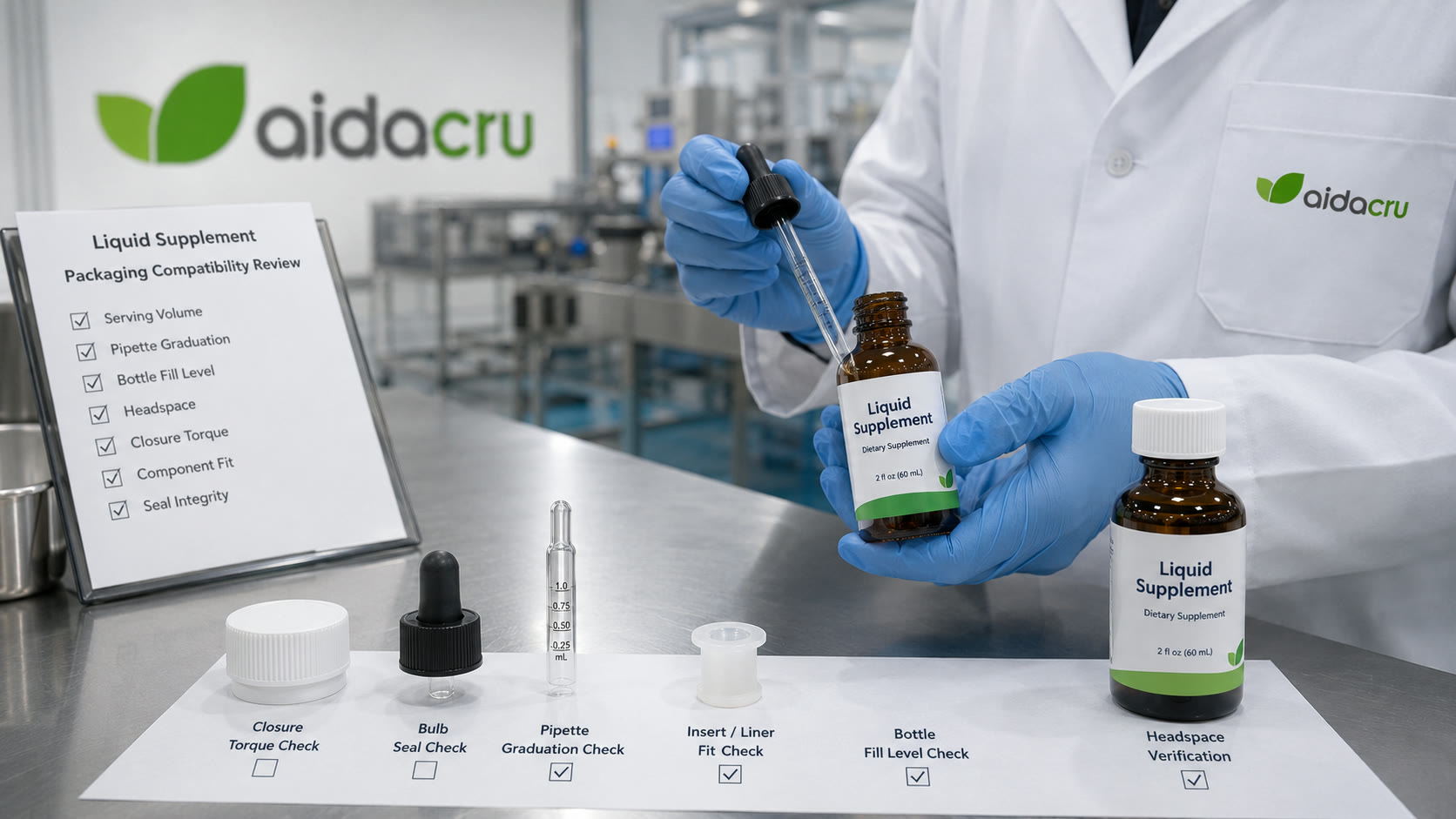
What Is a Liquid Supplement Packaging System?
A liquid supplement packaging system is the complete set of product-contact and delivery components used to contain, protect, measure, and dispense the finished formula. It can include the bottle, dropper or pump, pipette, bulb, cap, liner, insert, tamper-evident component, label, and secondary carton.
A liquid supplement can look finished in a beaker and still fail as a retail product. The formula may settle, the dropper may deliver an inconsistent volume, the cap may not match the bottle finish, or the label directions may describe a serving that the selected dispenser cannot reproduce conveniently.
For buyers, the right unit of review is not the liquid alone. It is the complete product system: formula, bottle, dropper or pump, closure, liner or insert, fill volume, label directions, and secondary packaging.
Start With the Formula Type
| Formula type | Typical behavior to evaluate | Packaging consequence |
|---|---|---|
| Solution | Ingredients remain dissolved under defined conditions | Clarity, chemical stability, and dispenser performance still require review |
| Suspension | Particles can settle | Redispersion, dose uniformity, headspace, and directions become important |
| Emulsion | Oil and water phases can separate | Mixing, droplet behavior, material compatibility, and storage need review |
The first decision is whether the product is intended to be a solution, suspension, or emulsion.
In a solution, the relevant ingredients remain dissolved under the defined conditions. In a suspension, dispersed particles may settle over time and need an appropriate redispersion strategy and label direction. An emulsion depends on control of the oil and water phases, interfacial system, and droplet behavior.
This classification affects more than appearance. It influences mixing order, shear, temperature, filtration decisions, filling behavior, dose uniformity, consumer instructions, and stability monitoring.
The development specification may need to address:
pH;
viscosity or flow behavior;
specific gravity;
appearance, color, and odor;
sedimentation, separation, or redispersibility;
microbial attributes;
fill volume or weight; and
assay or other formula-specific quality attributes.
Not every liquid needs every test. The point is to define the risks before selecting a package and writing directions.
A Common Buyer Mistake: Choosing the Bottle Before the Serving
A bottle mockup can make a liquid concept feel finished too early. The more useful sequence is to define the liquid behavior and intended serving first, then evaluate the dispenser and container around that use case.
For example, a 1 mL serving is not fully specified by writing “1 mL” on a concept sheet. The project still needs a dispenser that can measure that amount clearly and conveniently with the actual liquid. A suspension may also need enough headspace for effective redispersion, while a more viscous liquid may behave differently in the same pipette.
This is why appearance should be a packaging input—not the starting point for component approval.
Match the Dispenser to the Intended Serving
“One dropper” is often too vague for product development. Droppers vary in bulb, pipette, tip, graduation, material, and usable draw volume. Viscosity, surface tension, user technique, and how far the pipette is inserted can also affect delivery.
If the intended serving is expressed in milliliters, the team should determine how the consumer will measure it. If the serving is expressed as drops, the brand needs a justified way to connect drop count with the liquid and dispenser. A graduated pipette may help, but the markings, artwork, and actual dispenser still need to match.
USP <698> describes deliverable-volume testing for oral liquids. It should not be presented as a universal dietary-supplement requirement, but it illustrates an important principle: the amount a package can deliver matters, not only the nominal fill placed into the bottle.
Treat the Bottle and Closure as Matched Components
A bottle neck finish, cap thread, liner, wiper insert, tamper-evident feature, and dropper assembly are not interchangeable simply because they look similar.
The development team should review:
bottle material and color;
nominal and actual fill volume;
headspace;
neck finish and thread match;
liner or insert design;
closure application and opening behavior;
dropper fit and pipette clearance;
leakage in intended orientation and distribution conditions;
light and oxygen sensitivity; and
compatibility between the liquid and all product-contact materials.
An amber bottle can reduce some light exposure, but it does not prove stability. A tight cap does not automatically show that the formula, elastomer, liner, and closure will remain suitable throughout the intended shelf life.

Align Label Directions With the Physical Package
The Supplement Facts serving, suggested use, net contents, bottle fill, and dispenser should be reviewed as one information system.
For example, if the label recommends a 1 mL serving but the pipette has unclear graduations, the package creates avoidable confusion. If a suspension requires shaking, the instruction should be evaluated against the actual product behavior and available headspace. If the formula can stain or cling to the pipette, label placement and consumer handling may also need consideration.
Before artwork approval, confirm:
serving unit and measurement language;
servings per container;
dispenser type and markings;
storage and use instructions;
net quantity declaration;
lot/date coding area; and
label size, adhesion, and legibility on the selected bottle.
Run a Component Review Before Buying Production Quantities
A useful component review uses the actual or representative formula with the intended bottle and closure. The scope depends on product risk, but it may include assembly fit, torque or closure application, fill check, leak screening, dispensing observations, label fit, and stability-package evaluation.
The buyer should document the approved component codes or specifications. “Amber 30 mL bottle” is not enough if several suppliers offer different neck finishes, dimensions, or dropper assemblies.
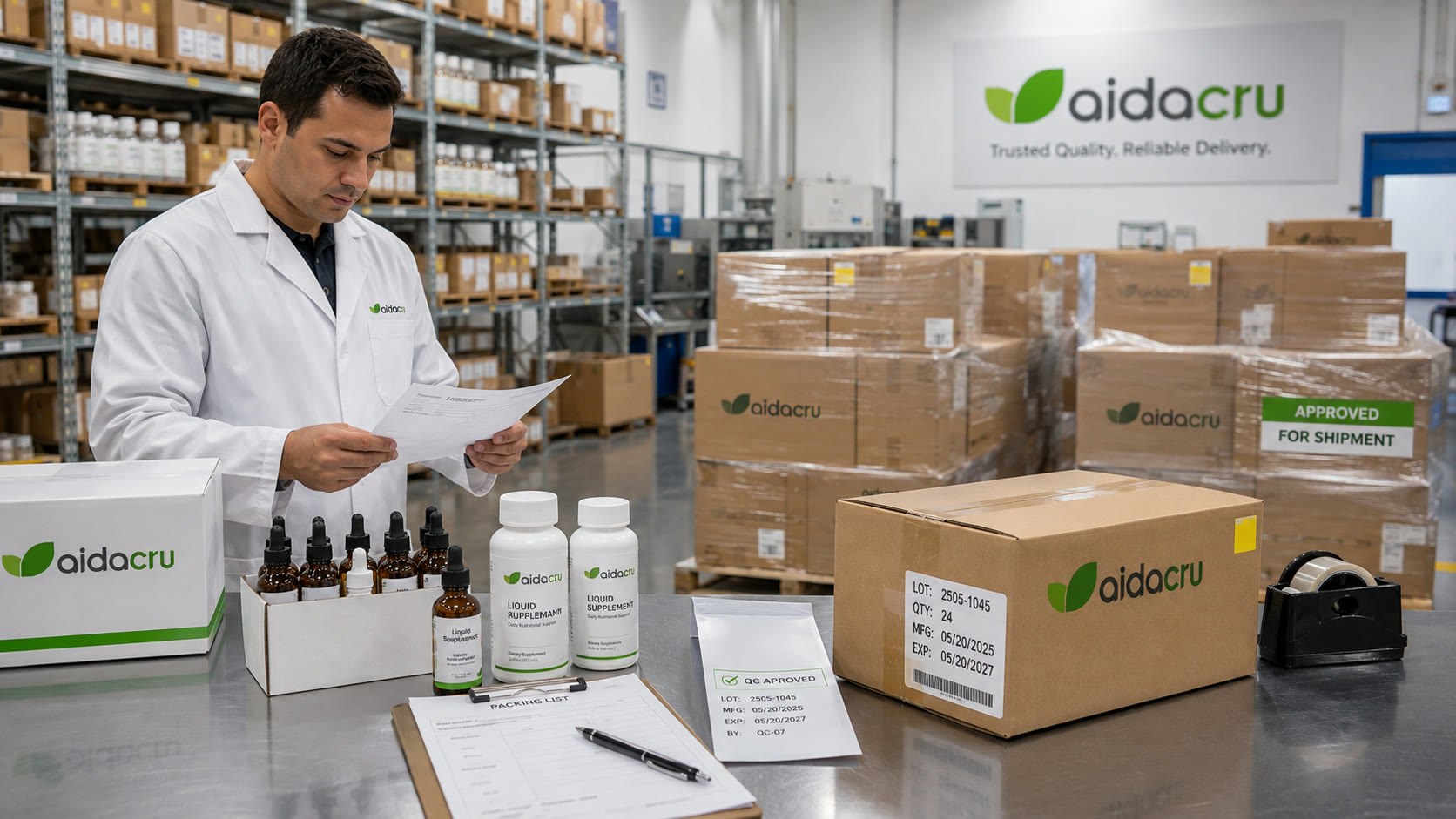
Component Approval Sheet
Formula type: solution, suspension, or emulsion
Target pH, viscosity, appearance, and relevant stability attributes
Intended serving and measurement method
Bottle material, color, volume, and neck finish
Dropper/pump design, material, and graduation
Closure, liner, insert, and tamper-evident feature
Fill volume, headspace, and servings per container
Label directions and storage statement
Component compatibility and distribution review plan
Approved component specifications and change-control responsibility
Key Takeaways
The formula and dispensing package form one product system.
A visually suitable dropper does not prove serving consistency, component fit, or shelf-life suitability.
Formula behavior, dispenser performance, closure fit, fill, directions, and stability should be reviewed before bulk component purchasing.
Buyers should approve component specifications, not just a packaging photograph.
Planning a Liquid Supplement?
Send Aidacru the formula or ingredient list, target concentration, serving volume, and target market first. If the bottle size, dispenser preference, forecast, or launch timing are already known, add them. We can use those inputs to map the open formula, dispensing, filling, component, and label questions before production components are committed.
Frequently Asked Questions
Should every liquid supplement use a dropper?
No. The right delivery format depends on serving volume, viscosity, formula behavior, user experience, and positioning. Pumps, measured caps, shots, or other formats may be more suitable for some products.
Can a suspension still be a viable product?
Potentially, if sedimentation, redispersion, serving uniformity, directions, packaging, and stability are adequately addressed. Clear acceptance criteria are important.
When should the dropper be selected?
Early enough to guide serving and package development, but final approval should follow review with the intended or representative formula and the actual component set.
What is the difference between nominal bottle volume and deliverable volume?
Nominal volume describes the container’s intended size. Deliverable volume concerns how much product can actually be transferred from the original container under a defined method. The appropriate review depends on the product and target requirements.
Does “shake well” solve every suspension problem?
No. Instructions cannot compensate for an unsuitable product system. The formula still needs justified criteria for sedimentation, redispersion, serving uniformity, packaging, and stability.
Continue Your Manufacturing Research
About Aidacru
Aidacru works with B2B supplement brands and sourcing teams on private-label and custom supplement projects. For liquid projects, the useful buyer discussion connects the formula type and serving to the bottle, dispenser, closure, fill, label, and packaging decisions rather than treating the bottle as a standalone design choice. Liquid capabilities, component options, compatibility work, tests, MOQ, pricing, and timing require project-specific confirmation.