

Effervescent Supplement Manufacturing: Why Moisture Control and Packaging Have to Work Together
Date: 2026-08-20 Categories: Supplement Blog Hits: 286
An effervescent tablet is designed to react quickly in water. The manufacturing challenge is making sure that reaction does not start in the factory, in the package, or in the customer’s cabinet.
Buyer Answer
An effervescent product has to be developed as one moisture-control system: formula, production environment, compression process, hold time, and primary package.
Acid and carbonate or bicarbonate components are designed to react in the presence of water, and many materials used in effervescent systems can be moisture-sensitive. Even limited moisture uptake may affect powder flow, tablet strength, appearance, carbon-dioxide release, and disintegration performance.
Brands should approve the commercial tablet and its package together—not a tablet sample first and a tube later.
What Makes Effervescent Tablets Different?
An effervescent tablet contains an acid source and a carbonate or bicarbonate source. When the tablet enters water, the components react and release carbon dioxide. The gas helps the tablet disperse or dissolve and creates the characteristic fizzing experience.
This format is used in hydration, vitamins, minerals, sports nutrition, and daily-wellness products. It can create a convenient drink format, but it also places tighter demands on moisture exposure, formula load, taste, tablet size, compression, and packaging.
Why Moisture Is the Central Manufacturing Risk
The same reaction that makes the format appealing also makes the unprotected formula sensitive.
Moisture can trigger the reaction too early
Water can enter through humid air, damp raw materials, cleaning residues, long open hold times, or insufficient package protection. Early reaction can consume part of the effervescent system before the customer ever uses the product.
If that reaction starts too early, the tablet may lose fizz, disperse irregularly, swell, develop surface damage, or create pressure inside the package.
Moisture changes powder behavior
Moisture uptake can increase cohesion and reduce flow. The blend may stick to equipment, feed inconsistently into the tablet press, or form agglomerates.
On the production floor, that can show up as weight variation, compression defects, downtime, and higher reject rates—all of which affect cost and delivery timing.
The package controls future exposure
The tablet remains moisture-sensitive after compression. A package with insufficient barrier performance can allow the product to change during storage or after repeated opening.
An attractive tube or sachet can still be the wrong package if its barrier performance does not fit the product.
The Commercial Manufacturing Path
1. Define the product brief
Start with target actives, amount per serving, intended water volume, flavor, sweetness, sodium or mineral constraints, tablet count, destination market, and package concept.
Tablet diameter and weight affect consumer use, compression, tube size, and shipping economics. The brand should also define whether one tablet delivers a full serving or whether multiple tablets are required.
2. Review raw-material moisture and compatibility
Evaluate acid and carbonate grades, particle size, moisture condition, flow, solubility, taste, and interaction with the active ingredients. Some materials may be highly hygroscopic or bring additional moisture into the formula.
A raw material can meet its chemical identity requirement and still be a poor manufacturing grade for the selected effervescent route.
3. Choose the powder-preparation route
Possible routes include direct compression, dry granulation, or another justified process. Conventional water-based wet granulation is difficult for many effervescent systems because water can initiate the reaction. Specialized nonaqueous or other approaches require product-specific evaluation.
| Route | Potential Advantage | Main Risk to Evaluate |
|---|---|---|
| Direct compression | Fewer process steps and no intentional water addition | Powder must flow, compress, and resist segregation without extensive granulation |
| Dry granulation | May improve handling or compression without a water-based binder | Compaction and milling can change particle size, flow, and tablet performance |
| Specialized nonaqueous or melt process | May support difficult formulas | Solvent, heat, residual, stability, scale-up, and cost implications require review |
The commercial route should fit the formula and package—not simply the shortest development path.
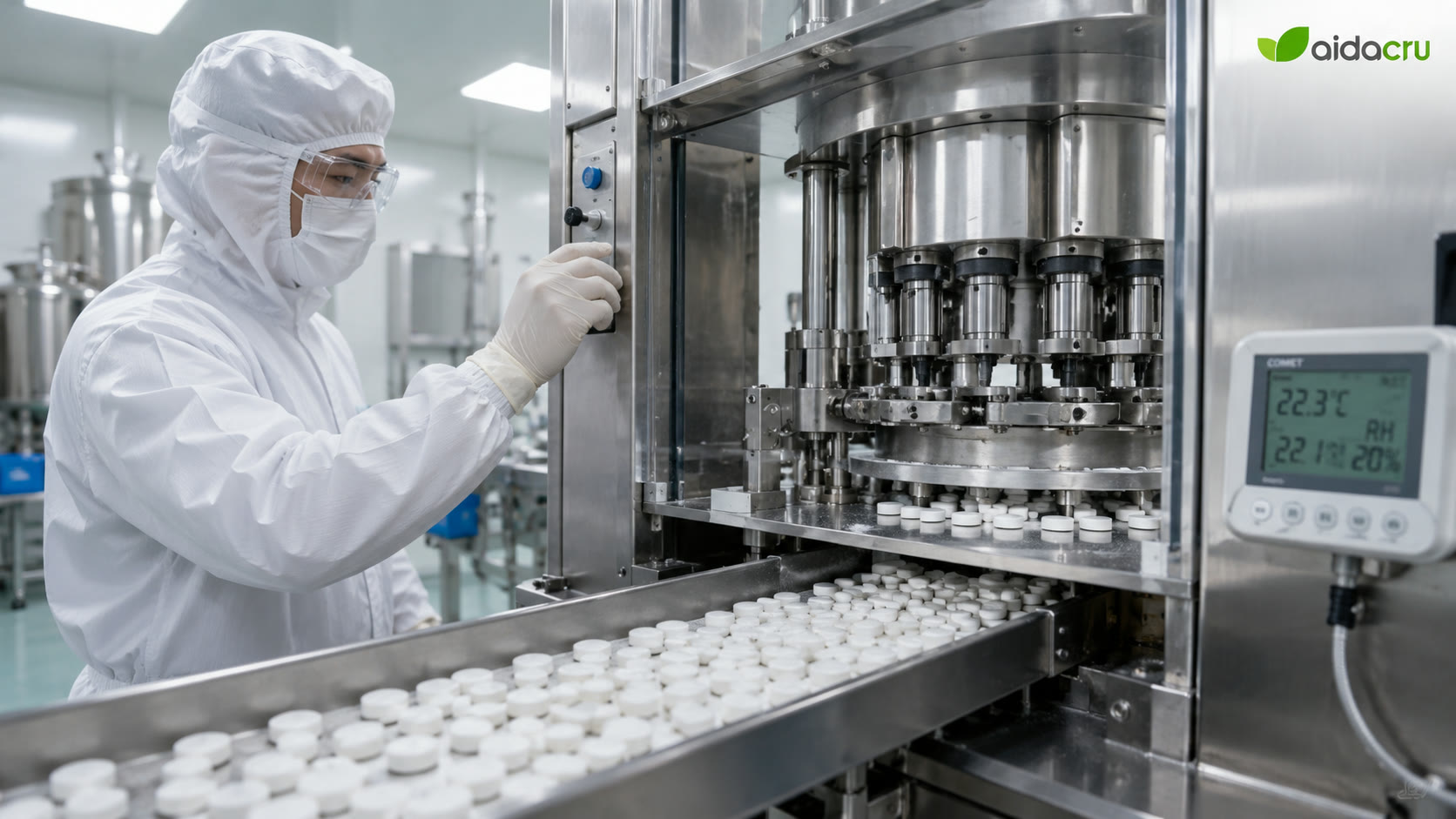
4. Control the production environment and exposure time
Temperature and relative humidity can affect how quickly the blend picks up water. Environmental targets should be based on the formula, materials, equipment, process, and hold time.
A generic “low-humidity” statement is not enough. The commercial process needs a monitored operating range appropriate to the actual product and facility.
The buyer should ask how long materials and finished tablets may remain exposed between dispensing, blending, compression, inspection, and packaging.
5. Blend without creating segregation
Effervescent formulas may contain large quantities of acid and carbonate plus much smaller quantities of vitamins, minerals, flavors, colors, or sweeteners. Differences in particle size and density can create segregation risk.
The blending plan should address addition sequence, mixing conditions, lubrication, transfer, and hopper behavior.
6. Compress within a workable process window
The press needs to produce tablets with acceptable weight, thickness, hardness, appearance, friability, and performance.
Too little mechanical strength can cause edge damage and breakage. More compression force is not automatically better; the correct window has to balance tablet strength, defect risk, and disintegration performance.
In-process checks may include tablet weight, thickness, hardness, visual defects, and other justified attributes depending on the formula and equipment.
7. Minimize the time before primary packaging
Finished tablets remain exposed until they enter the primary package. Trays, bins, room air, transport distance, and line stoppages all add exposure time.
The packaging plan should therefore be connected to the manufacturing process rather than treated as a separate downstream decision.
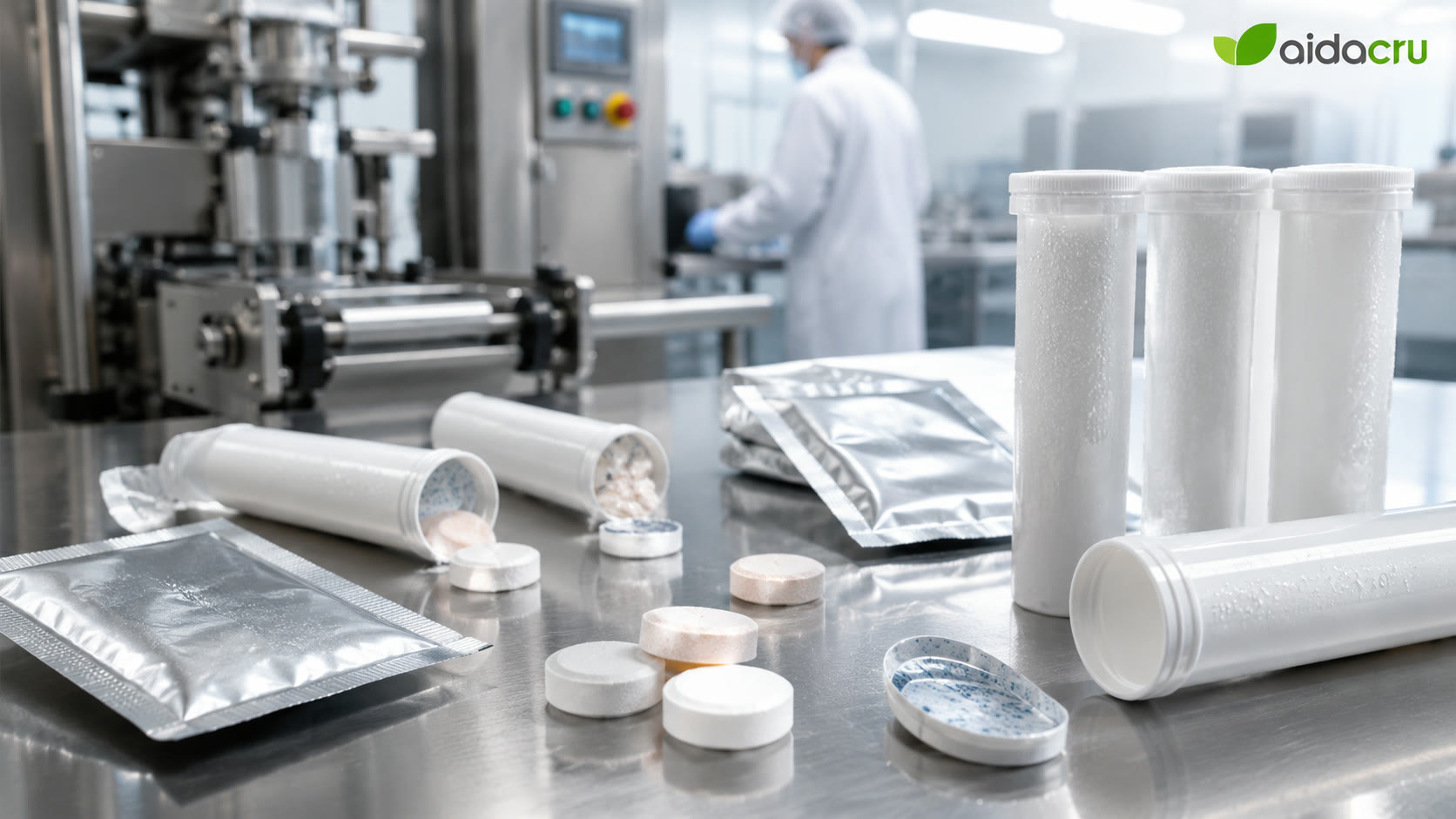
8. Package for moisture protection
Common options include tubes with desiccant closures, high-barrier foil sachets, and other sealed systems. Package selection should consider moisture-vapor transmission, closure performance, seal integrity, product count, headspace, consumer opening frequency, and distribution climate.
A desiccant is not a substitute for an unsuitable package. Its type and amount should be selected with the product, package, headspace, expected exposure, and shelf-life plan.
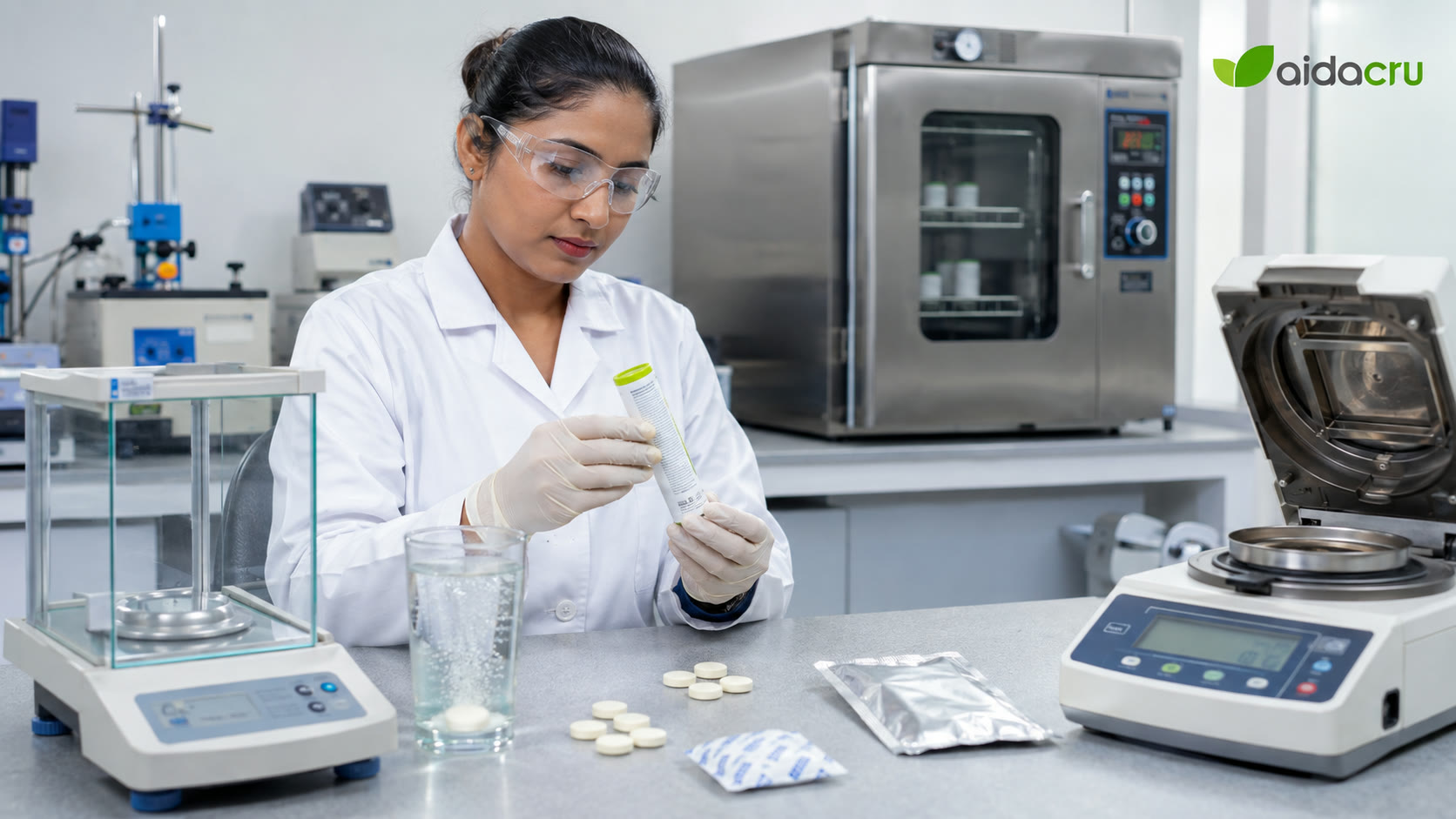
9. Verify the tablet and package together
The finished-product plan may include appearance, weight, hardness, friability, moisture-related attributes, microbiological or chemical specifications, disintegration, assay, package integrity, and stability observations.
USP provides a disintegration procedure for effervescent tablets for oral solution, but the applicable method and acceptance criteria must be selected for the actual product and market. A compendial method should not be presented as a completed Aidacru test unless that capability is confirmed.
Formula, Process, and Package: Who Controls What?
| System Element | Manufacturing Question | Buyer Decision |
|---|---|---|
| Acid and carbonate system | Will the materials remain dry, flow, compress, and react as intended? | Approve ingredients, serving, and sensory direction |
| Active ingredients | Do they add moisture, bulk, color, bitterness, or instability? | Set claim priorities and acceptable tablet size |
| Production environment | What exposure range and hold time are controlled? | Confirm factory capability before committing to the dosage form |
| Compression | Can the tablet survive handling and still disperse appropriately? | Approve physical and performance criteria |
| Primary package | Does the package protect the tablet through storage and use? | Approve tube or sachet components with the tablet |
What to Send Before an Effervescent Feasibility Review
Before asking for a commercial quote, align on:
Target actives and amounts per tablet.
One-tablet or multi-tablet serving direction.
Intended water volume and use instructions.
Acid, carbonate, mineral, sweetener, and flavor preferences.
Tablet size, shape, color, and count.
Tube, sachet, or other primary-package direction.
Closure, desiccant, seal, and tamper-evidence expectations.
Destination market, distribution climate, and sales channel.
Required tests, documents, and stability expectations.
Forecast, launch quantity, and replenishment timing.
6 Questions Worth Asking an Effervescent Manufacturer
Which ingredients create the highest moisture or compression risk?
Which manufacturing route is proposed, and why?
How are environmental conditions and exposure times controlled?
Which in-process checks define acceptable tablet compression?
How quickly do finished tablets enter the primary package?
Which package, testing, and stability inputs affect the quote and release plan?
FAQ
Why are effervescent tablets so sensitive to humidity?
They contain acid and carbonate components designed to react in water. Atmospheric moisture can begin that reaction or change powder and tablet properties before intended use.
Can effervescent tablets be made by direct compression?
Yes, some formulas can use direct compression when the materials have suitable flow, compressibility, stability, and uniformity. Other formulas may require dry granulation or a specialized process.
Does harder compression always produce a better tablet?
No. Compression force must balance mechanical strength, defect risk, and disintegration performance. The correct range is product- and equipment-specific.
Does every effervescent tube need a desiccant?
Not as a universal rule. Moisture-sensitive tablets often use a desiccant closure or another moisture-control component, but the selection should be justified with the product and package.
Is a sample tube enough to prove shelf life?
No. A sample shows the product at one point in time. Shelf-life support requires an appropriate stability plan using the final formula, commercial process, and intended market package.
Bottom Line
Moisture control starts with raw materials and does not end until the product is sealed in its retail package. The formula, process window, exposure time, tablet strength, disintegration, desiccant strategy, and primary package have to be developed as one connected system.
Discuss an Effervescent Supplement Project
Developing an effervescent supplement? Send Aidacru the target ingredients, amount per tablet, intended water volume, flavor, tablet size and count, packaging concept, destination market, forecast, and launch timeline. The review can identify open formulation, moisture-control, compression, packaging, testing, and quotation questions before sampling and scale-up.
For related capabilities, see Aidacru manufacturing and private-label supplement manufacturing, or contact the team with the project brief.
Technical References
USP harmonized disintegration procedure, including effervescent tablets for oral solution: https://www.usp.org/sites/default/files/usp/document/harmonization/gen-chapter/april-2019-m99460.pdf
Review of effervescent-system hygroscopicity and low-humidity processing: https://pmc.ncbi.nlm.nih.gov/articles/PMC7464369/
Direct-compression formulation study and compression considerations: https://pmc.ncbi.nlm.nih.gov/articles/PMC4246396/
U.S. FDA, Dietary Supplement CGMP Small Entity Compliance Guide: https://www.fda.gov/regulatory-information/search-fda-guidance-documents/small-entity-compliance-guide-current-good-manufacturing-practice-manufacturing-packaging-labeling