

Low-Dose Ingredients in Pre-Workout Powders: What Brands Should Check Before Production
Date: 2026-08-18 Categories: Supplement Blog Hits: 340
A pre-workout formula can be correct on paper and still be difficult to manufacture consistently. The challenge becomes greater when a small amount of one ingredient must be distributed through a much larger powder blend.
Buyer Answer
Low-dose uniformity is not something a manufacturer can solve by simply adding more blend time. It depends on the full manufacturing path—ingredient properties, dispensing accuracy, premix design, addition sequence, blender conditions, transfer, filling, representative sampling, and finished-product specifications.
For a brand, the question is bigger than whether the batch average hits the target: can the process support consistent finished servings from the first part of the run to the last?
What “Low Dose” Means in Manufacturing
Low-dose ingredient blend uniformity means distributing a relatively small component consistently throughout a much larger powder blend. In pre-workout products, that component may be a vitamin, mineral, botanical marker, flavor component, sweetener, color, or another ingredient used at a much lower level than the main formula base.
“Low dose” is a manufacturing relationship, not a universal milligram cutoff.
An ingredient can be difficult to distribute because its amount is small relative to the batch, because its particle size or flow behavior differs from the rest of the formula, or because the labeled amount leaves little room for variation.
Three related concepts should be separated:
| Term | What It Tells You | Why It Matters |
|---|---|---|
| Batch assay | The measured amount in the tested sample | A passing average does not show variation across the batch |
| Blend uniformity | How consistently an ingredient is distributed in the bulk blend | Poor distribution can create differences before filling begins |
| Finished-serving consistency | Whether finished servings contain an appropriate amount | This is closer to what the customer actually receives |
The verification plan must fit the product, ingredient, method, process, and applicable specifications. Pharmaceutical guidance can provide useful scientific principles, but it should not be presented as a dietary-supplement requirement without confirming the applicable regulation.
Why Pre-Workout Powders Can Segregate
Powders do not behave like liquids. A blend can look uniform and still separate during discharge, conveying, hopper movement, vibration, or filling.
Particle size and particle-size distribution
Large and small particles can move differently. Fine particles may adhere to larger carrier particles, form agglomerates, create dust, or migrate through spaces between coarser particles.
A blender sample can look acceptable and still fail to tell the whole story if the material separates later during transfer or filling.
Bulk density
Materials with different densities can respond differently to gravity and vibration. A dense mineral may not move through a hopper the same way as a lighter botanical powder or flavor system.
If segregation occurs after blending, the beginning and end of the filling run may not behave the same.
Flow, cohesion, and moisture behavior
Free-flowing, cohesive, electrostatic, oily, and hygroscopic materials create different handling problems. A powder that sticks to equipment or forms agglomerates may not enter or move through the blend as intended.
The formula tells you what should be in the batch. It does not tell you how reliably each ingredient will move through the commercial process.
Formula load and serving size
Pre-workout products often combine high-load amino acids with much smaller quantities of vitamins, flavors, sweeteners, or other components. A tight scoop size can make the ratio between the smallest and largest ingredients even more difficult to manage.
Even one additional active can change the manufacturing route, scoop size, package volume, flavor system, testing plan, and quote.
From Formula to Consistent Finished Servings
1. Characterize the formula before setting the process
Identify the smallest-inclusion ingredients and compare particle size, density, flow, moisture sensitivity, and tendency to agglomerate. Supplier grade matters because two materials with the same label name may process differently.
For an accurate feasibility review, the brand should provide the exact ingredient, grade or source requirement, target amount per serving, total serving weight, flavor direction, package format, and destination market.
2. Define the dispensing approach
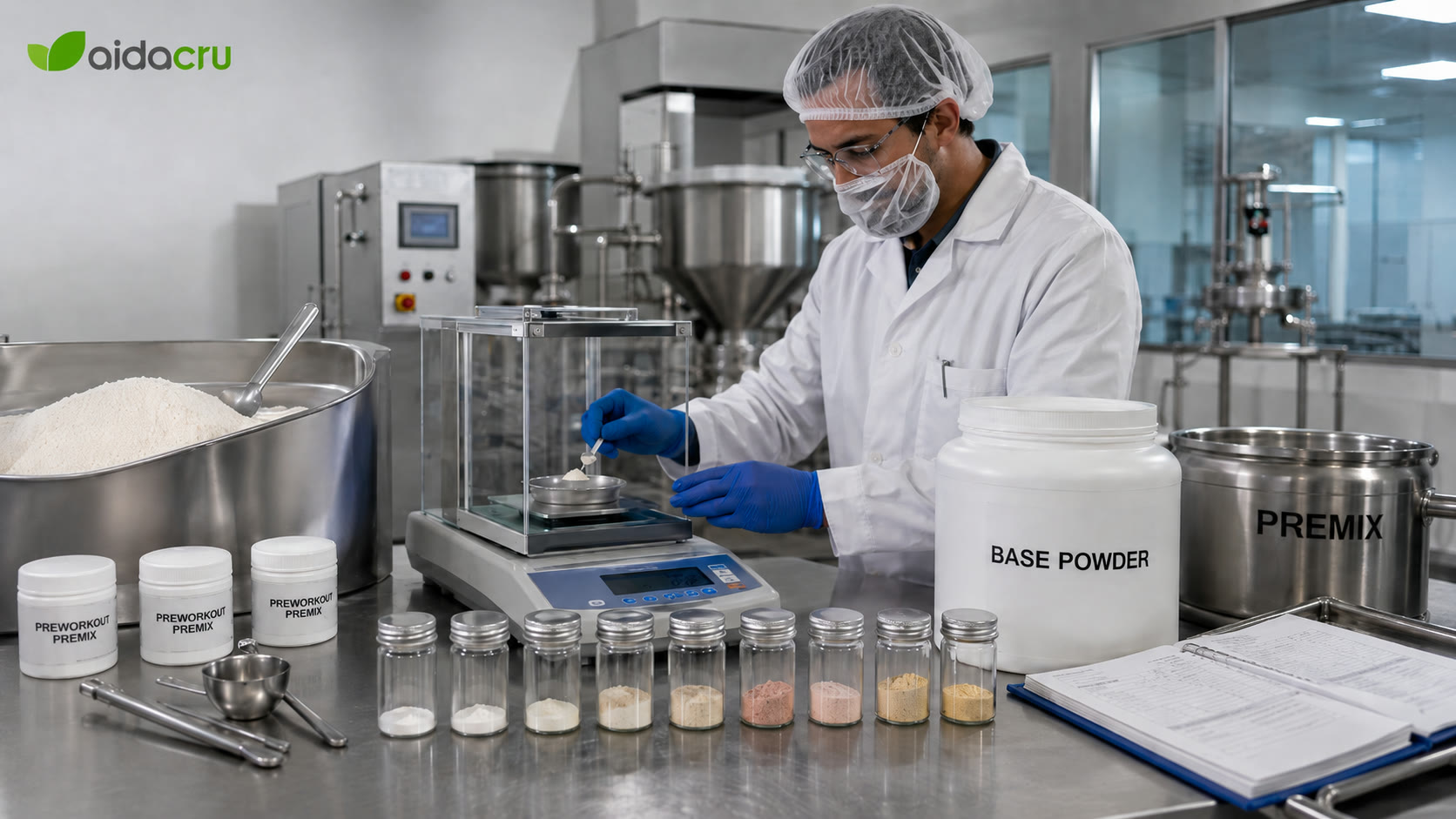
Low-inclusion components need a weighing and transfer approach appropriate to the target quantity and equipment. The process should also account for material that may remain in a bag, scoop, transfer container, or vessel.
A master formula shows what should enter the batch. It does not, by itself, prove that every small component was transferred as intended.
3. Decide whether a premix is appropriate
A premix can distribute a low-inclusion component through a smaller amount of compatible carrier before it enters the main blend. Geometric dilution is one possible staged approach.
Premixing is not automatically the right answer. Carrier selection, ratio, mixing energy, agglomeration, transfer, and the later main-blend step still need evaluation.
4. Set the addition sequence and blender conditions
Addition order can influence whether fine particles disperse, coat a carrier, remain in agglomerates, or collect on equipment surfaces. Blender type, fill level, speed, and time also affect powder movement.
Longer blending is not a universal solution. Over-processing can change particle interactions and may create new opportunities for segregation after discharge.
5. Evaluate transfer and filling
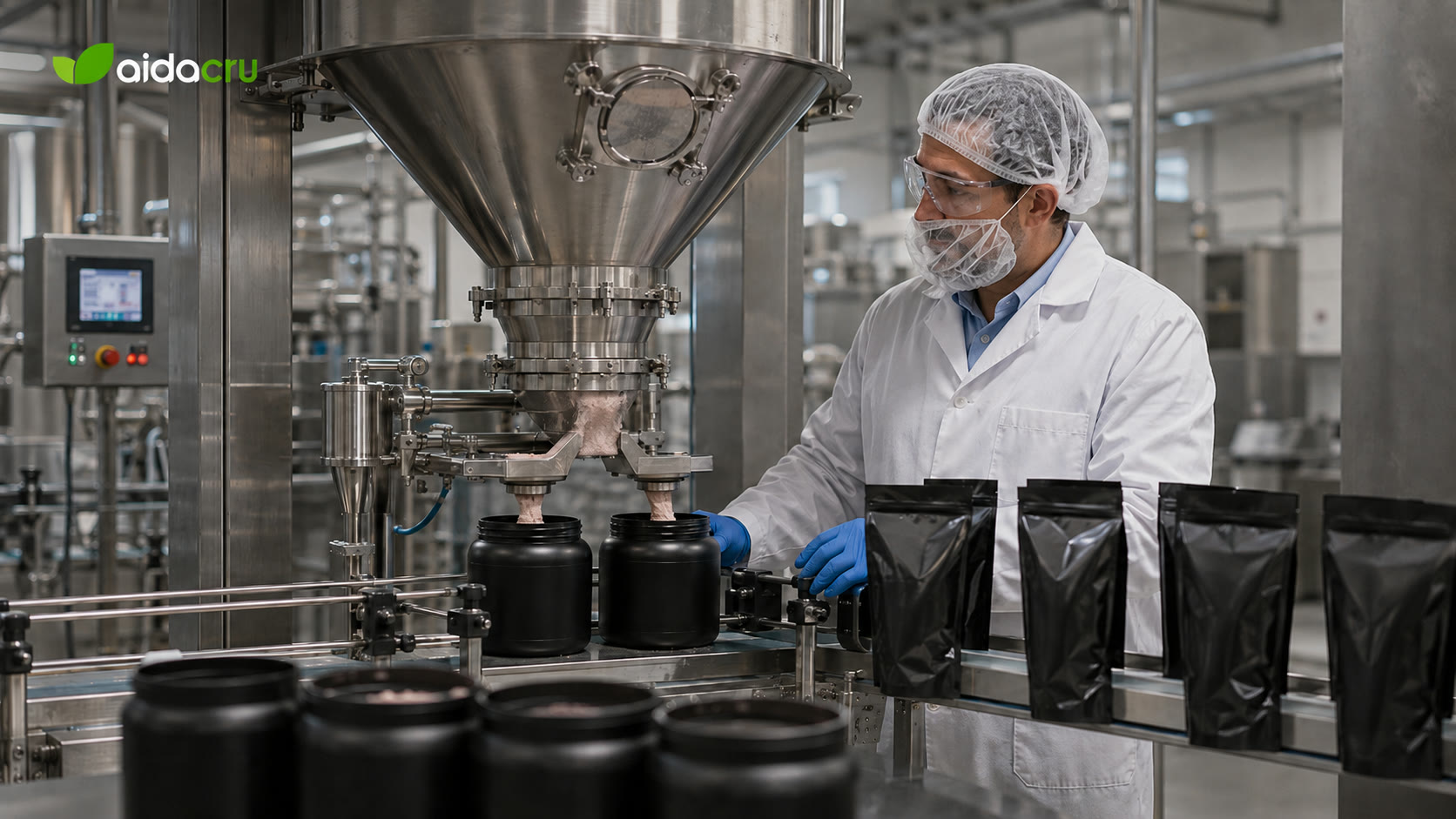
Uniformity can be lost after the blender stops. Discharge pattern, transfer distance, hopper geometry, vibration, and refill practices can all change the blend before it reaches the retail package.
For scoop-based powders, fill weight and package count confirm different attributes; they do not prove ingredient distribution.
6. Use a representative sampling plan
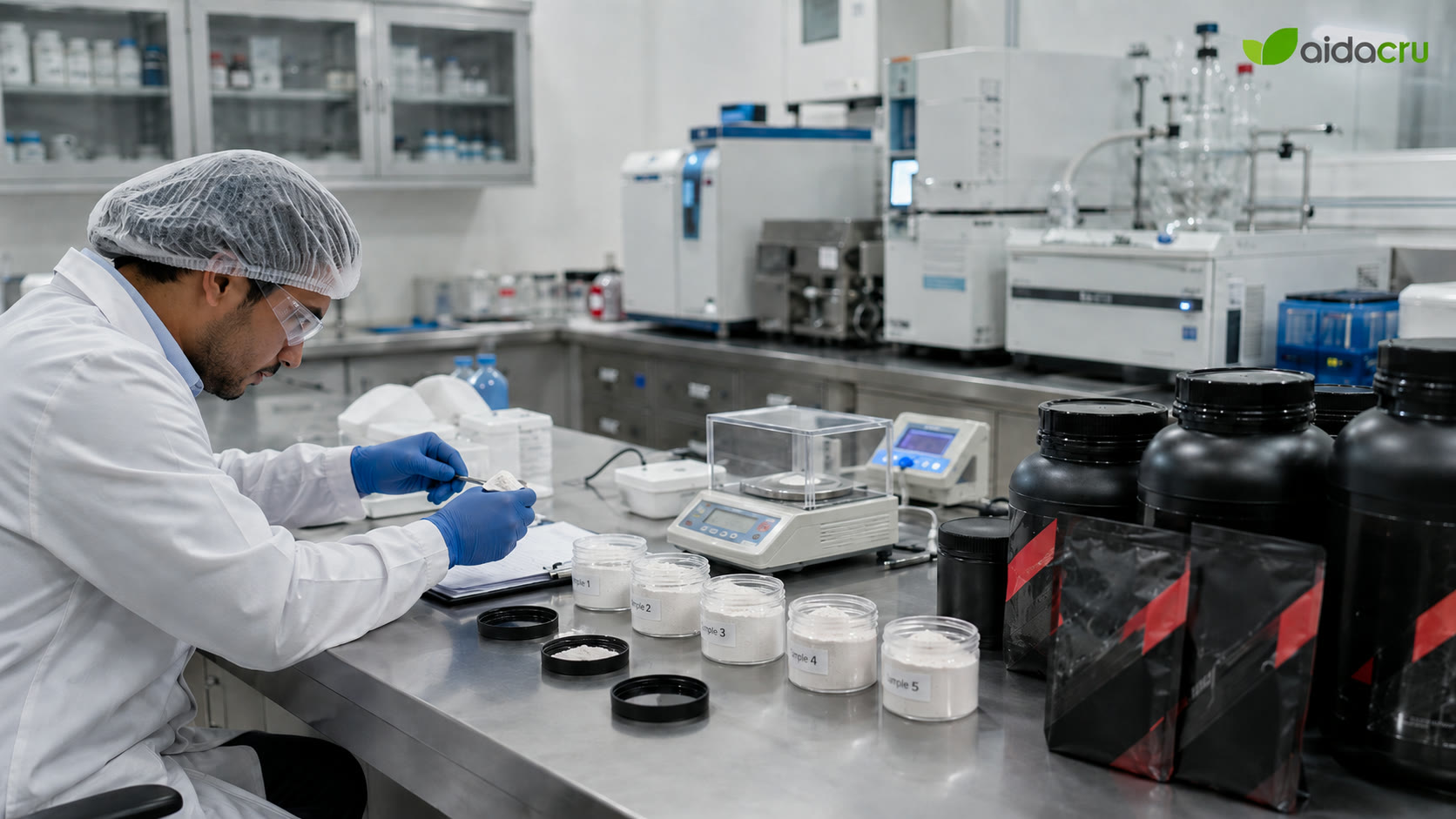
A sample is useful only if it represents the material or finished units being evaluated. Sampling location, timing, sample size, tool design, and handling can all influence the result.
There is no universal “one scoop from the top” rule that proves an entire batch is uniform. The sampling plan should match the process and risk.
7. Connect in-process data to finished-product release
In-process monitoring helps show whether the manufacturing process remained under control. Finished-product testing or examination addresses selected product specifications.
Under U.S. dietary supplement CGMP, manufacturers establish product specifications and use appropriate tests or examinations, with documented reasoning, to support finished-batch verification and quality-control review. This does not mean every formula needs the same test panel.
Direct Blending, Premix, or Granulation?
| Route | When It May Be Considered | Main Question |
|---|---|---|
| Direct blending | Components already have compatible handling properties | Can the low-inclusion material disperse and remain distributed through transfer and filling? |
| Premix or geometric dilution | A small component benefits from staged distribution through a carrier | Is the carrier appropriate, and will the premix remain uniform in the main blend? |
| Granulation or agglomeration | Particle engineering may improve flow or reduce segregation risk | What are the stability, flavor, scale-up, cost, and label implications? |
No route should be selected from marketing preference alone. The formula, process, equipment, package, and verification plan need to work together.
What to Send Before a Feasibility Review
A useful feasibility review starts with a complete project brief. Include:
Exact ingredient list and target amount per serving.
Supplier, grade, or source restrictions.
Total serving weight and servings per container.
Powder, stick pack, capsule, or tablet format.
Flavor, sweetener, color, and “free from” requirements.
Destination market and proposed label claims.
Package type, fill weight, and scoop or sachet direction.
Forecast, launch quantity, and replenishment plan.
Required documents and third-party testing expectations.
Sample approval criteria for taste, appearance, flow, and physical format.
6 Questions Worth Asking a Pre-Workout Powder Manufacturer
Which ingredients create the highest uniformity or segregation risk?
Is a premix, geometric dilution, or another process step being considered, and why?
How do ingredient grade and particle properties affect the proposed process?
What happens between final blending and retail-package filling?
How is the sampling plan designed to represent the batch or filling run?
Which finished-product specifications, methods, laboratories, and costs need confirmation before quotation?
FAQ
Is low-dose blend uniformity the same as potency?
No. Potency or assay generally describes the measured amount in a sample. Uniformity addresses how consistently that amount is distributed across the blend or finished units.
Does longer blending always improve uniformity?
No. The result depends on ingredient properties, blender design, load, speed, time, and what happens after discharge. Additional blending may not correct an unsuitable formulation or process.
Can a passing raw-material COA prove finished-product uniformity?
No. A raw-material COA describes the tested ingredient lot. It does not show how that ingredient was distributed through the finished production batch.
Why can the blend change during filling?
Gravity, vibration, hopper movement, particle-size differences, density differences, and flow behavior can allow materials to separate after blending. The risk depends on the product and equipment.
Can Aidacru review a low-dose pre-workout concept?
Aidacru can review a project brief and identify open questions around formula load, ingredient handling, dosage form, sampling, packaging, and quotation inputs. Specific capabilities, methods, MOQ, and timing require project confirmation.
Bottom Line
A low-dose formula is only as strong as the process used to manufacture and verify it. Particle properties, premixing, transfer, filling, sampling, and finished-product specifications all matter—and a blend that looks uniform in the mixer can still change before it reaches the final package.
Discuss a Low-Dose Powder Project
Planning a low-dose pre-workout formula? Send Aidacru the formula, per-serving targets, total serving weight, format, flavor direction, packaging concept, destination market, forecast, and launch timeline. The goal is to identify open formulation, processing, sampling, packaging, and quotation questions before the project moves into bulk production.
For related capabilities, see Aidacru manufacturing and private-label supplement manufacturing, or contact the team with a project brief.
Technical References
U.S. FDA, Dietary Supplement CGMP Small Entity Compliance Guide: https://www.fda.gov/regulatory-information/search-fda-guidance-documents/small-entity-compliance-guide-current-good-manufacturing-practice-manufacturing-packaging-labeling
U.S. FDA, Risk-Based Blend and Content Uniformity Assessment: https://www.fda.gov/science-research/fda-science-forum/risk-based-blend-and-content-uniformity-assessment-case-study
Peer-reviewed study of low-dose blend homogeneity, excipient particle size, and blending technique: https://pmc.ncbi.nlm.nih.gov/articles/PMC5469472/
Muselík et al., blend segregation and content uniformity review: https://pmc.ncbi.nlm.nih.gov/articles/PMC8620778/