

As-Is vs. Dry-Basis Potency: How Supplement Manufacturers Calculate Formula Input
Date: 2026-08-31 Categories: Supplement Blog Hits: 263
A supplier specification says an ingredient is 98% pure on a dry basis. The lot certificate also reports 4% moisture. Should production weigh 102.04 kilograms to deliver 100 kilograms of active—or more?
That question cannot be answered from the headline assay alone. The calculation depends on the assay basis, the form of the active being declared, the actual lot result, and the approved manufacturing record. A small basis error can affect label target, batch yield, capsule capacity, cost, and final release.
Quick Answer
“Dry basis” removes an agreed water or volatile fraction from the assay calculation. “As-is” describes the material in the condition in which it will actually be weighed. If a dry-basis assay must be converted to an as-is value, the manufacturer needs the matching moisture or loss-on-drying result and a documented calculation rule.
Potency correction is not the same as intentional overage. Potency correction accounts for the strength of the incoming lot; overage deliberately adds more of a dietary ingredient than the label target and must be separately defined in the master manufacturing record.
What Do “As-Is” and “Dry Basis” Mean?
An assay result is meaningful only when its basis is clear.
As-is potency expresses the measured active content in the material as received and weighed.
Dry-basis potency expresses active content after mathematically excluding the water or volatile fraction defined by the method.
Anhydrous basis may exclude water specifically, but the exact compendial or supplier definition still matters.
Active-moiety basis expresses the amount of the nutrient or active portion rather than the total compound weight.
These terms are not interchangeable. A mineral salt may be tested as a compound but declared as an elemental mineral. A botanical extract may have a marker assay but be added by total extract weight. A hydrated ingredient may contain bound water that is part of its chemical form. The specification, method, COA, formula, and label must use compatible definitions.
Why the COA Headline Can Produce the Wrong Input
The assay basis may not match the weighing basis
Production weighs physical material, not a theoretical dry solid. If a supplier reports only a dry-basis assay, using that number directly as the as-is potency can understate the amount required.
Buyer consequence: the finished batch may receive less active than the approved calculation intended.
The moisture result may use a different method or lot
Loss on drying can include water and other volatile material. Karl Fischer testing is more specific to water. A specification may use another defined moisture method. The correction should use the value and basis specified for the same lot—not a value copied from a typical data sheet.
Buyer consequence: a mathematically neat formula can still be technically mismatched.
The assay may describe the wrong chemical basis
“Magnesium citrate,” “elemental magnesium,” and “magnesium” are not automatically the same calculation input. Similar issues arise with hydrates, salts, standardized botanical markers, enzymes, and live microorganisms.
Buyer consequence: a formula can hit the compound weight while missing the label-declared amount.
Rounding can accumulate across a large batch
Rounding the assay, moisture, conversion factor, and dispensing quantity too early can create a meaningful difference at scale. The approved rule should state calculation precision and the final rounding step.
Buyer consequence: different operators or software systems may generate different batch quantities from the same COA.
A Practical Calculation Framework
The following equations illustrate the logic. They are not universal release formulas; the approved specification and test method control the actual calculation.
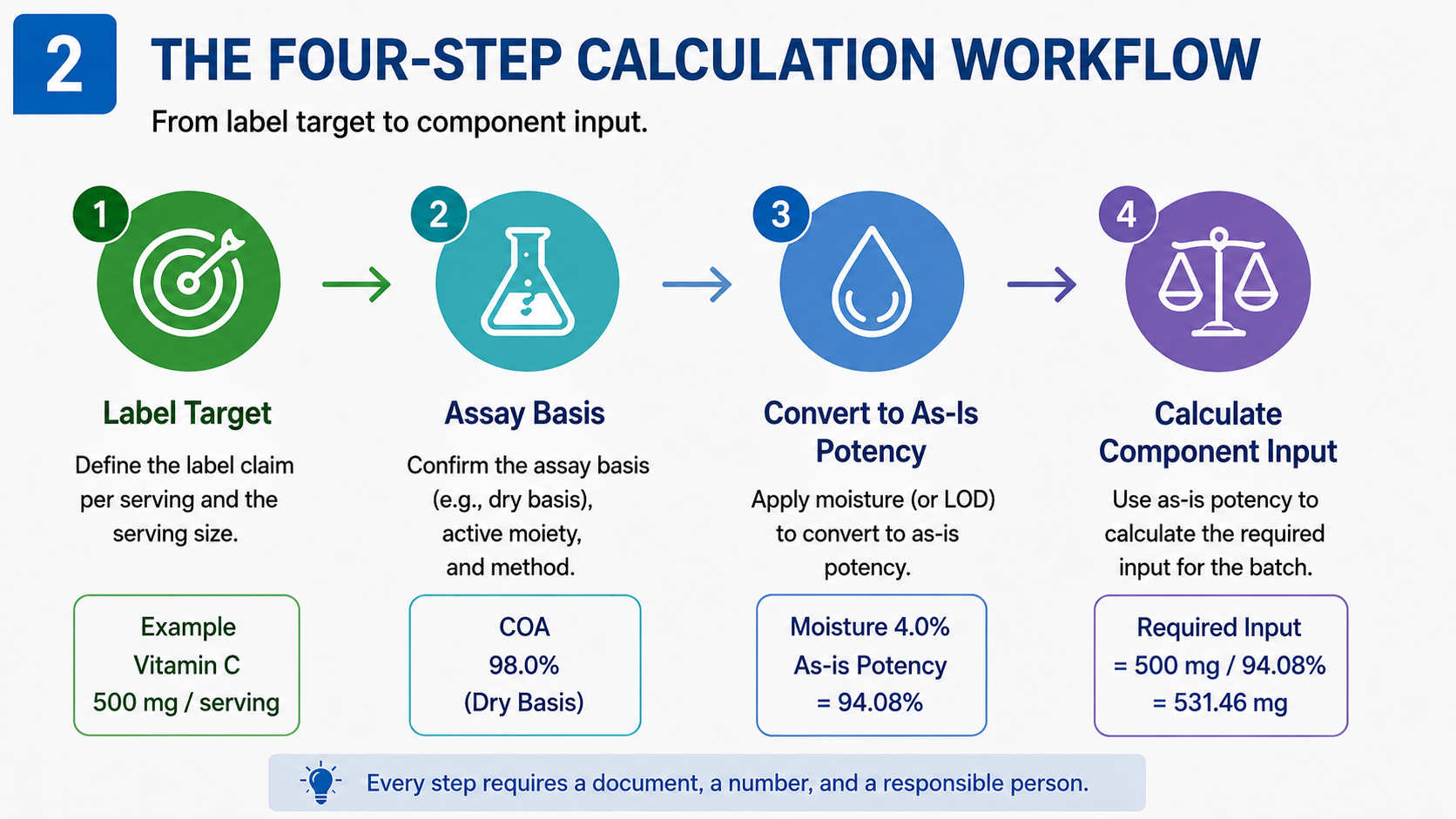
Step 1: Define the label or formula target
Start with the amount of the declared dietary ingredient per serving, the number of servings, and the planned theoretical batch size.
Target active mass = active amount per serving × theoretical servings
If the label declares an elemental mineral, active vitamin equivalent, enzyme activity, or another specific basis, convert the target to that same basis before calculating component input.
Step 2: Identify the COA assay basis
Confirm whether the lot result is:
as-is;
dry basis;
anhydrous basis;
activity per gram;
elemental or active-moiety basis; or
a marker compound rather than total ingredient potency.
Do not infer the basis from a percent sign alone.
Step 3: Convert dry-basis potency when required
When the approved specification defines a dry-basis assay and a compatible moisture fraction, a simplified conversion may be:
As-is potency fraction = dry-basis potency fraction × (1 − moisture fraction)
Example only:
dry-basis potency: 98.0%;
moisture: 4.0%;
calculated as-is potency: 0.98 × 0.96 = 0.9408, or 94.08%.
The water or volatile correction must match the test method and material definition. Do not use this equation when the reported assay is already as-is or when the specification requires another correction.
Step 4: Calculate the lot-specific component input
Component input = target active mass ÷ as-is potency fraction
Using the example above, the theoretical component input required to supply 100 kilograms of active would be about 106.29 kilograms—not 102.04 kilograms.
This number would still need review for unit conversion, active-moiety equivalence, manufacturing loss assumptions, rounding, batch size, and any approved overage.
Step 5: Record the calculation and verification
The master manufacturing record establishes the component weights and any intentional overage. The batch production record documents the lot-specific execution. The applicable calculation, source COA, version, units, and independent verification should be traceable.
Under 21 CFR 111.210, a dietary supplement master manufacturing record includes the weight or measure of each component and a statement of any intentional dietary-ingredient overage. It also includes instructions for verifying component weights and additions.
Potency Correction Is Not Intentional Overage
| Decision | What It Does | Typical Input | What It Does Not Prove |
|---|---|---|---|
| Lot potency correction | Adjusts the dispensed component amount for the measured strength of the incoming lot. | Approved specification, lot COA, calculation basis. | That an extra amount was intentionally added above the formula target. |
| Moisture or volatile correction | Aligns a dry-basis or anhydrous result with the material as weighed. | Lot-specific result and compatible method. | That the ingredient remains stable through shelf life. |
| Active-moiety conversion | Converts compound mass to the nutrient or active basis used in the formula or label. | Molecular, compendial, or supplier-defined equivalence. | That the dosage form has enough physical capacity. |
| Intentional overage | Adds an approved amount beyond the target to address a defined reason. | Master manufacturing record and supporting rationale. | Permission to compensate for weak process control or an unsupported shelf-life claim. |
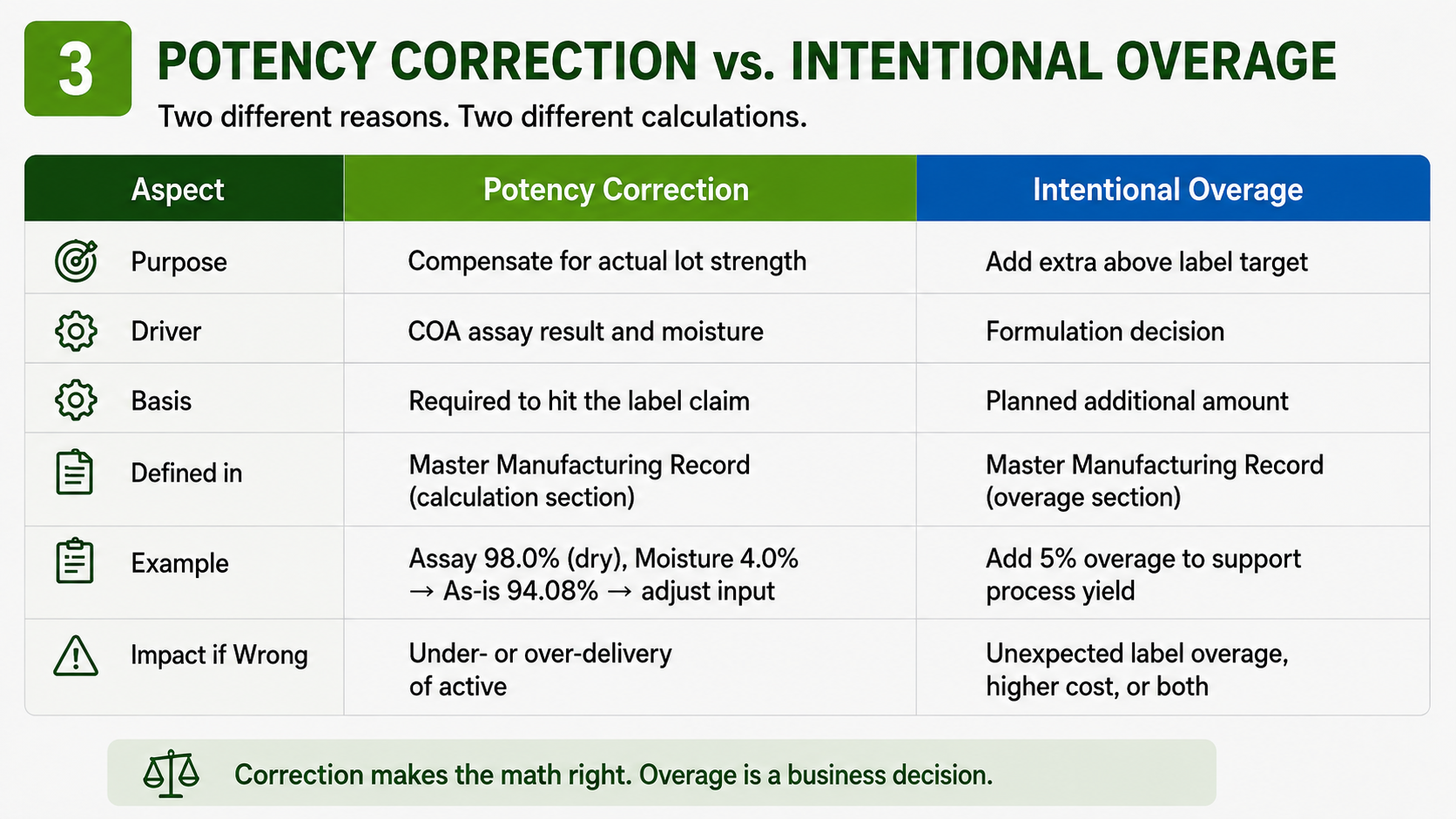
Brands should ask the manufacturer to keep these decisions separate. Combining them into one unexplained “extra percentage” makes review, costing, and change control difficult.
What the Manufacturer Should Verify Before Dispensing
Ingredient identity and specification
The material name, grade, supplier code, chemical form, and lot must match the approved specification. A COA from the correct supplier is not enough if it describes a different grade or basis.
Test result and method
The COA should state the test or examination method, limits, and actual results. When a manufacturer relies on a supplier COA under 21 CFR Part 111, supplier qualification and periodic confirmation requirements also apply.
Units and equivalents
Percent, milligrams per gram, international units, activity units, CFU, and elemental equivalents cannot be mixed without an approved conversion.
Formula and label version
The calculation must use the current formula, current Supplement Facts target, current serving size, and current batch size. A label revision can change the manufacturing input even when the ingredient list appears unchanged.
Dosage-form capacity and yield
Correcting a low-potency lot increases total component weight. That can affect capsule fill, tablet size, gummy solids, powder serving weight, package count, and cost. A mathematically correct input may expose a physical product-design problem.
Change-Control Triggers Brands Often Miss
Recalculate and review the formula when any of the following changes:
ingredient supplier or grade;
assay basis or analytical method;
moisture or loss-on-drying specification;
salt, hydrate, or carrier form;
standardized botanical marker;
serving size or label target;
batch size or manufacturing site;
dosage form or unit capacity; or
planned overage or shelf-life strategy.
A supplier substitution should not be approved only because both materials have the same common name.
B2B Procurement Checklist
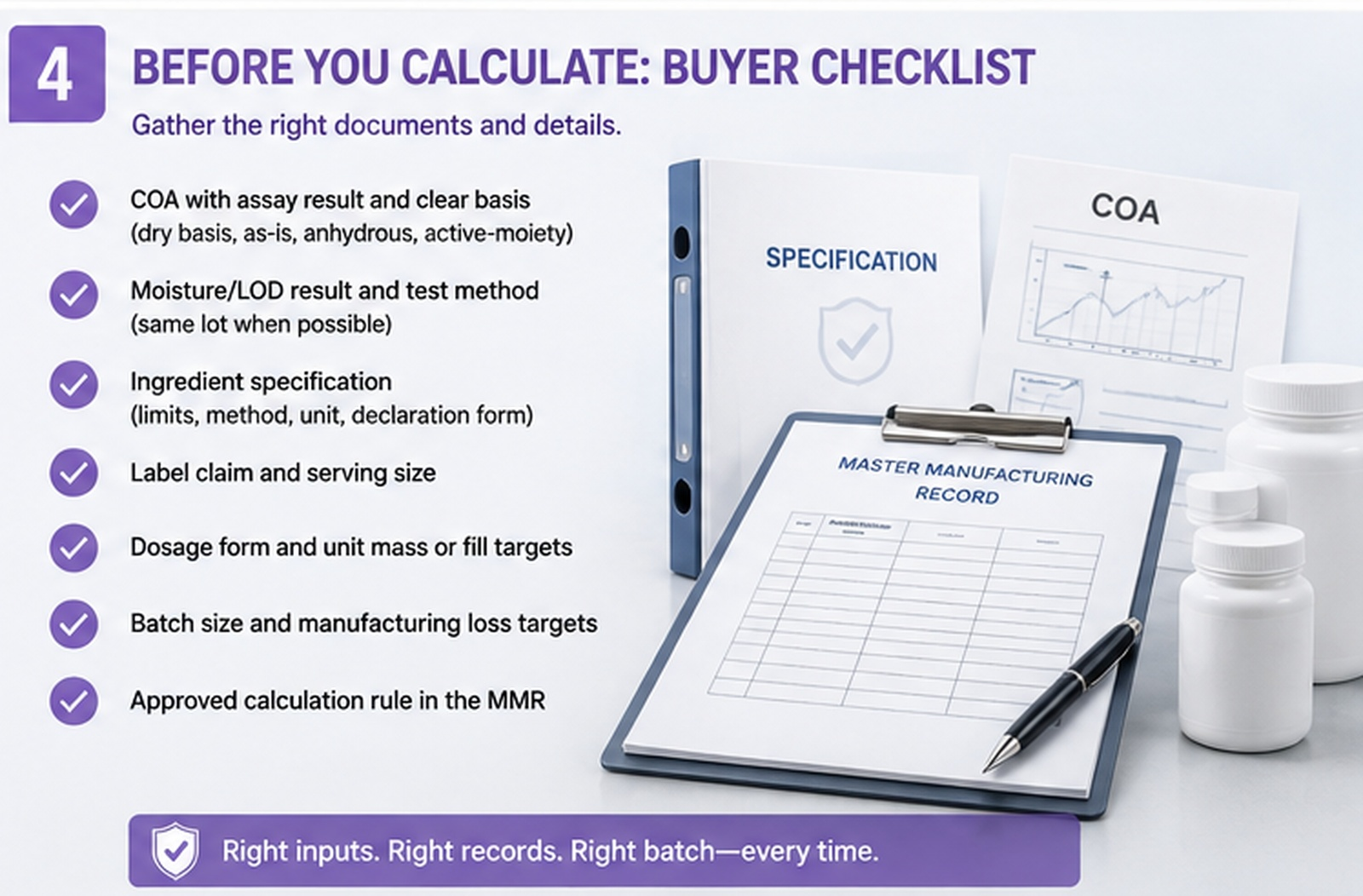
Exact ingredient name, supplier, grade, and item code.
Current material specification and lot COA.
Assay result, basis, method, limit, and actual value.
Moisture, water, or loss-on-drying result and method.
Chemical form, hydrate status, carrier, and standardization details.
Label-declared basis and amount per serving.
Complete formula and theoretical batch size.
Approved calculation and rounding rule.
Lot-specific dispensing quantity and verification record.
Separate rationale for any intentional overage.
Dosage-form capacity and finished-unit impact.
Change-control owner and approval path.
Frequently Asked Questions
Is dry-basis potency always higher than as-is potency?
It is generally higher when the conversion excludes a positive water or volatile fraction, but the specification and method define the result. Do not assume the relationship without reviewing the analytical basis.
Can we calculate formula input from the supplier specification minimum?
Development and commercial calculations may use different rules. Lot-specific manufacturing input should follow the approved master manufacturing record, material specification, and quality procedures—not an informal choice between a typical value and specification minimum.
Should every ingredient receive a potency correction?
No. The need depends on how the component is specified and used. Some components are added by fixed weight; others require an assay, activity, moisture, or active-moiety adjustment.
Is moisture correction the same as loss-on-drying correction?
Not necessarily. Loss on drying can capture water plus other volatile matter, while a water-specific method measures water. Use the method named in the approved specification.
What happens when the corrected input no longer fits the capsule?
The team may need to review ingredient grade, concentration, capsule size, units per serving, or dosage form. Do not solve a capacity problem by ignoring the lot potency.
Does a higher input automatically count as overage?
No. A lot potency correction is intended to deliver the approved target from material that is less than 100% active. Intentional overage is a separate, documented addition above the target.
Who should approve the calculation rule?
Responsibilities depend on the quality agreement and manufacturer procedures. At minimum, formulation, production, and quality teams need one controlled rule and clear verification ownership.
What should a brand send for a formula-input review?
Send the formula, label target, serving size, dosage form, batch size, ingredient specification, lot COA, package concept, target market, forecast, and launch timing. Ingredient-specific feasibility, testing, MOQ, and lead time require project confirmation.
Key Takeaways
A percent assay is incomplete without its basis.
Production weighs material as received, so a dry-basis result may require a documented conversion.
Assay basis, moisture method, chemical form, active-moiety basis, and units must align.
Potency correction and intentional overage are different decisions.
A corrected input can change dosage-form capacity, yield, package count, cost, and final release.
Use the current lot COA, current formula version, and one controlled calculation rule.
Discuss a Lot-Specific Formula Review
Send Aidacru your target market, formula, label amount, serving size, dosage form, ingredient specification, lot COA, package concept, forecast, and launch timing. The review can identify open calculation, capacity, process, testing, documentation, and quotation questions before the component is released to production.
Technical References
U.S. FDA, Dietary Supplement CGMP Small Entity Compliance Guide: https://www.fda.gov/regulatory-information/search-fda-guidance-documents/small-entity-compliance-guide-current-good-manufacturing-practice-manufacturing-packaging-labeling
21 CFR 111.210, Master Manufacturing Record Requirements: https://www.govinfo.gov/content/pkg/CFR-2025-title21-vol2/pdf/CFR-2025-title21-vol2-part111.pdf
U.S. FDA, Dietary Supplement Labeling Guide: https://www.fda.gov/food/dietary-supplements-guidance-documents-regulatory-information/dietary-supplement-labeling-guide
Aidacru, Raw-Material Grade Transfer Guide: https://www.aidacruhealth.com/en/supplement-raw-material-grade-transfer-guide-n6406.html