

Same Ingredient, Different Production Result: A Raw-Material Grade Transfer Guide
Date: 2026-08-03 Categories: Supplement Blog Hits: 321
The ingredient name did not change. The assay still passes. So why does the powder stop flowing, the capsule weight move, or the flavor look different?
Because a material can meet its identity and assay requirements and still behave differently in a manufacturing process.
What Brands Need to Know Before Approving a Source Change
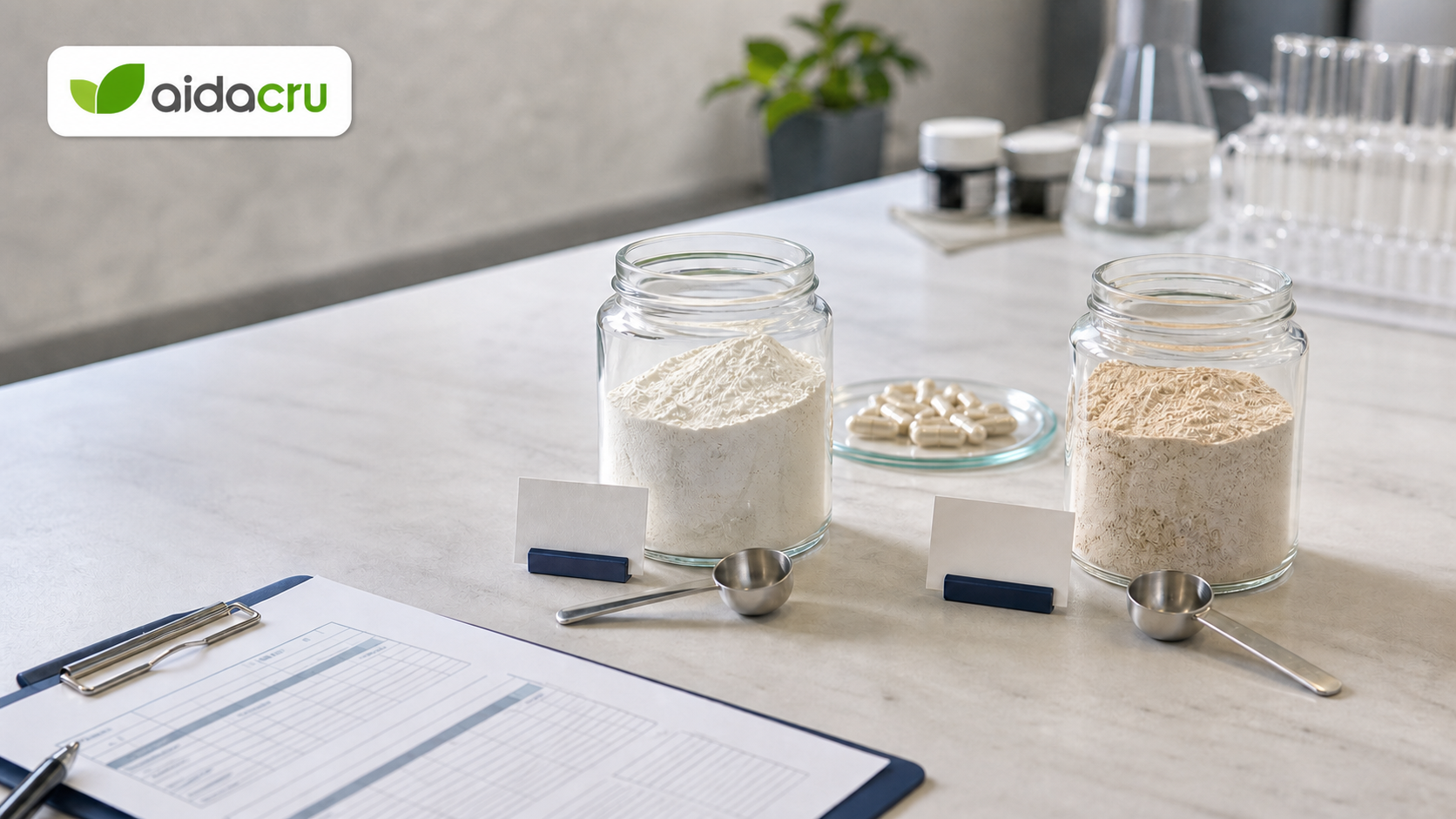
A supplement ingredient transfer should compare both quality specifications and functional material attributes. Identity, assay, contaminants, and supplier documentation determine whether the material meets established requirements. Particle-size distribution, bulk density, moisture, carrier system, solubility, and sensory profile help determine whether it will run acceptably in the intended formula and dosage form.
Before approving a new source, compare the documents, assess what changed, make a risk-based sampling plan, test the material in the intended product format, and define acceptance criteria. A lower price or matching ingredient name is not enough to approve a production transfer.
Why a Matching Ingredient Name Is Not a Manufacturing Equivalence Decision
The ingredient name answers one question: what is the material supposed to be?
Production needs several additional answers:
- What is the standardized assay or marker-compound range?
- Is a carrier or processing aid present?
- What is the particle-size distribution?
- How dense and compressible is the powder?
- How much moisture does it contain, and how readily does it pick up more?
- Does it dissolve, disperse, or suspend as the formula requires?
- Does its color, odor, or flavor change the finished product?
For U.S. dietary supplement manufacturing, 21 CFR 111.70 requires component specifications for identity and for attributes needed to ensure the finished supplement meets its requirements for purity, strength, and composition. Section 111.75 describes identity testing, supplier qualification, COA reliance, and specification verification. These requirements establish a quality foundation, but a brand still needs a practical process-transfer decision for its specific product.
The buyer consequence is straightforward: a material may be acceptable as an ingredient but still require formula or process changes before it is an acceptable replacement in a finished product.
Specification Equivalence and Functional Equivalence Are Different
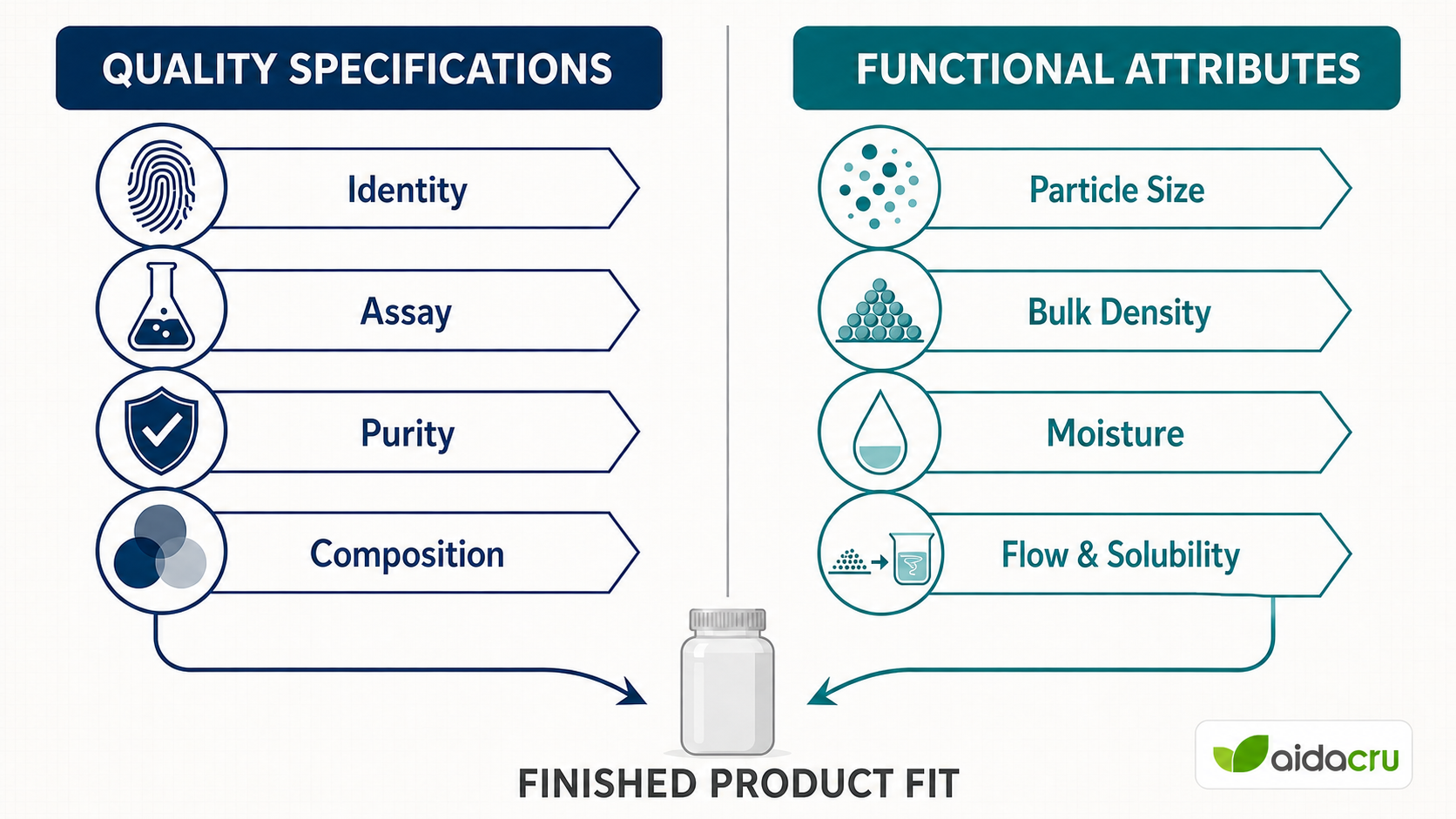
| Review layer | Typical questions | Buyer consequence |
|---|---|---|
| Identity | Is it the correct ingredient, botanical species, plant part, chemical form, or nutrient source? | Wrong identity is a stop decision. |
| Strength or standardization | Does the assay or marker range match the formula and label calculation? | A different standardization can change use quantity and other-ingredient load. |
| Purity and contaminants | Are applicable contaminant and microbiological limits defined and met? | A failure may prevent use or final batch release. |
| Composition | What carriers, diluents, residual solvents, or processing aids are present? | The same active percentage can still produce a different finished formula. |
| Functional attributes | How does the material flow, compact, dissolve, disperse, taste, or interact with moisture? | Production performance and sensory approval may change. |
| Supply and change control | Did the supplier, site, process, country of origin, or test method change? | Documentation, labels, samples, and approvals may need review. |
A useful transfer assessment keeps these layers separate. Passing one does not automatically close the others.
Six Material Attributes That Commonly Change Production Behavior
1. Standardization and Carrier System
A botanical extract may be standardized to the same marker compound but supplied with a different carrier. That change can affect the total quantity used, label review, allergen assessment, color, flavor, water interaction, and blend behavior.
Buyer action: compare the complete composition and calculation basis, not only the marker claim printed in the product name.
2. Particle-Size Distribution and Particle Shape
Fine particles may be more cohesive and dusty. Broad size differences between ingredients can increase segregation risk during transfer or hopper discharge. Coarser particles may flow differently or feel gritty in a powder drink.
Research on capsule filling has shown that material attributes such as particle size, density, flow, compressibility, and friction can affect capsule fill weight and filling performance. The exact relationship depends on the machine and process, which is why a specification value should not be converted into a universal production rule.
Buyer action: ask whether the new source changes the particle-size range or morphology and whether the intended equipment is sensitive to that change.
3. Bulk Density, Tapped Density, and Compressibility
Bulk density affects how much powder fits in a capsule, scoop, stick pack, blender, or shipping container. Tapped density and compressibility help describe how the powder consolidates under handling or vibration.
If the new material is less dense, the target serving may no longer fit the selected capsule size or stick-pack dimensions. If it packs differently, filling settings and weight control may also change.
Buyer action: confirm the serving mass, available fill volume, and expected density range before approving the transfer.
4. Moisture and Water Interaction
Moisture can affect caking, stickiness, microbial risk, reaction rates, tablet compression, gummy texture, and package selection. “Moisture content” and “water activity” are related but not interchangeable. One describes how much water is present; the other helps describe how available that water is for reactions or microbial growth.
Buyer action: determine which measure is relevant to the ingredient and finished dosage form, then connect it to storage and packaging decisions.
5. Solubility, Dispersibility, and Suspension Behavior
An ingredient does not need to be fully soluble in every product. It does need to behave as intended. A powder drink may need acceptable dispersion. A liquid may require a controlled suspension. A gummy or tablet may need uniform distribution before setting or compression.
Buyer action: define the intended user experience and manufacturing state. “Soluble” without a method, medium, temperature, concentration, and time is not a complete specification.
6. Color, Odor, and Flavor
Botanical materials can vary naturally. A source change may alter bitterness, astringency, color, or odor enough to require flavor-system or appearance review even when the active specification passes.
Buyer action: use an approved sensory benchmark and document whether an observed difference is acceptable, adjustable, or a rejection criterion.
How the Same Source Change Can Affect Different Dosage Forms
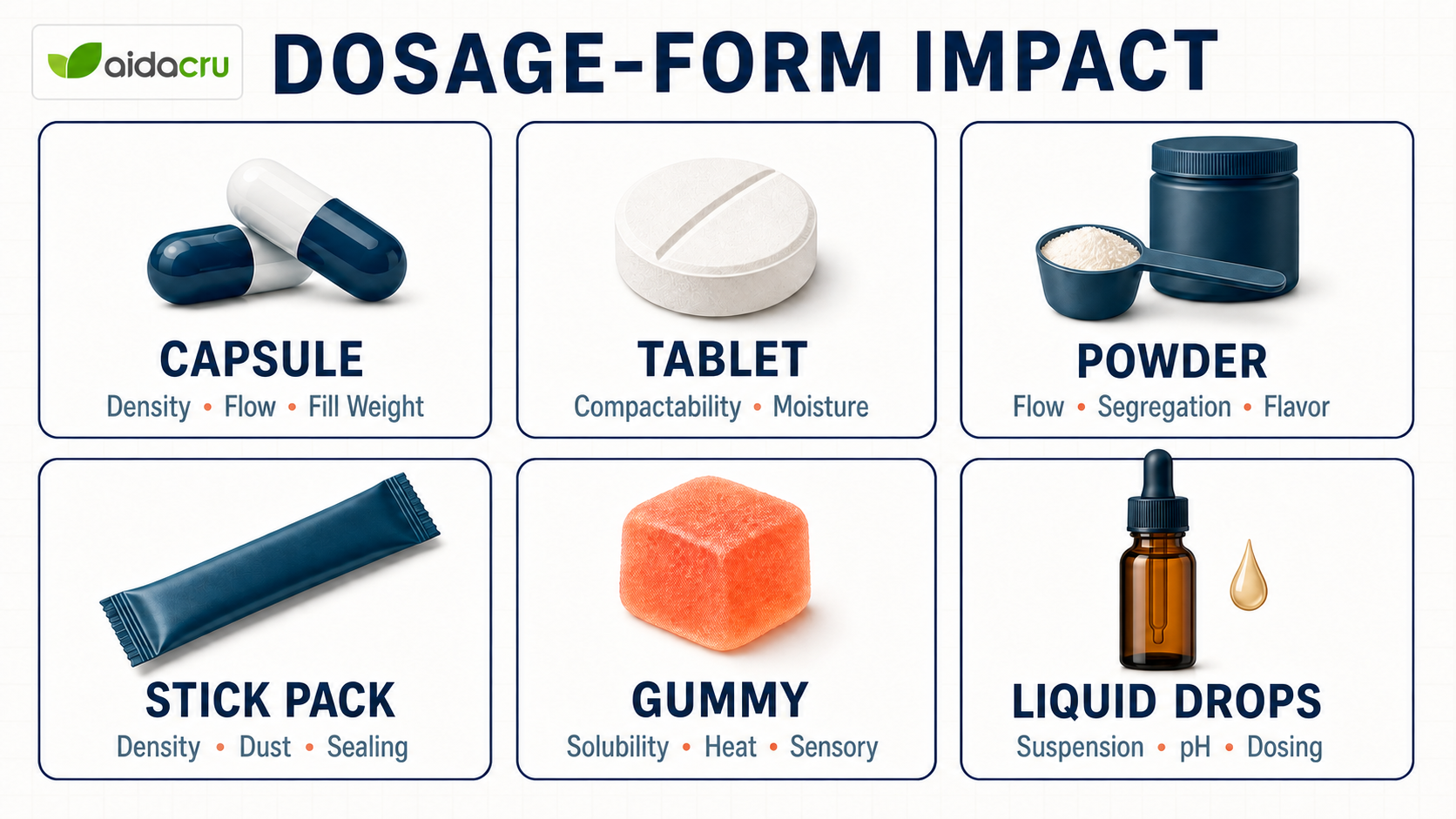
| Dosage form | Material attribute to watch | What may go wrong | Buyer decision |
|---|---|---|---|
| Capsule | Density, flow, compressibility, particle size | Target fill may not fit; fill-weight variation may increase | Confirm capsule size and filling feasibility |
| Tablet | Compactability, lubrication sensitivity, moisture | Sticking, capping, weak tablets, or slow disintegration | Reconfirm formula and compression process window |
| Powder or tub | Flow, segregation, dispersibility, flavor | Inconsistent filling, settling, dusting, poor user experience | Reconfirm blending, filling, serving, and flavor benchmark |
| Stick pack | Density, flow, dust, moisture | Metering variation or powder in the seal area | Reconfirm dose volume, film, and sealing trial |
| Gummy | Solubility, heat sensitivity, color, flavor | Uneven distribution, sedimentation, taste or appearance changes | Reconfirm addition stage and sensory acceptance |
| Liquid drops | Solubility, suspension behavior, pH interaction | Sediment, precipitation, dosing inconsistency, or appearance change | Define whether the product is a solution or suspension and how it is used |
A Seven-Step Raw-Material Transfer Workflow
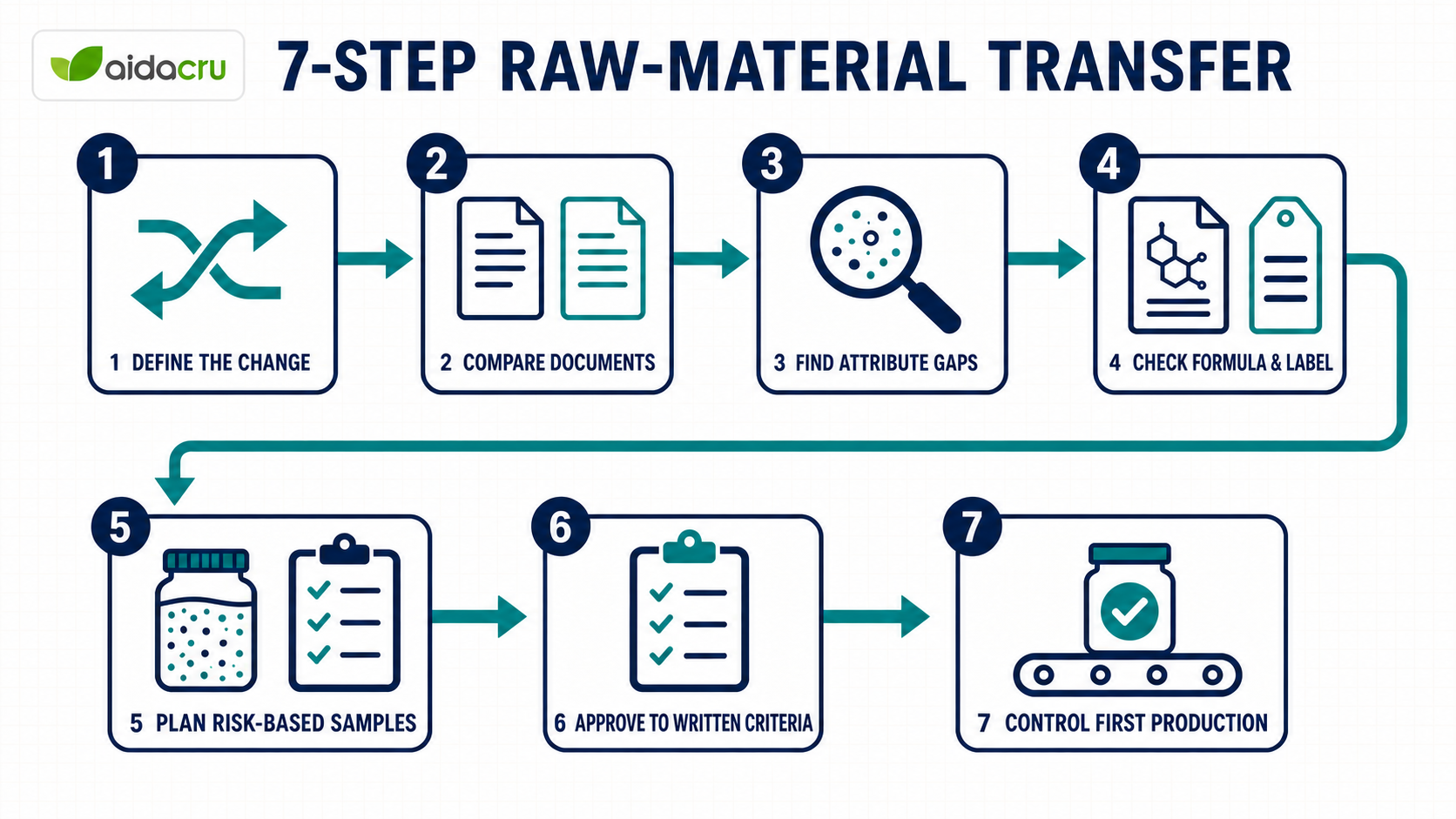
Step 1: Define the Reason for the Change
Document whether the driver is price, supply continuity, country of origin, standardization, regulatory documentation, performance, or supplier consolidation. The reason affects the acceptable trade-offs.
Step 2: Compare Documents Side by Side
Review the specification, COA format, test methods, allergen statement, origin, manufacturing site, storage conditions, retest or expiration information, and full composition where available.
Do not compare one supplier’s specification limit with another supplier’s single batch result as though they are the same type of information.
Step 3: Identify Material-Attribute Gaps
List the data that matter to the dosage form but are absent from the standard COA: particle size, bulk density, moisture behavior, solubility, color range, or another functional property.
Step 4: Assess Formula and Label Impact
Recalculate the active contribution and carrier load. Review the ingredients list, allergen position, country-of-origin requirements, claims, and any formula record affected by the change.
Step 5: Set a Risk-Based Sample Plan
The sample should answer specific questions. A bench blend may be enough to compare flavor or color. Filling, compression, depositing, or packaging questions may require a more representative line trial.
Step 6: Approve Against Written Criteria
Record the source, lot, formula version, process conditions, package, tests, sensory benchmark, deviations, and decision. “Looks okay” is not a transferable approval standard.
Step 7: Control the First Production Use
Identify the in-process checks most likely to reveal a transfer problem: blend behavior, fill weight, tablet ejection, appearance, viscosity, yield, or another product-specific attribute. Review the first batch before treating the new source as routine.
What the Buyer Should Put in the Transfer Package
- Current and proposed supplier specification sheets
- Representative or lot-specific COAs
- Full composition and carrier information, where applicable
- Country of origin and manufacturing-site information
- Allergen and dietary-positioning statements
- Target formula and serving size
- Dosage form and selected package
- Current approved sample or sensory benchmark
- Target market and label requirements
- Required launch quantity and timing
- Written transfer acceptance criteria
- Change-control owner and approval record
Common Approval Mistakes
Approving Only from Price and Assay
This misses functional attributes that affect the manufacturing line and finished user experience.
Treating the COA as a Complete Formula-Transfer Protocol
The COA supports defined quality decisions. It does not necessarily describe every attribute that controls filling, compression, dispersion, or flavor.
Testing the New Material in Water but Selling It in a Gummy or Capsule
The sample format should match the decision. A solubility cup test cannot answer capsule-fill or gummy-process questions.
Changing the Source Without Updating the Approved Version
The ingredient source or grade should be traceable to the formula, sample, specification, batch record, and label review affected by the change.
Frequently Asked Questions
Can two ingredients with the same assay be used interchangeably?
Not automatically. Assay is one attribute. Carrier composition, particle size, density, moisture, solubility, sensory profile, and test methods may still differ.
Is a supplier COA enough to approve a new dietary ingredient source?
No. The applicable identity and component-specification requirements, supplier qualification, and product-specific manufacturability questions must also be addressed. The exact verification route depends on the component and quality system.
When is a new sample required after a supplier change?
When the change could affect formula composition, process behavior, sensory characteristics, packaging, specifications, or label decisions. The sample scope should match the risk.
Why does bulk density matter for capsules and stick packs?
It helps determine how much powder occupies a given volume. A density change can affect capsule-size fit, stick-pack dimensions, machine settings, and fill control.
Does finer powder always mean better quality?
No. Finer material may dissolve or distribute differently, but it may also become more cohesive, dusty, or difficult to flow. The preferred range depends on the product and process.
Should the old and new suppliers use the same test method?
Method alignment helps prevent false comparisons. If methods differ, the buyer and quality team should understand whether the results are directly comparable.
Can a raw-material transfer change the Supplement Facts or ingredients list?
Yes. A different strength, chemical form, carrier, or allergen status may affect formula calculations or label content. Review the label before commercial approval.
What should Aidacru receive for an initial transfer review?
Send the current and proposed specifications or COAs, target market, formula, serving size, dosage form, packaging, forecast, and desired launch timing. Any capability, test, timing, or feasibility statement remains subject to project confirmation.
Build the Transfer Around the Finished Product
A successful raw-material transfer does not end when the new COA is accepted. It ends when the new material is documented, sampled, processed, packaged, and reviewed against the requirements of the finished supplement.
Next step: Send us the current and proposed ingredient documents, target formula, serving size, dosage form, package concept, market, forecast, and launch timing. We’ll identify the open quality, formulation, production, and approval questions before the change reaches a bulk order.