

Astaxanthin Softgels Private Label: How to Evaluate a 120-Count In-Stock SKU
Date: 2026-10-17 Categories: Supplement Blog Hits: 175
Quick Answer
Private-label astaxanthin softgels should be evaluated by source organism, declared amount per serving, analytical basis, carrier system, shell composition, stability support, packaging, and lot documents—not by capsule color alone. Aidacru currently has a 120-softgel pouch format available for B2B discussion; the final 12 mg statement, microalgae source, MCT carrier, free-from language, certification marks, inventory, and commercial terms require document-level confirmation before use.
Key Takeaways
- “Astaxanthin” is not a complete specification; buyers need source, material form, concentration, input calculation, and declared finished-product amount.
- The oil carrier and softgel shell are part of the product and can affect labeling, allergens, market positioning, and stability.
- Red capsule color is not proof of identity or potency.
- Certification logos, “third-party tested,” non-GMO, and free-from claims require the applicable evidence for the exact product and market.
- A complete RFQ should include target market, desired serving, 120-count pouch, quantity, label requirements, documents, delivery country, and launch timing.
What Are Astaxanthin Softgels?
Astaxanthin softgels are oil-based or oil-compatible soft capsules containing an astaxanthin ingredient in a defined carrier and shell system. Commercial products may differ in ingredient source, concentration, amount per serving, carrier oil, softgel shell, other ingredients, packaging, and testing approach.
For buyers, the product identity should come from controlled documents. The name on the front panel cannot replace the raw-material specification, master formula, finished-product specification, approved label, and lot-specific release records.
What Is the Current In-Stock Format?
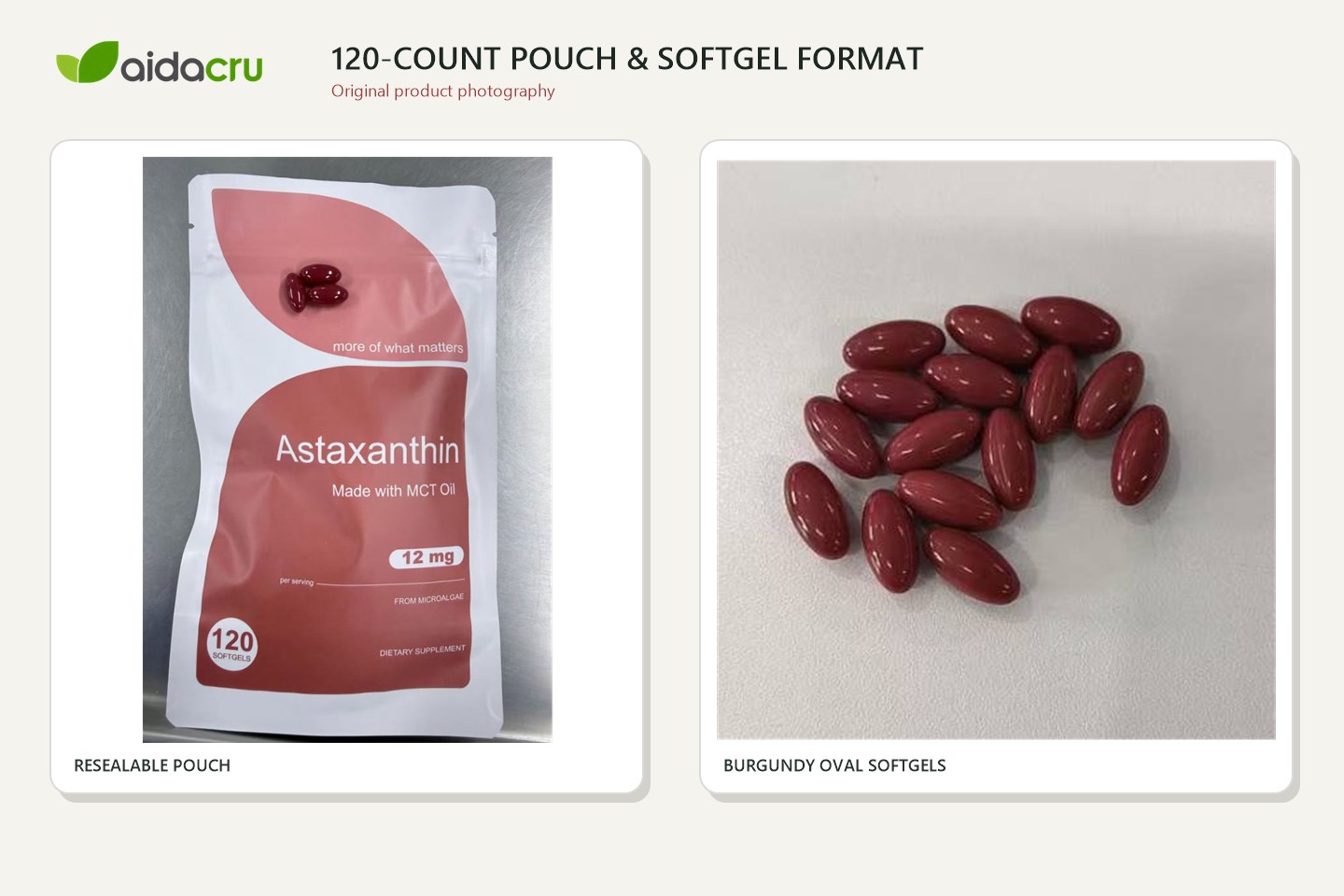
The product materials supplied for this article show:
- 120 softgels per resealable pouch;
- a front-panel 12 mg per serving statement;
- microalgae-source positioning;
- MCT oil positioning;
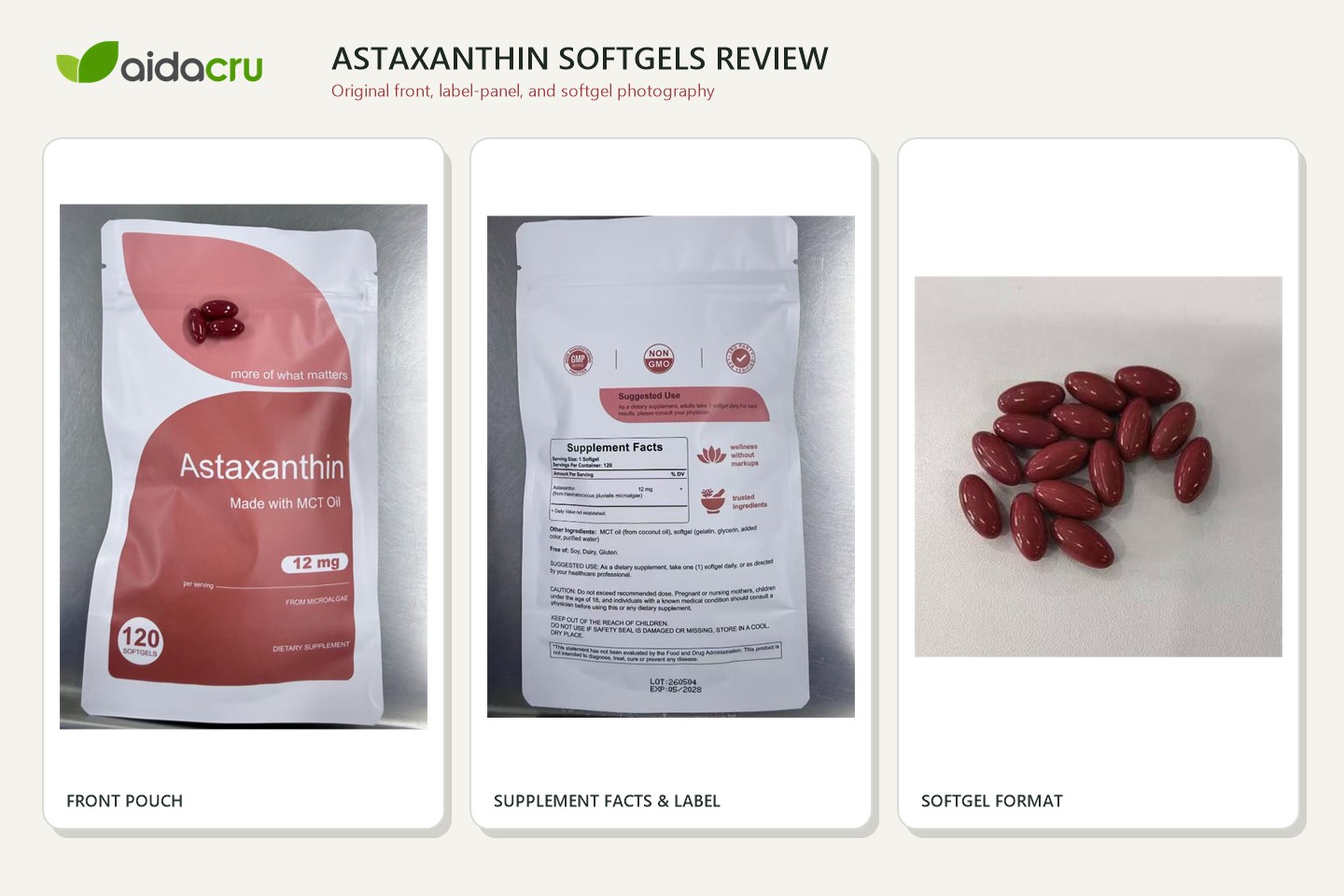
- a one-softgel serving shown on the sample back panel;
- current stock availability; and
- OEM/private-label availability for B2B discussion.
The sample package also shows certification, third-party, non-GMO, and free-from statements. Those claims should not be copied to a new label or public article until the buyer has reviewed the relevant, current evidence and confirmed that it applies to the exact formula, lot, facility scope, and destination market.
Why Source and Potency Must Be Reviewed Together
An astaxanthin raw material may be identified by source, concentration, carrier, and other technical attributes. The formula calculation should connect the amount of raw material added to the amount of astaxanthin declared per serving.
This is especially important when a concentrated ingredient is carried in oil. Buyers should ask whether the label amount refers to the active astaxanthin, the total raw-material blend, or another basis, and how the finished-product result is specified and tested.
Astaxanthin Softgels vs Other Dosage Forms
| Dosage form | Why a buyer may choose it | Main procurement control | Packaging consideration |
|---|---|---|---|
| Softgel | Suitable for oil-based fill systems and familiar supplement presentation | Fill composition, active basis, shell compatibility, leaks, oxidation control | Bottle, blister, or pouch barrier and count |
| Hard capsule | May suit compatible dry ingredient systems | Powder flow, fill weight, capsule shell, ingredient form | Bottle or blister moisture control |
| Gummy | Consumer-friendly chewable format | Feasible active load, flavor, color, stability, serving size | Bottle or pouch with texture and moisture protection |
| Liquid drops | Adjustable serving and liquid presentation | Concentration, dosing device, oxidation, flavor, fill volume | Bottle, closure, dropper, and light/oxygen protection |
The format should follow the material and product strategy. A dosage form should not be selected only because it is currently popular.
Seven Technical and Commercial Checks
1. Identify the Raw-Material Source
Request the material name, biological source, supplier specification, country-of-origin information where required, and relevant traceability documents. If a species name or microalgae statement will appear on the label, ensure it matches the approved source documentation.
2. Confirm the Declared Amount and Serving Basis
The current sample displays 12 mg per serving and a one-softgel serving. Confirm that the current master formula, finished-product specification, Supplement Facts, and analytical or calculation basis all support the same statement.
3. Review the Carrier Oil
Ask what oil or carrier system is used, its source, specification, and role in the formula. If “MCT oil” or a coconut source will be declared, verify the ingredient wording and any destination-market or customer-specific implications.
4. Review the Softgel Shell
Confirm shell ingredients, color system, glycerin or plasticizer, gelatin or alternative shell basis, and any relevant dietary-positioning implications. Do not advertise vegan or vegetarian positioning unless the actual shell supports it.
5. Define the Finished-Product Tests
The agreed specification may address identity, astaxanthin content or another defined potency measure, microbiological limits, heavy metals, physical appearance, fill weight, disintegration, leaks, and other project-relevant attributes. The precise panel and method should be stated rather than assumed.
6. Evaluate Stability and Packaging Together
Astaxanthin ingredients and oil systems may require protection from environmental exposure. Ask what packaging and storage conditions support the proposed shelf life, and whether the pouch barrier, seal, headspace, coding, and handling are included in the available evidence.
7. Audit Every Marketing Claim and Logo
Statements such as non-GMO, third-party tested, free from specific allergens, GMP, natural source, or a specific potency require the relevant proof and correct wording. A logo on a sample package should never be transferred automatically to another brand's artwork.
From Stock Review to a Private-Label Order
Step 1: Define the Target Product
State the country, channel, intended positioning, serving concept, 120-count pouch requirement, expected quantity, delivery destination, launch date, and documents required by your compliance or quality team.
Step 2: Request the Current Product and Lot File
Ask for the formula or specification, raw-material and source details, serving and potency basis, carrier and shell composition, ingredient and allergen statement, packaging specification, current inventory, lot status, and available test documents.
Step 3: Inspect a Representative Sample
Review capsule appearance, uniformity, odor, tackiness, leakage, deformation, pouch seal, count, coding, label legibility, and shipping presentation. Use agreed acceptance criteria rather than a visual “looks good” approval.
Step 4: Review the Label and Claims
Reconcile the amount per serving, servings per container, ingredients, allergen statements, directions, warnings, net quantity, responsible-party details, storage statement, lot/date coding, certifications, and any structure/function language.
Step 5: Confirm Private-Label Scope
Define whether the project uses existing finished inventory, new labels on an existing platform, different pouch artwork, a bottle or other package, or a custom formula. Each option changes feasibility, quantities, documents, and schedule.
Step 6: Agree Release, Commercial, and Shipping Terms
Document the included tests and product records, price scope, packaging components, case pack, payment, freight terms, stock allocation, release responsibilities, and expected ship date. Reconfirm the lot and quantity before payment and dispatch.
B2B Procurement Checklist
- [ ] Target country and sales channel identified
- [ ] 120-softgel count and serving basis confirmed
- [ ] Current stock quantity, lot, and allocation terms confirmed
- [ ] Astaxanthin source and raw-material specification reviewed
- [ ] Active amount per serving and calculation/test basis verified
- [ ] Carrier oil and shell composition confirmed
- [ ] Ingredient, allergen, storage, and warning statements reviewed
- [ ] Finished-product specification and test plan agreed
- [ ] Stability support and pouch barrier system reviewed
- [ ] Certification marks, non-GMO, third-party, and free-from claims substantiated
- [ ] Sample acceptance criteria documented
- [ ] Private-label scope, quantity, price, freight, and timeline aligned
Frequently Asked Questions
1. Does the current pouch contain 120 softgels or 120 servings?
The supplied package is presented as 120 softgels and shows a one-softgel serving. Confirm the current approved label and specification before treating that as 120 servings for the commercial product.
2. Can I publish the 12 mg statement shown on the sample?
Only after the exact formula, serving basis, raw-material concentration, finished-product specification, label, and supporting test or calculation file have been reconciled. The photograph alone is not evidence.
3. What does “from microalgae” mean in a buyer review?
It is a source statement that should connect to the raw-material identity and supplier documents. Ask for the exact source information and ensure the public wording matches the approved technical file.
4. Why is a carrier oil used?
The carrier is part of the fill system and helps define how the ingredient is delivered in the softgel. Buyers should review its identity, source, quantity basis, label wording, and compatibility with the product and target market.
5. Does a dark red softgel prove potency?
No. Appearance is a physical attribute, not an assay. Identity and potency should be addressed through the agreed specification, methods, and product documents.
6. Can I use the GMP, non-GMO, or third-party-tested logos from the sample pouch?
Not automatically. Confirm who owns or authorizes each mark, what product or facility scope it covers, its validity, and whether the wording and artwork are permitted for your exact product and market.
7. Can the pouch be changed to a bottle or custom package?
Potentially, but packaging changes require feasibility, component, count, labeling, stability, quantity, and schedule review. An in-stock pouch does not mean another package is immediately available.
8. What information should I send for a quotation?
Send the target country, sales channel, desired 120-count format, expected quantity, existing or custom formula preference, package and label needs, delivery destination, target date, and required documents. State whether you need current stock or a future production program.
About Aidacru
Aidacru supports B2B dietary supplement sourcing and development across softgels, gummies, capsules, tablets, powders, sticks, liquids, and other common formats. Manufacturer-direct discussions may cover available product platforms, private label, OEM, or ODM according to feasibility and the buyer's requirements.
Formula, potency, source, claims, certification scope, documents, stock, MOQ, lead time, and price are specific to the project and must be confirmed. This article is a procurement guide and does not claim that astaxanthin prevents, treats, or cures any condition.
Request the Astaxanthin Softgel File
Send Aidacru your target market, sales channel, expected quantity, serving and 120-count requirements, package preference, delivery country, launch timeline, and documentation checklist.
CTA: Request the current specification, source and potency support, sample, lot-specific documents available for review, dated stock confirmation, private-label scope, and quotation for the 120-count Astaxanthin Softgels.
Related Buyer Resources
- Product solutions
- Quality-control buyer guide
- Global buyers FAQ
- Manufacturing lead-time guide
- Contact/RFQ
Technical References
- FDA, Dietary Supplement Labeling Guide
- FDA, Label Claims for Conventional Foods and Dietary Supplements
- Google Search Central, Creating helpful, reliable, people-first content
- Google Search Central, Article structured data
Final Key Takeaways
The commercial value of a 120-count astaxanthin softgel depends on more than stock status or package appearance. A qualified buyer should verify the source, potency basis, carrier oil, shell, tests, stability and packaging support, claims, lot documents, and current allocation before approving a private-label or wholesale order.