

How to Build a Women's Creatine Product Line: Powder, Stick Packs, and Gummies
Date: 2026-07-30 Categories: Supplement Blog Hits: 298
A women's creatine line should not begin with pink packaging.
It should begin with three harder questions:
- Which consumer behavior is the product designed to support?
- What serving can the selected dosage form realistically deliver?
- Can the formula remain manufacturable, measurable, and stable in that format?
Creatine has moved beyond a male bodybuilding stereotype, while research interest in women has grown. That does not give brands permission to promise weight loss, hormonal balance, pregnancy benefits, menopause treatment, mood treatment, or guaranteed performance. It does create an opportunity to design more relevant formats, use occasions, and communication—without overstating the evidence.
Short Answer
Build the line around use occasions and dosage-form tradeoffs:
- Powder tub: flexible serving, relatively direct manufacturing route and efficient active delivery.
- Single-serve stick: portability and portion control, with additional powder-flow, dosing, film and seal constraints.
- Gummy: convenient sensory format, but active load, pieces per serving, heat, moisture, pH, texture and stability must be solved together.
Use creatine monohydrate as the evidence baseline unless another form has a justified product rationale. Lock the intended serving before selecting pack size, flavor system, unit count or claims.
Start with the Consumer Problem, Not a Gender Color Palette
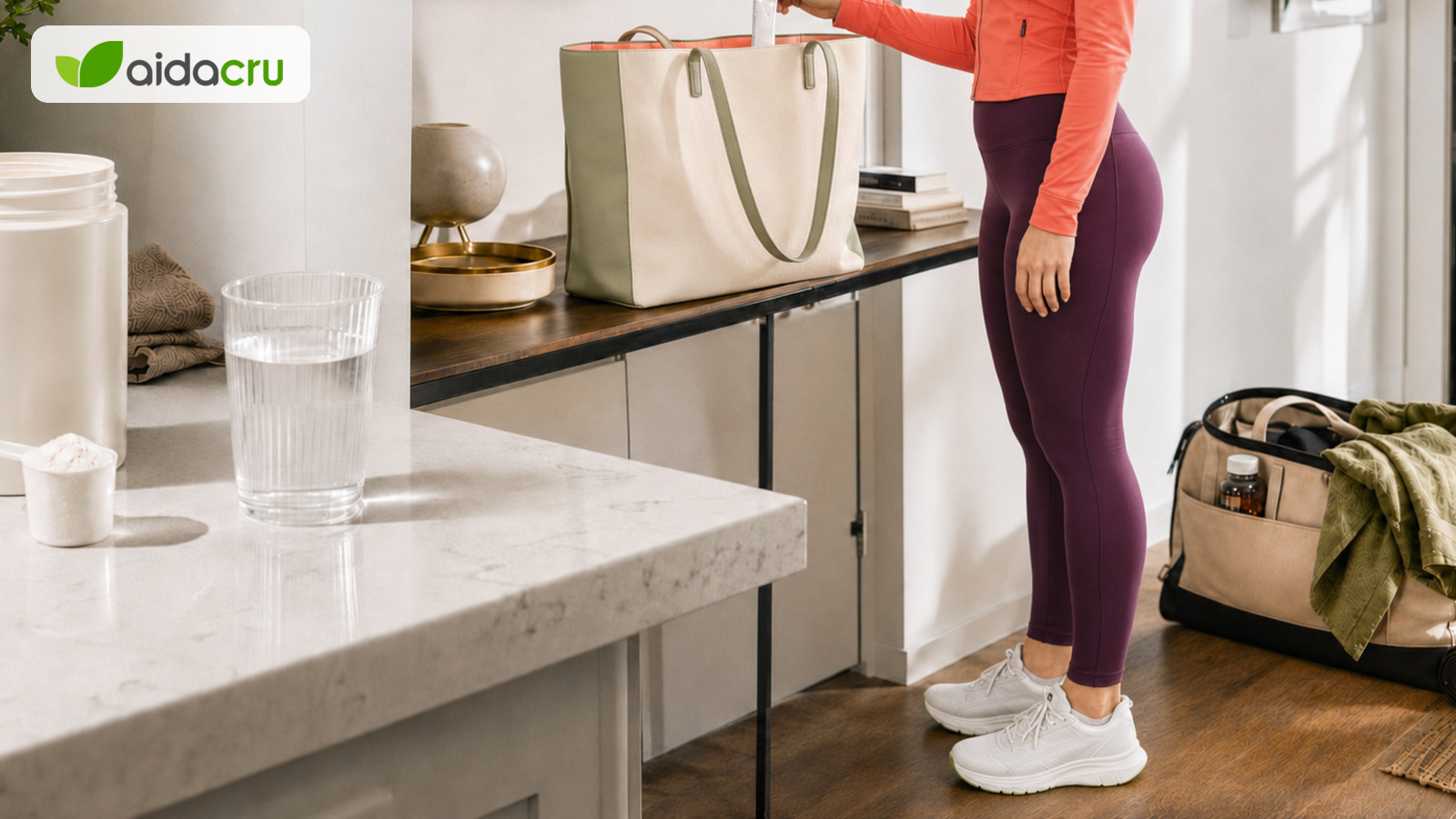
A women-focused line can be segmented by:
- new versus experienced creatine users;
- gym versus at-home routines;
- daily ritual versus workout-bag use;
- flavored versus unflavored preference;
- powder mixing tolerance;
- travel and portability;
- subscription versus retail purchase;
- price per serving;
- desired serving flexibility.
These are observable product-design variables. They are more defensible than assuming all women want the same flavor, package or health outcome.
Research reviews describe growing interest in creatine across women's life stages while also noting that women have historically been underrepresented in the evidence base. For brands, the practical response is precise positioning and careful claims—not a universal “female biology” promise.
Step 1: Define the Evidence and Claims Boundary
NIH's Office of Dietary Supplements describes creatine monohydrate as the most widely used and studied form and notes that individual performance responses vary.
For product planning, that means:
- creatine monohydrate is a logical benchmark;
- alternative forms should not be assumed superior;
- product claims must match the exact ingredient, serving and evidence;
- express and implied advertising claims both require substantiation;
- market-specific labeling and notification requirements need qualified review.
Avoid unsupported claims about:
- fat loss;
- hormone regulation;
- pregnancy or fertility;
- treatment of menopause symptoms;
- anxiety, depression or cognitive disorders;
- guaranteed strength, body-composition or recovery results.
A product can still communicate format, serving transparency, quality controls and intended use without converting scientific interest into a medical promise.
Step 2: Choose a Line Architecture
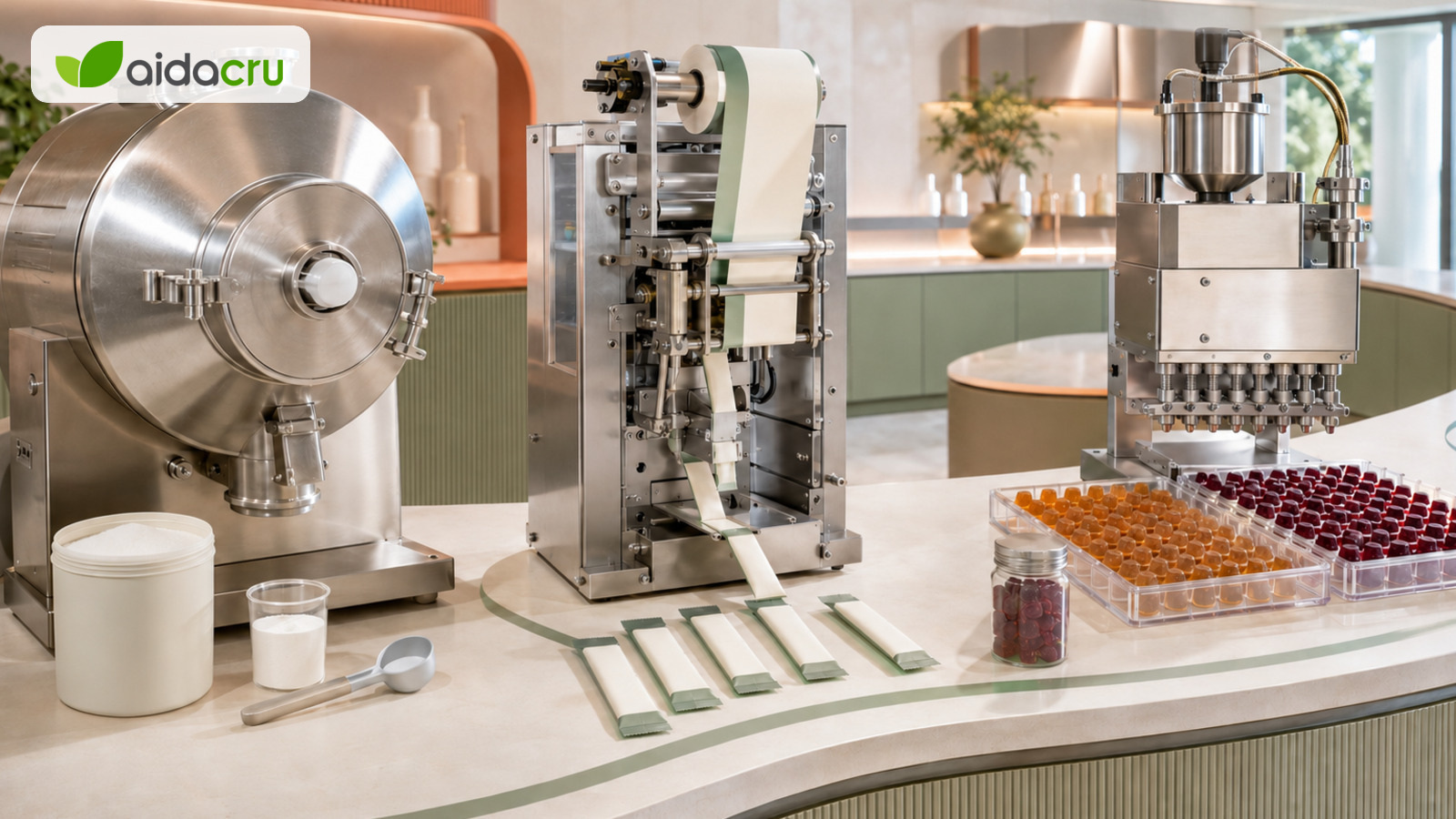
One practical three-format line looks like this:
| Product | Role in the line | Manufacturing advantage | Main technical constraint |
|---|---|---|---|
| Unflavored or lightly flavored powder tub | everyday foundational SKU | dry format and flexible serving | flow, dispersibility, scoop and moisture |
| Flavored single-serve stick | travel/workout convenience | unit-dose portability | dosing, dust, film barrier and seal |
| Creatine gummy | sensory/convenience extension | differentiated experience | active load, piece count, pH, heat and stability |
This is a planning model, not a recommendation that every brand launch all three. A focused brand may begin with one format and add another only after repeat-purchase behavior is understood.
Route 1: Creatine Powder in a Tub
Typical production flow
- receive, quarantine and release ingredients;
- sieve or deagglomerate where appropriate;
- weigh active and supporting ingredients;
- prepare a premix when low-dose flavors, colors or other components require it;
- load ingredients in a controlled sequence;
- blend;
- transfer to the filling hopper;
- fill tubs by weight;
- add the scoop and a desiccant if the product needs one;
- close, seal, label and case-pack.
Critical technical variables
Particle size and dispersibility
Creatine particle characteristics can affect:
- perceived grittiness;
- dispersion rate;
- dust;
- blend behavior;
- consumer mixing experience.
“Instant” or “fast-dissolving” language should not be used without a clear basis. Solubility and dispersion are not identical.
Bulk density
Bulk density connects formula, serving and package:
- container capacity;
- apparent fill level;
- scoop volume;
- filling behavior;
- shipping cube.
A formula change can require a new tub or scoop even when the net weight remains unchanged.
Blend uniformity and segregation
Flavor, acid, sweetener and low-dose components may differ from creatine in particle size and density. A blend can segregate during discharge or filling after it has passed an earlier mixing check.
The development plan should consider:
- premixing;
- loading sequence;
- transfer distance;
- hopper behavior;
- sampling locations;
- fill-to-fill consistency.
Moisture control
Dry creatine powder is generally more stable than creatine in aqueous systems, but the finished blend may contain hygroscopic flavors, acids or other ingredients. The product's moisture behavior—not the creatine name alone—should determine bottle, liner, induction seal and desiccant decisions.
Best buyer questions
- What is the actual bulk density of the final blend?
- How was the scoop matched to serving mass?
- What are the relevant powder-flow and segregation risks?
- Does the flavored system alter moisture sensitivity?
- Which attributes will be monitored during filling?
Route 2: Single-Serve Creatine Stick Packs
A stick is not merely a smaller tub.
Typical production flow
- prepare and release the blend;
- unwind registered rollstock;
- form the film into one or more lanes;
- create the longitudinal seal;
- meter the powder;
- form cross seals;
- cut and code;
- inspect weight, registration and seal;
- count sticks into cartons.
Critical technical variables
Serving mass versus pack dimensions
The selected serving, flavor system and powder density determine how much volume the stick must hold. A large serving can require:
- a wider or longer pack;
- different carton dimensions;
- a different consumer mixing instruction;
- a different production format.
Powder feeding
Fine powder, static, poor flow or segregation can affect dosing. The correct dosing principle depends on the actual formula and equipment. Auger filling is one option, not a universal solution.
Seal contamination
Powder in the seal zone can create channels or weak seals. Control requires an appropriate combination of:
- powder behavior;
- dosing and drop timing;
- dust extraction or management where available;
- seal-jaw condition;
- temperature, pressure and dwell time;
- line speed.
Rollstock compatibility
Confirm:
- laminate structure;
- barrier objective;
- sealant layer;
- film width;
- repeat length;
- roll direction;
- eye mark;
- core and roll diameter;
- artwork-free seal areas.
Best buyer questions
- Has the final blend been trialed in the intended pack dimensions?
- How will fill variation be monitored across lanes?
- What seal or leak checks are selected?
- Does the film barrier match the product and shelf-life objective?
- How are sticks reconciled into cartons and finished cases?
Route 3: Creatine Gummies
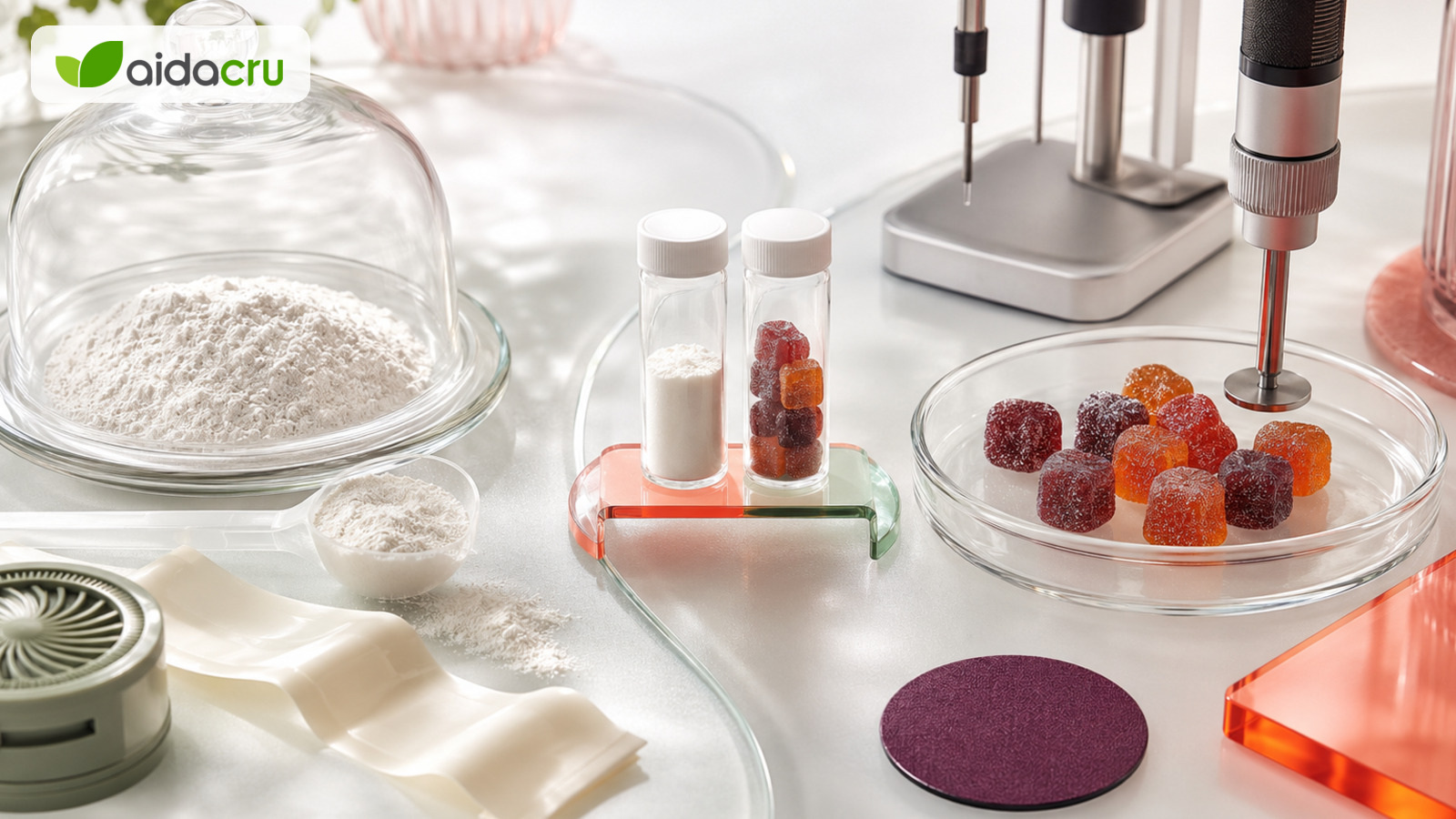
Gummies can make the category more approachable, but they create the most complex format decision in this line.
Typical production flow
- prepare the syrup phase;
- hydrate or dissolve the gelling system;
- cook or concentrate;
- cool to the appropriate addition window;
- add creatine and other actives using a controlled sequence;
- add acid, flavor and color;
- verify pH, soluble solids, and other process checks required by the formula;
- deposit into molds;
- cool and set;
- demold;
- condition or dry;
- finish, inspect, count and package.
Critical technical variables
Active load and pieces per serving
The intended creatine serving has to fit within:
- practical gummy weight;
- acceptable pieces per serving;
- gel structure;
- flavor system;
- process viscosity;
- package count and economics.
A high active load can alter depositing, texture, and flavor. Finalize the serving with manufacturing input before approving front-label concepts.
Heat and addition sequence
Heat-sensitive ingredients should not be assumed to survive an uncontrolled gummy-cooking step. The active-addition window and exposure time belong to the actual formulation and equipment.
pH and aqueous stability
Creatine is comparatively stable as a dry powder, but its behavior in water is influenced by pH and temperature. Because a gummy contains water and acids, the proposed formula needs its own assay and stability evidence. This does not mean that every creatine gummy will fail.
Water activity, moisture and texture
Water activity and moisture influence:
- texture;
- sticking;
- drying time;
- microbial and chemical stability risk;
- package barrier.
Evaluate the sample after it reaches its final conditioning target and place it in the proposed retail package.
Analytical method
A gummy can make analytical extraction more difficult. The laboratory method must work for the finished gummy, not just for raw creatine powder.
Best buyer questions
- What creatine amount is feasible per piece for this formula?
- How many pieces create the intended serving?
- When is creatine added, and how is process exposure controlled?
- What are the pH, water-activity, moisture and texture targets?
- Does the assay method work for the finished gummy?
- What stability work supports the intended package and shelf life?
Step 3: Design Flavor by Use Occasion
Do not force one flavor across all formats.
Powder tub
Options may include:
- unflavored for stacking;
- light citrus or fruit for water;
- a flavor designed for a larger serving volume.
Stick pack
The consumer may expect:
- a compact flavor experience;
- portability;
- clear mixing instructions;
- minimal residue.
Gummy
The flavor must work with:
- active taste;
- acid system;
- gel structure;
- finish;
- storage-related flavor changes.
Approve flavor in the final serving and dosage form. A bench flavor tested in water will not predict the same experience in a gummy.
Step 4: Build Packaging Around the Actual Product
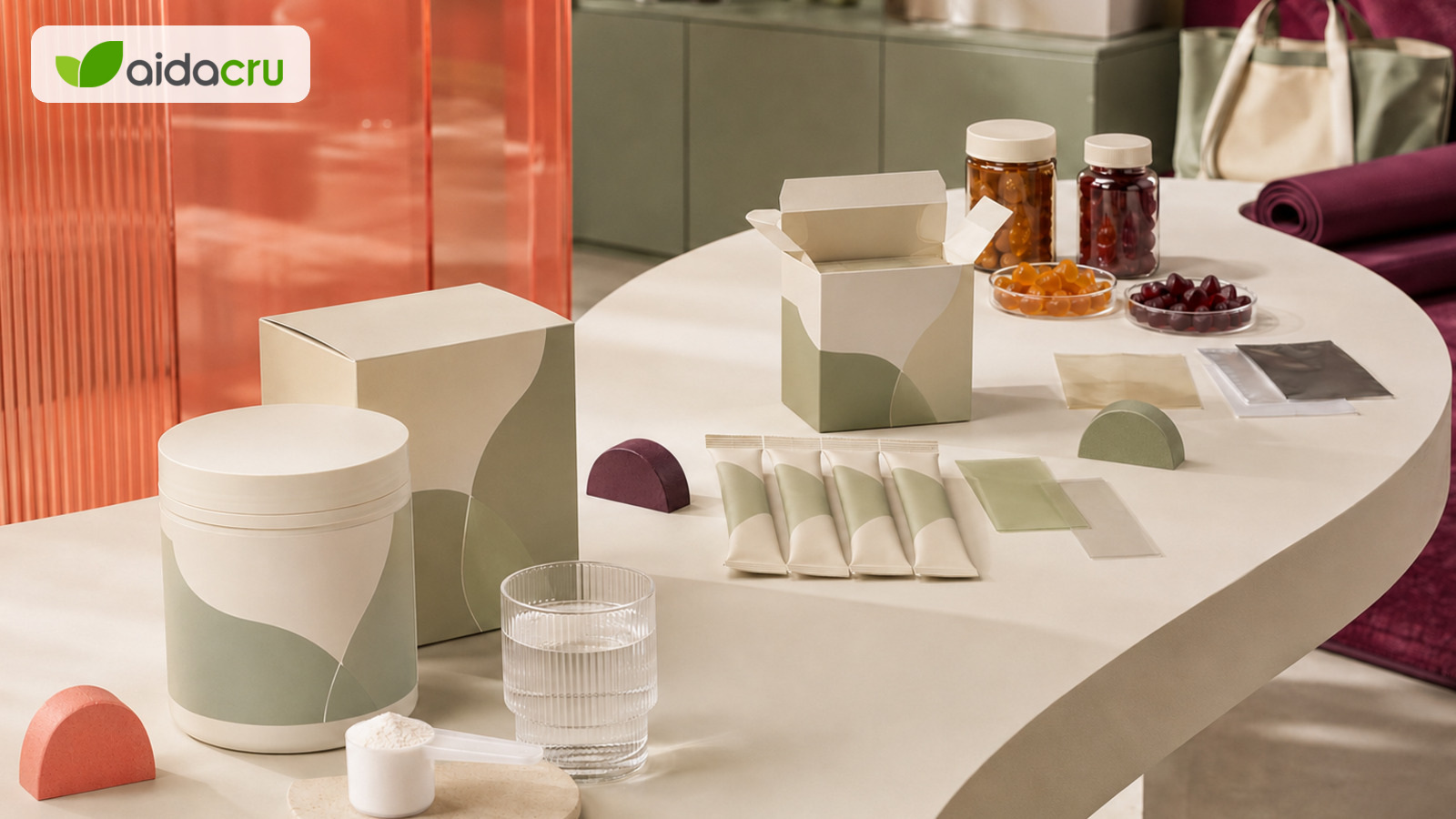
Powder tub
Lock:
- bulk density;
- net weight;
- tub volume;
- scoop;
- closure and liner;
- induction seal;
- desiccant decision;
- label dimensions.
Stick pack
Lock:
- serving mass;
- film structure;
- stick dimensions;
- artwork repeat;
- carton count;
- seal and leak evaluation;
- case pack.
Gummy bottle or pouch
Lock:
- final conditioned gummy;
- piece dimensions and count;
- moisture behavior;
- bottle/pouch barrier;
- headspace;
- closure/seal;
- desiccant decision;
- shipping compression.
Packaging artwork should follow these decisions, not lead them.
Step 5: Create One Brand System but Separate Specifications
The three products may share:
- brand positioning;
- visual system;
- audience;
- claims policy;
- quality language;
- launch story.
They still require separate:
- master formula and serving;
- manufacturing process;
- in-process criteria;
- finished-product specification;
- analytical method;
- package specification;
- stability rationale;
- approval record.
Shared branding does not make the products technically interchangeable.
Recommended Launch Sequence
Launch one format first when:
- the brand has not validated consumer demand;
- gummy or stick-pack development remains technically open;
- working capital is limited;
- packaging component quantities are not aligned;
- the line would otherwise be delayed by its hardest SKU.
Launch a coordinated line when:
- each SKU has a clear use occasion;
- serving and claims are aligned;
- all three development tracks have realistic timelines;
- packaging quantities can be managed;
- the brand has a bundle and repeat-purchase strategy.
A practical sequence may begin with powder, followed by stick packs and then gummies. That sequence is not universal; it depends on channel, differentiation and manufacturing feasibility.
Product-Line Development Checklist
Commercial brief
- ☐ target consumer and use occasion;
- ☐ target channel and price;
- ☐ format role;
- ☐ serving and pack count;
- ☐ flavor direction;
- ☐ claims boundary;
- ☐ launch sequence.
Manufacturing
- ☐ creatine form and specification;
- ☐ particle and density considerations;
- ☐ blend or gummy process;
- ☐ scale-up risks;
- ☐ in-process controls;
- ☐ finished-product analytical method;
- ☐ stability plan.
Packaging
- ☐ tub/scoop fit;
- ☐ stick film and seal;
- ☐ gummy moisture barrier;
- ☐ pack count matches the serving and servings per container;
- ☐ artwork dimensions;
- ☐ distribution configuration.
Common Product-Planning Mistakes
Building the line around one trend claim
Research interest alone does not support a product-level claim.
Assuming powder, sticks and gummies can use one formula
They have different mass, water, heat, flow, flavor and packaging constraints.
Selecting package size before density or piece count
This creates empty-looking tubs, overfilled bottles or artwork rework.
Treating a gummy sample as stable because it tastes good
Taste does not verify assay, moisture, texture or shelf-life behavior.
Launching three SKUs with no distinct use occasion
The products compete with one another instead of creating a product system.
Frequently Asked Questions
Is creatine monohydrate appropriate as a product-development baseline?
It is the most widely studied form and a useful evidence baseline. The selected ingredient and claims still require project and market review.
Is a creatine gummy equivalent to creatine powder?
No. Serving delivery, moisture, acidity, heat exposure, texture, pieces per serving and analytical testing differ.
Can the same flavored blend be used in a tub and stick pack?
Possibly, but powder density, dosing behavior, serving mass, film dimensions and seal cleanliness must be evaluated in the stick format.
How many gummies should be in a serving?
That depends on the intended creatine amount, feasible active load per piece, gummy weight, texture, flavor, and final pack. The answer comes from formulation work, not a standard industry number.
Are women's creatine claims different from general sports-nutrition claims?
Claims must follow the exact product evidence and target-market rules. Gender-specific wording does not remove substantiation requirements.
Should the line launch with all three formats?
Only when each format has a distinct job and its development, packaging and supply timeline is controlled. A staged launch may reduce risk.
When should artwork begin?
After early brand work, production artwork should wait until serving, package dimensions, label data and component specifications are stable.
What should a manufacturer receive in the first brief?
Target market, consumer, format, serving, flavor, dietary requirements, claims direction, package concept, forecast and launch window.
Submit a Format-Specific Creatine Brief
Send us:
- target market and consumer;
- preferred creatine form;
- target serving;
- powder, stick or gummy format;
- flavor direction;
- pack count;
- dietary and ingredient restrictions;
- claims direction;
- forecast and launch target.
We’ll flag the format-specific formulation, production, and packaging questions that need answers before a final quote. Available formats, feasible active load, tests, MOQ, sample timing, and production lead time require project confirmation.
Key Takeaways
- Design the line around consumer use occasions, not stereotyped gender visuals.
- Use creatine monohydrate as the evidence benchmark unless another choice is justified.
- Finalize serving size and format before packaging and claims.
- Powder, stick packs and gummies require separate manufacturing specifications.
- A creatine gummy needs formula-specific stability work because it is a moist, often acidic dosage form.
- Launch sequencing should follow manufacturing readiness and clear product differentiation.