
Ceylon Cinnamon Softgels for Private Label Brands
Date: 2026-10-21 Categories: Supplement Blog Hits: 127
Quick Answer
Private label Ceylon cinnamon softgels give supplement brands a ready-to-evaluate botanical format, but the product name alone is not enough for supplier approval. Buyers should confirm the botanical identity, plant part, material form, amount per serving, carrier oil, softgel shell, finished-product tests, current packaging, and market-specific label language before placing an order.
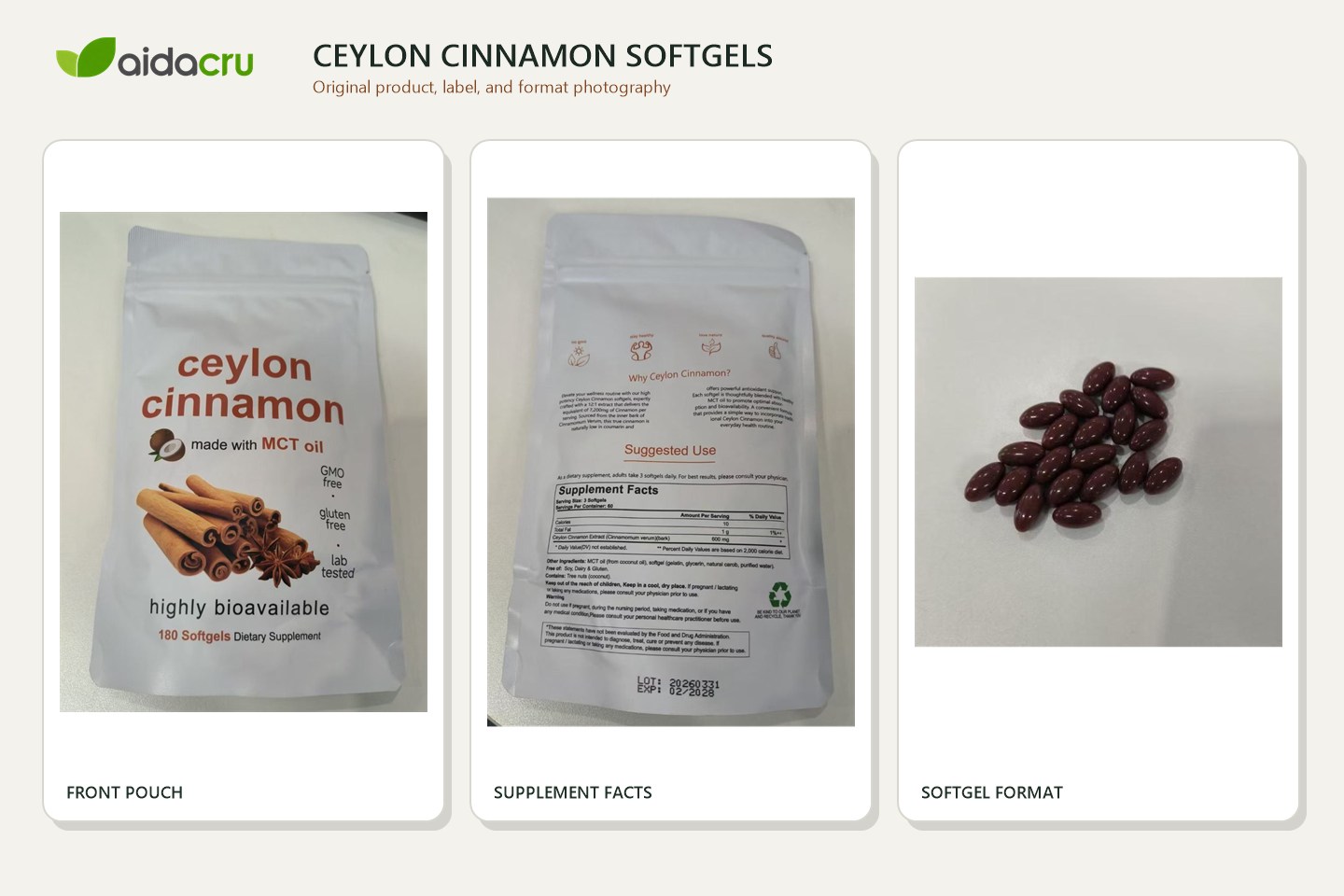
The photographed sample is presented as a 180-count Ceylon cinnamon softgel pouch made with MCT oil. Its back panel shows a three-softgel serving, 60 servings per container, and 600 mg of Ceylon cinnamon extract per serving. These details describe the pictured sample and must be reconfirmed against the current specification and available batch at quotation.
What Are Ceylon Cinnamon Softgels
Ceylon cinnamon softgels are oil-based dietary supplement capsules positioned around Ceylon cinnamon, commonly identified as Cinnamomum verum or Cinnamomum zeylanicum. The softgel format can provide a compact daily serving and allows the botanical material to be paired with a carrier such as MCT oil.
For a brand owner, the key sourcing question is not whether the front label says Ceylon cinnamon. It is whether the material identity, plant part, extract or powder form, amount per serving, carrier system, and test records all match the approved formula and finished label.
Current Sample Snapshot
| Field | Pictured sample | Buyer action |
|---|---|---|
| Product format | Softgels in a resealable pouch | Confirm final package, closure, count, and label dimensions |
| Serving design | 3 softgels per serving; 60 servings | Confirm the serving is appropriate for the intended market and label |
| Botanical amount | 600 mg per serving on the photographed panel | Match the formula calculation, specification, and finished-product test basis |
| Carrier | MCT oil listed on the sample | Confirm source, allergen review, and other-ingredient declaration |
| Count | 180 softgels | Confirm current stock count and fill-count tolerance |
| Printed stock date | EXP 02/2028 on the photographed pouch | Verify the actual batch and remaining shelf life before ordering |
Ceylon Cinnamon Versus Cassia in a Procurement Brief
Ceylon cinnamon and cassia are different sourcing categories. A purchasing brief should therefore specify the accepted Latin name rather than relying on the word cinnamon. The brief should also define the plant part, material form, country-of-origin documentation where required, identity method, contaminants, and any marker-compound or compositional requirement relevant to the intended label.
| Procurement field | Ceylon cinnamon brief | Why it matters |
|---|---|---|
| Botanical identity | Cinnamomum verum or accepted synonym | Prevents substitution with a different cinnamon species |
| Plant part | State the approved part used | Plant part can affect composition and documentation |
| Material form | Powder, extract, or other defined form | Changes the calculation, carrier load, and specification |
| Assay and extract ratio | List only when applicable and documented | An extract ratio is not the same as a marker-compound assay |
| Finished format | Softgel shell, color, size, carrier, and count | Connects ingredient approval to the market-ready SKU |
B2B Procurement Checklist
- Confirm the common and Latin botanical names and the plant part used.
- Request the current ingredient specification, supplier COA, and identity-test information.
- Confirm whether the 600 mg declaration refers to raw material, extract input, or another defined calculation basis.
- Review MCT oil source, softgel shell composition, allergens, colorants, and all other ingredients.
- Request finished-product tests appropriate to the market, including microbiological and applicable contaminant testing.
- Confirm count, fill tolerance, packaging barrier, label dimensions, batch coding, and remaining shelf life.
- Treat MOQ, sample timing, production timing, and stock availability as quotation-specific terms.
Private Label OEM and ODM Options
| Route | Best fit | Buyer inputs required |
|---|---|---|
| Private label | Brands evaluating an existing formula and package | Target market, quantity, label artwork, and packaging choice |
| OEM adjustment | Brands changing count, shell, carrier, or packaging around an existing concept | Required changes, label target, tests, and forecast |
| ODM development | Brands building a differentiated botanical formula | Formula brief, dosage form, serving target, claims boundary, market, and timeline |
From Inquiry to Bulk Production
- Submit the target market, quantity, packaging, desired serving, and launch timing.
- Review the current specification, sample batch, label panel, available documents, and quotation assumptions.
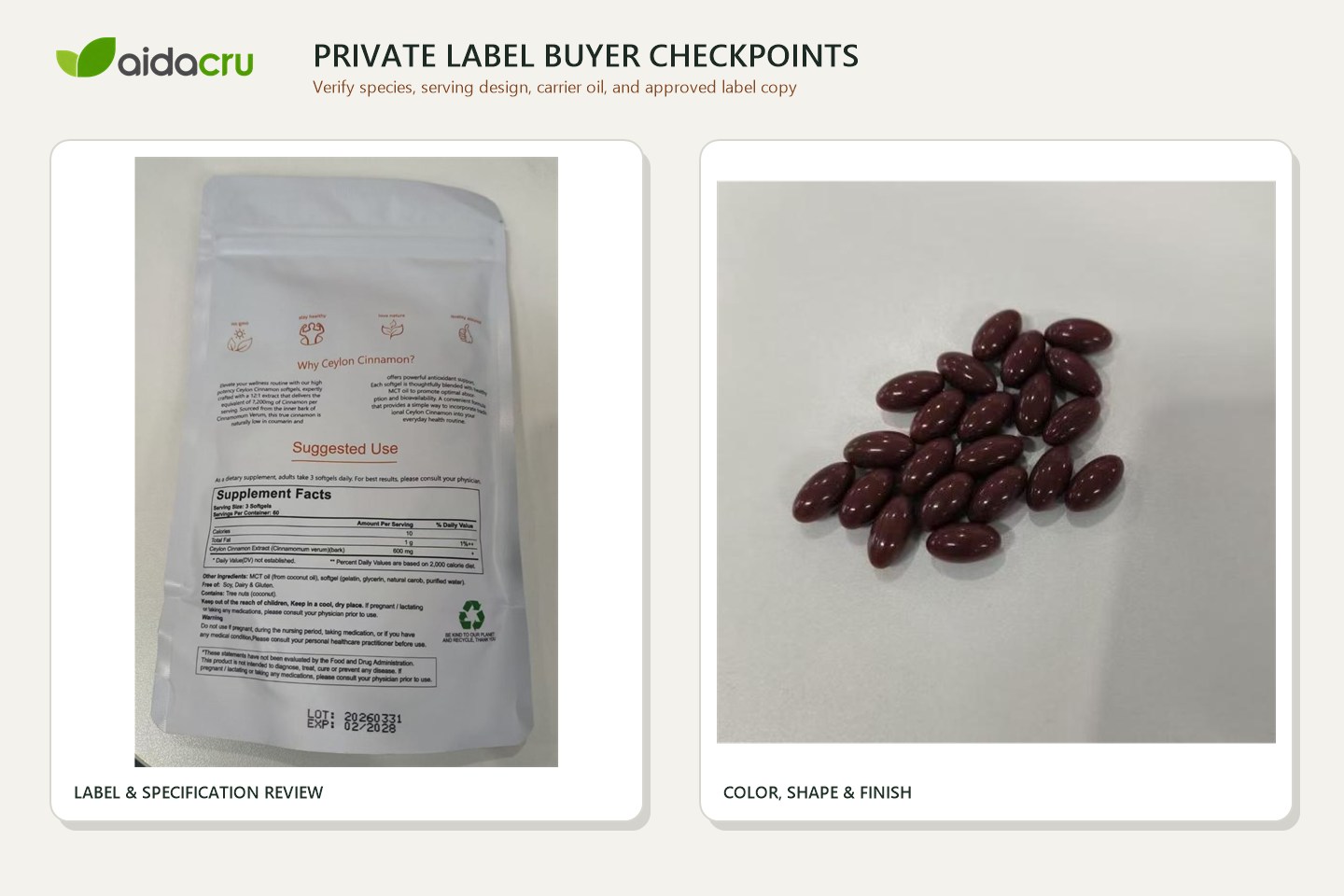
- Evaluate physical samples for size, appearance, odor, swallowability, pouch or bottle fit, and label presentation.
- Approve formula, component specifications, finished-product specifications, packaging artwork, and test plan.
- Approve the production sample and written order terms before bulk manufacture.
- Review finished-batch documentation and release requirements before shipment.
Frequently Asked Questions
What makes a cinnamon softgel a Ceylon cinnamon product
The approved raw-material identity should support the Ceylon cinnamon species named in the specification and label. A front-panel name without matching identity documentation is not enough for supplier approval.
Is a 10 to 1 extract the same as a standardized assay
No. An extract ratio describes a manufacturing relationship between starting material and extract. An assay describes a measured compound or marker level. Buyers should request the exact specification used for the formula.
Why is MCT oil used in a softgel
MCT oil may be used as a carrier in an oil-based softgel system. The supplier should confirm its source, quantity basis where relevant, compatibility, allergen review, and declaration on the finished label.
What should be tested before a private label order
The test plan depends on the formula and market. Buyers commonly review identity and component documentation, microbiological limits, applicable contaminants, finished-product specifications, fill count, and label reconciliation.
Can the pouch be changed to a bottle
Packaging can usually be evaluated as a separate project variable. Bottle size, closure, label dimensions, count, light and moisture protection, shipping conditions, and commercial quantity can change cost and timing.
What is the MOQ for Ceylon cinnamon softgels
The earlier project brief used a reference entry quantity, but the final MOQ must be confirmed for the current formula, package, label, material availability, and production schedule.
How quickly can samples and bulk orders ship
Timing should be confirmed in the quotation. Existing stock, custom packaging, printed components, testing, release, destination documents, and freight method can all change the schedule.
Key Takeaways
- Approve botanical identity and specification details before approving the marketing name.
- Treat the pictured 180-count pouch as a sample snapshot, not a permanent stock promise.
- Match formula, label, tests, packaging, MOQ, and timing in one written approval set.
- Use a project-specific RFQ to obtain current commercial terms.
Related Aidacru Resources
Request the Current Specification and Samples
To evaluate Ceylon cinnamon softgels for your brand, send Aidacru your target market, estimated quantity, preferred packaging, label concept, and launch timeline. The team can then confirm the current specification, available sample batch, project-specific MOQ, documentation, pricing, and production schedule before you approve a purchase order.