


Quick answer: Working with one manufacturer can simplify documentation, version control, packaging coordination and launch planning across multiple formats. It does not mean one formula can be copied into every format. Gummies, powders, stick packs, capsules and liquids still need separate feasibility, samples, specifications and quality controls.
A growing supplement brand may start with one product and then expand the concept across several use occasions. A sleep platform might include a gummy, a capsule and a powder. A sports line may combine creatine powder, hydration sticks and a portable gummy. A women’s wellness line may use capsules for concentrated botanicals and powder for larger servings.
The operational question is whether to divide those products across suppliers or coordinate them through one manufacturing partner.
What Supplier Consolidation Can Improve
One manufacturer can create a shared operating system for:
- Product briefs
- Raw-material specifications
- Sample records
- Packaging versions
- Label files
- Quality documents
- Production schedules
- Shipment preparation
This can reduce duplicate communication and make it easier for the brand to compare products within one portfolio.
What Must Remain Format-Specific

Each dosage form has a different technical system.
| Format | Separate development questions |
|---|---|
| Gummy | Pectin or gelatin, sweetness, acid, active load, heat and sticking |
| Powder | Solubility, flavor, particle size, flow, density and moisture |
| Stick pack | Powder behavior, fill weight, film, sealing and carton |
| Capsule | Fill weight, capsule size, shell type and unit count |
| Liquid | Solubility, flavor, preservation, bottle and dispensing |
The brand can share positioning, color system and ingredient story, but it still needs a format-specific approved formula and reference sample.
One Concept Does Not Mean One Formula
Suppose a brand wants a magnesium-centered relaxation line. A powder may accommodate a larger serving. Capsules may avoid flavor. Gummies may need a lower load or different magnesium form to preserve taste and texture. Liquid development introduces solubility and preservation questions.
The formulas can belong to one product family without being identical.
Build a Master Product Architecture
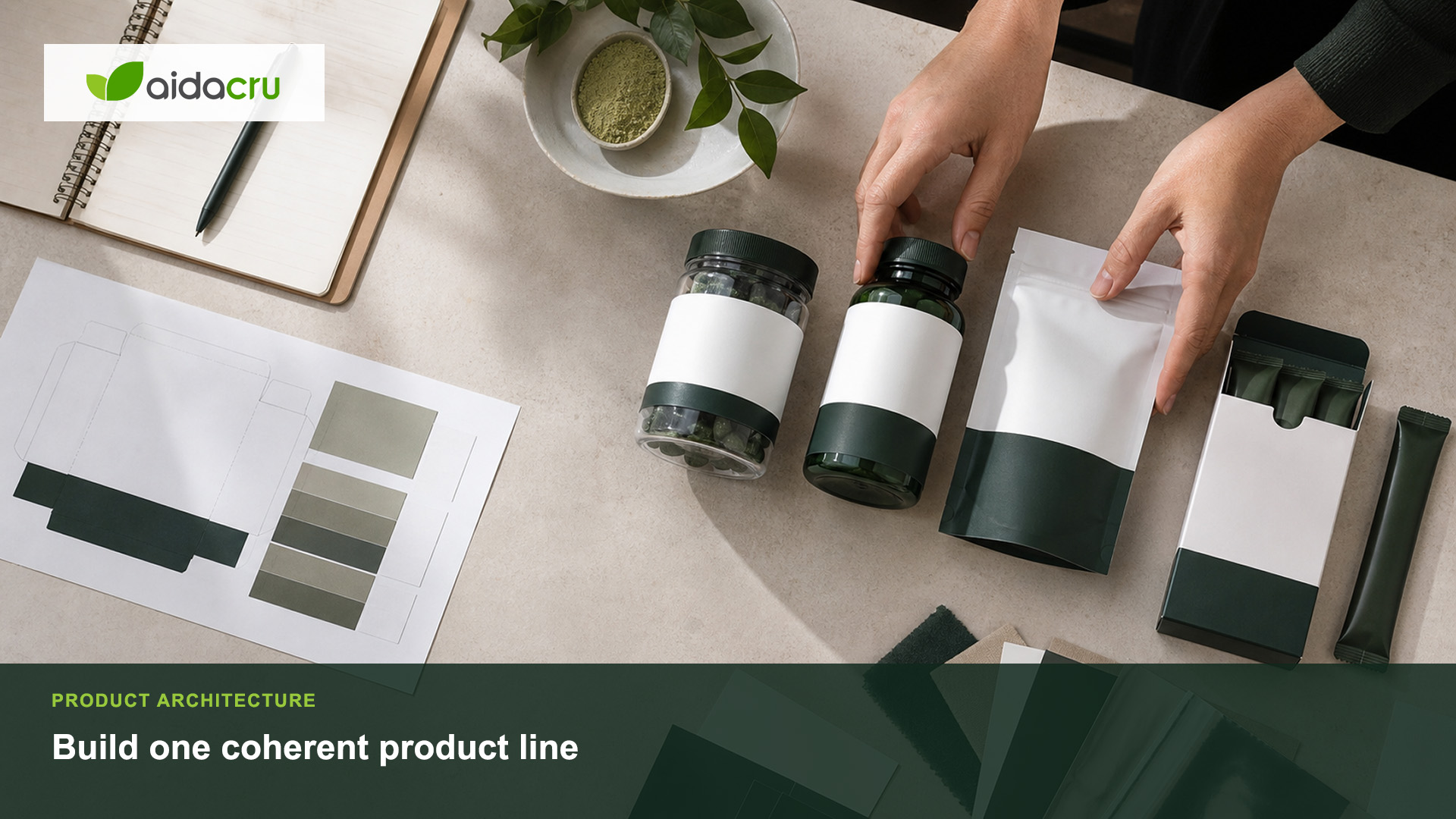
A master architecture should define:
- Brand-level product promise
- Role of each SKU
- Target consumer and use occasion
- Active ingredients and serving direction
- Dosage format
- Package and channel
- Claims boundary
- Launch sequence
This prevents a common problem: creating several formats that compete with one another without giving the consumer a reason to choose each one.
Decide Whether One Manufacturer Is the Right Fit
Strong fit
- The manufacturer can evaluate all required formats
- The brand wants coordinated documentation
- Products share a launch calendar
- Packaging needs a consistent system
- The brand values one technical communication path
Weak fit
- One format requires highly specialized equipment outside the manufacturer’s verified capability
- The brand needs a proprietary process held by another supplier
- The project would sacrifice technical quality only to reduce supplier count
- The manufacturer cannot provide clear format-specific records
Supplier consolidation should improve control, not hide capability gaps.
Coordinate Ingredients Without Assuming Equivalence
If several SKUs use the same named ingredient, confirm:
- Supplier and specification
- Grade and particle size
- Assay or standardization
- Allergen and origin information
- Suitability for the dosage form
- Label declaration
The same ingredient name may require different technical properties in a powder, gummy or liquid.
Packaging System Planning
A consistent portfolio does not require identical packages. It requires intentional hierarchy.
The brand can standardize:
- Logo and color roles
- Product naming
- Information hierarchy
- Claims review process
- Barcode and version control
- Case-mark structure
The package format can then change by use occasion: bottle for gummies, tub for powder, carton for sticks and dropper bottle for liquid.
Production and Launch Sequencing
Do not assume every SKU should launch on the same day. A controlled sequence may be safer:
| Phase | Product | Objective |
|---|---|---|
| Phase 1 | Anchor SKU | Validate positioning, channel and repeat-use behavior |
| Phase 2 | Complementary format | Add a new use occasion |
| Phase 3 | Bundle or travel format | Increase retention and average order value |
Parallel development can save calendar time, but artwork and production should follow written formula and sample approvals.
Quality-Control Questions
Ask the manufacturer:
- How are specifications separated by SKU?
- How are label and artwork versions controlled?
- Which tests apply to each dosage form?
- Can raw-material documents be mapped to the final formula?
- How are packaging components inspected?
- How are production and shipment records organized?
- Who owns final approval at each stage?
Risk Review
The main risks of a multi-format project are:
- Formula drift between concept and production
- Conflicting serving directions
- Inconsistent ingredient naming
- Packaging versions moving out of sync
- One SKU delaying the full launch
- Claims being copied across formats without evidence
- Inventory imbalance between formats
A shared project tracker should record owner, version, approval date and next action for every SKU.
Frequently Asked Questions
Is one manufacturer always better than several suppliers?
No. One manufacturer is useful when it has verified capability across the required formats and can improve coordination without reducing technical quality.
Can a gummy and powder use the same ingredient list?
They may share core ingredients, but amounts, excipients, flavor, processing and stability usually need separate development.
Does one manufacturer reduce MOQ?
It can simplify coordination, but each formula and packaging component can still have its own minimum. The complete project should be quoted by SKU.
Can all formats share one label design?
They can share a visual system. Supplement Facts, serving directions, warnings, net contents and package dimensions remain format-specific.
Should all products launch together?
Not necessarily. An anchor SKU followed by complementary formats can reduce inventory and positioning risk.
What should a brand send for a multi-format review?
Send the master product concept, SKU roles, ingredients, serving directions, formats, packaging, quantity ranges, markets and launch sequence.
Create One Portfolio Brief
Aidacru supports product-development discussions across gummies, powders, stick packs, capsules, tablets, softgels and liquids. The most efficient starting point is one master brief with separate SKU tables.
Related resources:
- Private Label Supplement Manufacturing Process
- Supplement OEM Quality Control Checklist
- One-Stop Service
- Contact Aidacru
Quality reference:
This article provides general B2B manufacturing information. Capabilities, tests and documents must be confirmed for the specific project.