

Quick answer: A credible GLP-1 companion nutrition line should be organized around ordinary nutrition routines rather than medication-like promises. Start with one clearly defined consumer need, choose a format that can carry the required serving, validate taste and tolerance, and build a second SKU only when it adds a distinct use occasion.
GLP-1 medications have created a new planning question for supplement brands: should the brand launch one broad “support” product or build a small system of complementary products? The better B2B answer is usually a focused product architecture. Each SKU should have one understandable role, a feasible serving size and a compliant reason to exist.
This guide is not another trend overview. It is a practical product-line planning framework for brand founders, product managers and private-label buyers evaluating powders, stick packs, capsules, gummies and bundled routines.
Compliance boundary: Dietary supplements should not claim to treat medication side effects, replace prescription products, reproduce drug effects or guarantee outcomes. Consumers using prescription medication should discuss supplements and persistent symptoms with a qualified healthcare professional.
Start With Consumer Routines, Not a Long Ingredient List
The first product-line decision is not which ingredients are popular. It is which routine the brand wants to support. A useful brief identifies the user, the use occasion and the practical obstacle the product is designed around.
| Product-line role | Consumer routine | Formats to evaluate | Main manufacturing question |
|---|---|---|---|
| Daily protein or amino-acid routine | Convenient nutrition when regular meals feel difficult | Powder, stick pack, ready-to-mix sachet | Can the serving fit the format and still taste acceptable? |
| Hydration routine | Portable fluid and electrolyte use | Powder, stick pack, tablet | Are mineral level, sweetness, solubility and film barrier aligned? |
| Fiber routine | Gradual daily fiber intake | Powder, stick pack, capsule | Is the serving practical and are directions clear? |
| Micronutrient routine | Daily nutrient coverage | Capsule, tablet, gummy, powder | Does the formula remain readable, stable and easy to use? |
| Active-lifestyle routine | Protein, creatine or other sports-nutrition habits | Powder, stick pack, capsule, selected gummy concepts | Can the active dose fit without excessive servings? |
The table is a planning tool, not a medical recommendation. Ingredient selection, serving size and warnings require formula-specific review.
Build a Three-Layer Product Architecture
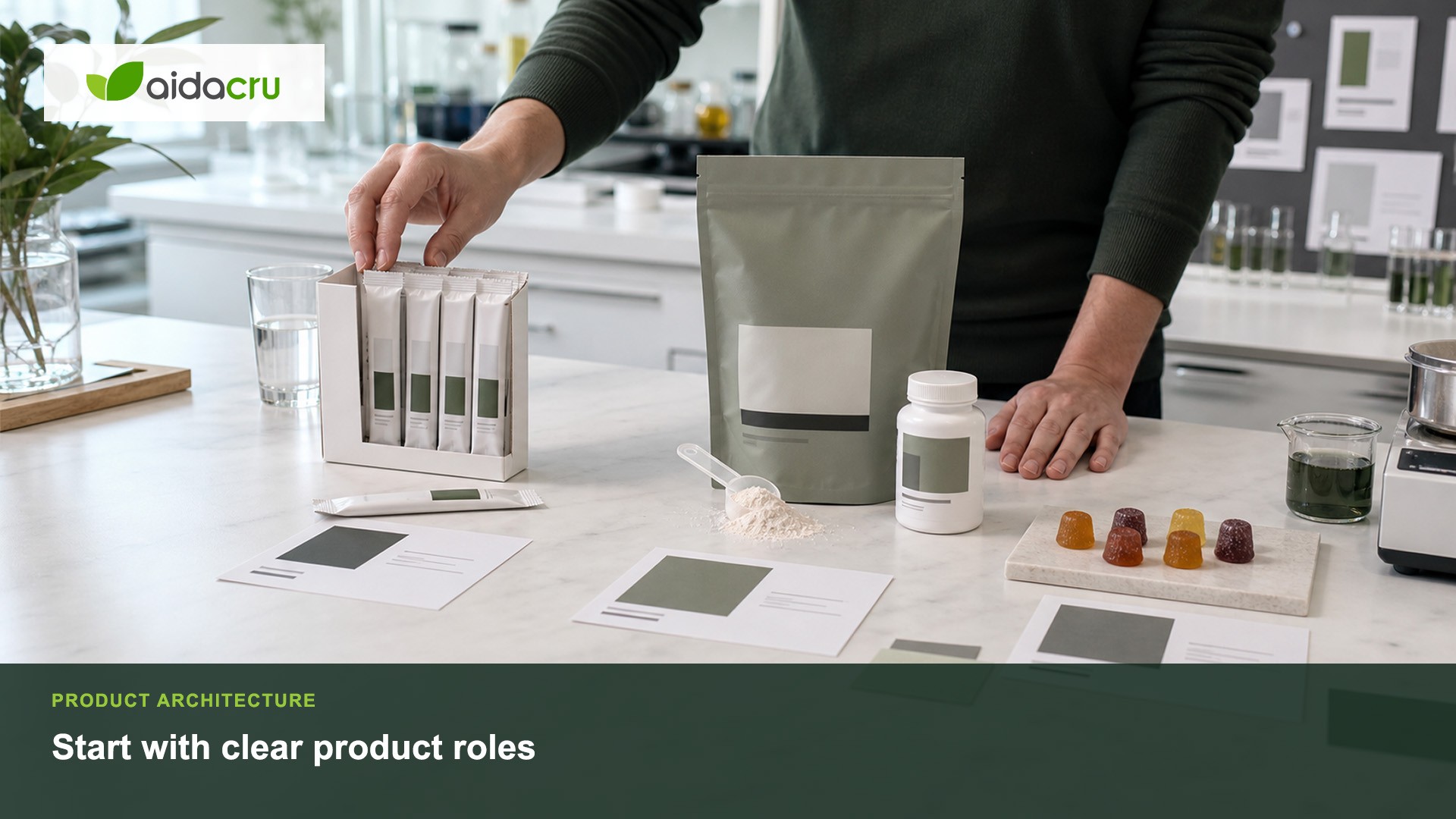
Layer 1: The anchor product
The anchor SKU should solve the clearest routine problem and be easy to explain in one sentence. It may be a hydration stick, a daily powder or a capsule-based nutrition product. The format must support the active load, target cost and channel.
Layer 2: The complementary product
The second SKU should add a different use occasion rather than repeat the first product in another bottle. A morning powder and a meal-time capsule may be more coherent than two powders with overlapping ingredient stories.
Layer 3: The retention product
The third SKU should strengthen repeat use, portability or subscription value. Single-serve sticks, travel packs or a simplified bundle can support this role, but only after the first products have clear specifications and stable economics.
Decide Which SKU Should Launch First
A first launch should score well across five criteria:
- The consumer can understand the use occasion quickly.
- The serving fits the chosen dosage format.
- Flavor and texture risks can be tested during sampling.
- Packaging works for the sales channel.
- The claims can stay within ordinary nutrition-support language.
A large all-in-one formula can appear attractive on a concept board but become difficult when the required serving, taste, ingredient compatibility and packaging cost are calculated. A narrower first SKU often produces a cleaner label and a more useful market test.
Match Formula Role to Dosage Format
Powders
Powders are often the most flexible route for gram-level ingredients, protein, fiber and hydration concepts. The tradeoffs are flavor masking, scoop or sachet accuracy, powder flow, moisture protection and a larger package.
Stick packs
Stick packs create a clear single-use routine and can work well for travel, subscriptions and creator demonstrations. They require film selection, seal validation, powder-flow control and a fill weight that fits the chosen stick dimensions.
Capsules and tablets
Capsules can support concentrated ingredients and avoid flavor problems, but high serving weights may require multiple units. The buyer should confirm capsule count, shell type and consumer-use directions before approving the concept.
Gummies
Gummies provide strong visual and sensory differentiation. They also have lower active-loading capacity and introduce pectin or gelatin selection, sweetness, acid balance, moisture, heat and sticking considerations. Gummies should be chosen because the formula fits the format, not only because the format is popular.
Plan the Line as One System, Then Validate Each SKU Separately

A shared product-line concept can use consistent colors, naming and buyer positioning. The technical work still has to be completed by SKU.
Each format needs its own:
- Formula and serving-size assessment
- Raw-material specification review
- Flavor or swallowing assessment
- Packaging compatibility review
- Sample approval record
- Finished-product specifications
- Label and claims review
- Stability and quality plan
Changing a powder into a gummy is not a packaging change. It is a new dosage-form development project.
Packaging and Channel Planning
Amazon-oriented products need clear version control, readable labels and packaging that tolerates parcel fulfillment. DTC subscriptions may benefit from daily sticks or coordinated bundles. Retail projects may require different shelf dimensions, case packs and barcode workflows.
Before sampling, send the manufacturer:
- Target country and sales channels
- Intended consumer and use occasion
- Preferred format
- Ingredient and serving direction
- Packaging concept
- First-order quantity range
- Required documentation
- Target launch date
This information helps separate an attractive concept from a manufacturable launch plan.
Compliance-Safe Positioning
Use language about ordinary dietary routines and product characteristics. Examples include “supports daily hydration,” “supports protein intake,” “designed for a convenient nutrition routine” and “formulated for active adults.”
Avoid statements that a supplement:
- Treats nausea, constipation or another medication adverse reaction
- Prevents muscle loss
- Works like semaglutide or tirzepatide
- Enhances the effect of prescription medication
- Allows a consumer to stop medical treatment
The final label, product page, advertisements and creator scripts should be reviewed together. A compliant bottle cannot correct an impermissible marketplace listing.
A Practical Development Sequence
| Stage | Brand decision | Manufacturer output |
|---|---|---|
| Product architecture | Define anchor, complementary and retention roles | Format and feasibility comments |
| Formula brief | Confirm ingredients, serving, exclusions and market | Preliminary specification and sample route |
| Sample round | Evaluate taste, texture, use and packaging | Reference sample and change log |
| Commercial review | Confirm unit economics and first-order scope | Quotation, packaging plan and production assumptions |
| Label review | Lock claims, directions and warnings | Final formula and documentation package |
| Production | Approve formula, sample and artwork versions | Batch, packaging and release records |
Questions to Ask a Manufacturer
- Which proposed ingredients create serving-size or flavor problems?
- Which format gives the cleanest first launch?
- What changes when the same concept moves to a second format?
- Which packaging components have separate minimums?
- What testing and documentation are available for this formula?
- Which claims require additional substantiation or legal review?
Frequently Asked Questions
What is a GLP-1 companion nutrition product?
It is a dietary supplement or nutrition product positioned around everyday routines such as hydration, protein intake or general nutrient intake for a defined audience. It should not claim to replace medication or treat adverse reactions.
Should a new brand launch a bundle first?
Usually only when each component has a clear role and the brand can manage multiple specifications, packaging components and inventory positions. One strong anchor SKU is often easier to validate.
Which format is best for a GLP-1 companion line?
There is no universal best format. Powders and stick packs can accommodate larger servings, capsules avoid flavor issues, and gummies support sensory differentiation when the active load fits.
Can one formula be produced as a powder and a gummy?
The concept may be related, but the formula cannot normally be copied directly. Serving capacity, excipients, taste, processing and stability must be reassessed.
Can the product claim to reduce medication side effects?
Dietary supplement marketing should not claim to treat medication adverse reactions. Final wording requires market-specific regulatory review.
What information is needed for an OEM review?
Provide the target market, consumer, product role, ingredients, serving size, format, packaging, quantity range, required documents and launch timing.
Build the Product Line With Clear Inputs
Aidacru can review a proposed GLP-1 companion nutrition architecture across powders, stick packs, capsules, tablets and gummies. Start with the anchor-product role, serving direction, market and packaging rather than a long unprioritized ingredient list.
Related resources:
Regulatory references:
This article provides general B2B product-development information and is not medical or legal advice.