
Short Answer
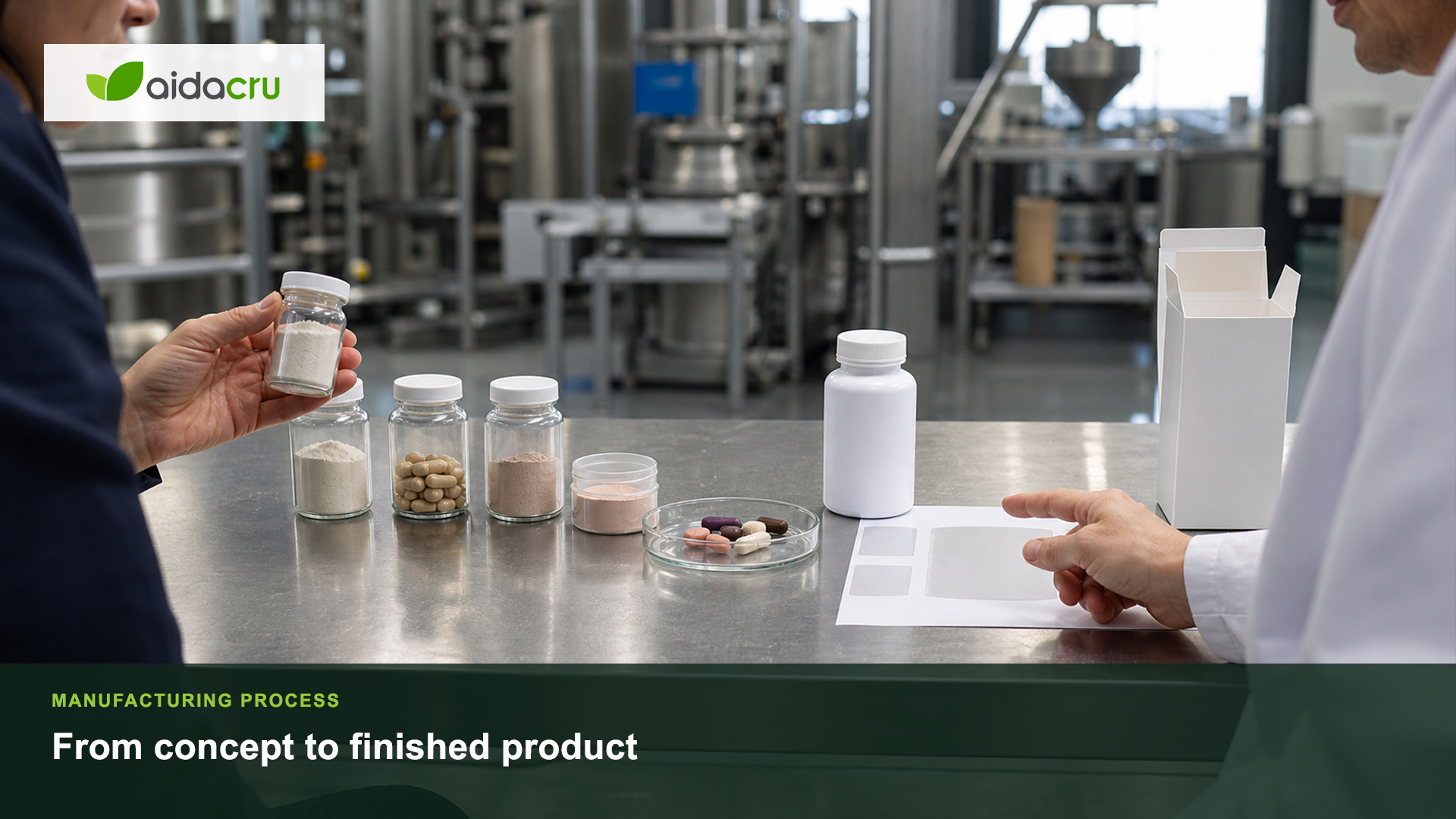
Private label supplement manufacturing usually moves from product concept to dosage form selection, formula direction, sample development, packaging preparation, production planning, quality checks and packing support. The process is faster when buyers prepare target market, product category, dosage form, formula direction, packaging style and estimated order quantity before sample development.
Aidacru helps supplement brands develop private-label products from formula planning to sample development, packaging and bulk production across capsules, gummies, powders, stick packs, tablets, liquids and softgels.
Process Timeline Table
| Stage | Buyer Decision | Manufacturer Role | Main Output |
|---|---|---|---|
| 1. Product concept | Target customer, sales channel, product category | Clarify feasibility and development route | Product brief |
| 2. Dosage form | Capsule, gummy, powder, stick pack, tablet, liquid, softgel | Explain format tradeoffs | Format direction |
| 3. Formula direction | Ingredient idea, serving size, flavor needs | Suggest formula route and sample feasibility | Sample formula direction |
| 4. Sample development | Taste, texture, appearance feedback | Produce and adjust prototypes | Approved sample reference |
| 5. Packaging preparation | Bottle, pouch, jar, carton, stick pack | Support packaging proof and format matching | Packaging confirmation |
| 6. Production planning | Quantity, timeline, launch target | Plan materials, MOQ and production schedule | Production plan |
| 7. QC and final checks | Confirm sample, label and packaging | Review process and finished goods | Shipment-ready order |
| 8. Packing/export support | Carton and delivery needs | Prepare packing and documents where applicable | Handoff for shipping |
What Buyers Usually Delay
Many delays come from decisions that seem small at the start but become critical later.
| Delayed Item | Why It Causes Problems | Better Timing |
|---|---|---|
| Target market | Claim wording, packaging and import needs may vary | Before formula direction |
| Dosage form | Affects formula, MOQ, sample and packaging | Before sample development |
| Flavor preference | Important for gummies, powders and liquids | Before first sample |
| Packaging style | Affects materials and filling method | During sample discussion |
| Label proof | Late artwork changes can delay production | Before production planning |
| Quantity target | MOQ cannot be discussed accurately without it | Before RFQ |
| Launch date | Unrealistic timing creates pressure and errors | At project start |
What to Prepare Before Sample Development
Before asking for samples, prepare:
Product concept and target customer.
Sales channel: Amazon, Shopify/DTC, distributor, retail or global buyer.
Preferred dosage form.
Core ingredient direction or reference product.
Flavor direction if relevant.
Serving size expectation.
Packaging preference.
Estimated first order quantity.
Target sample review date.
Claim and label wording concerns.
This makes sample development more focused and reduces unnecessary revisions.
Step 1: Define the Product Concept
A supplement project should begin with a clear customer routine. Is the product for sports nutrition, beauty-from-within, women's wellness, digestive health, hydration support, sleep support or another product direction? Is the buyer testing a first SKU or expanding a product line?
This business context shapes every manufacturing decision that follows.
Step 2: Choose the Dosage Form
Dosage form affects formula feasibility, packaging, content marketing, MOQ and customer experience. A gummy project is different from a powder project. A softgel project is different from a stick pack project.
This article should internally link to the dosage form article with anchor text such as "how to choose the right supplement dosage form" so readers can compare capsules, gummies, powders, stick packs, tablets, liquids and softgels in more detail.
Step 3: Plan Formula Direction
Formula direction includes core ingredients, supporting ingredients, serving size, taste and texture expectations, and compliance-aware positioning. Buyers do not need a finished formula to begin, but they should know the category and intended customer.
Step 4: Develop and Review Samples
Samples help the buyer evaluate whether the concept feels realistic. For gummies, powders and liquids, feedback should cover taste, sweetness, texture, color and usage experience. For capsules, tablets and softgels, feedback may focus more on size, appearance and packaging fit.
Step 5: Prepare Label and Packaging
Packaging should be reviewed before bulk production. Buyers should confirm packaging format, label proof, artwork version, pack size, carton needs and any target-market review requirements. Packaging errors are avoidable when label proof and packaging files are confirmed early.
Step 6: Plan Production
Production planning includes MOQ, raw materials, packaging materials, production schedule and final confirmation. Buyers should avoid late formula or packaging changes at this stage.
Step 7: Quality Control and Final Checks
This article should internally link to the quality control article with anchor text such as "supplement OEM quality control checklist." Quality checks may include raw material review, in-process checks, packaging verification, label confirmation and finished product inspection.
Step 8: Packing and Export Preparation
Packing and export preparation may include carton organization, batch organization, shipping preparation and documents where applicable. Global buyers should confirm import requirements for their target market before placing an order.
Buyer Checklist
Product category defined.
Target market defined.
Sales channel selected.
Dosage form selected or comparison requested.
Formula direction prepared.
Flavor requirements noted.
Packaging preference prepared.
Quantity target estimated.
Sample review timeline set.
Label and claim review needs identified.
Infographic Concept
Title: "From Supplement Idea to Finished Product"
Layout: Left-to-right workflow with eight steps: Product Concept -> Dosage Form -> Formula Direction -> Sample Development -> Packaging Proof -> Production Planning -> QC Checks -> Packing/Shipping Prep.
Use icons for market brief, capsule/gummy/powder formats, beaker/formula sheet, sample tray, label proof, calendar/MOQ sheet, checklist, carton.
FAQ
What is the first step in private label supplement manufacturing?
The first step is defining the product concept, target market, sales channel and intended dosage form.
What should I prepare before sample development?
Prepare product category, target customer, dosage form, ingredient direction, flavor preference, packaging idea, estimated quantity and timeline.
When should packaging be discussed?
Packaging should be discussed during sample planning, not after production planning, because it affects MOQ, materials and product presentation.
What usually delays a supplement manufacturing project?
Common delays include unclear target market, late formula changes, delayed label proof, packaging uncertainty and unrealistic launch timelines.
Can a new brand start without a final formula?
Yes. A new brand can start with target market, category and product direction, then discuss ODM or private label development support.
How does QC fit into the process?
QC should be considered before production, including sample reference, label proof, packaging verification and finished product checks.
Related Buyer Guides
- Compare supplement dosage forms
- Review the OEM quality-control checklist
- See Aidacru private-label manufacturing capabilities
Discuss Your Supplement Project
Send Aidacru your product concept, target market, preferred dosage form, estimated order quantity, packaging direction and sample timeline. We can help you discuss formula direction, sample development, MOQ and production planning.
Key Takeaways
Manufacturing starts with a clear product concept, not production.
Dosage form and packaging should be decided early.
Sample feedback should be specific.
Late formula and label changes create delays.