

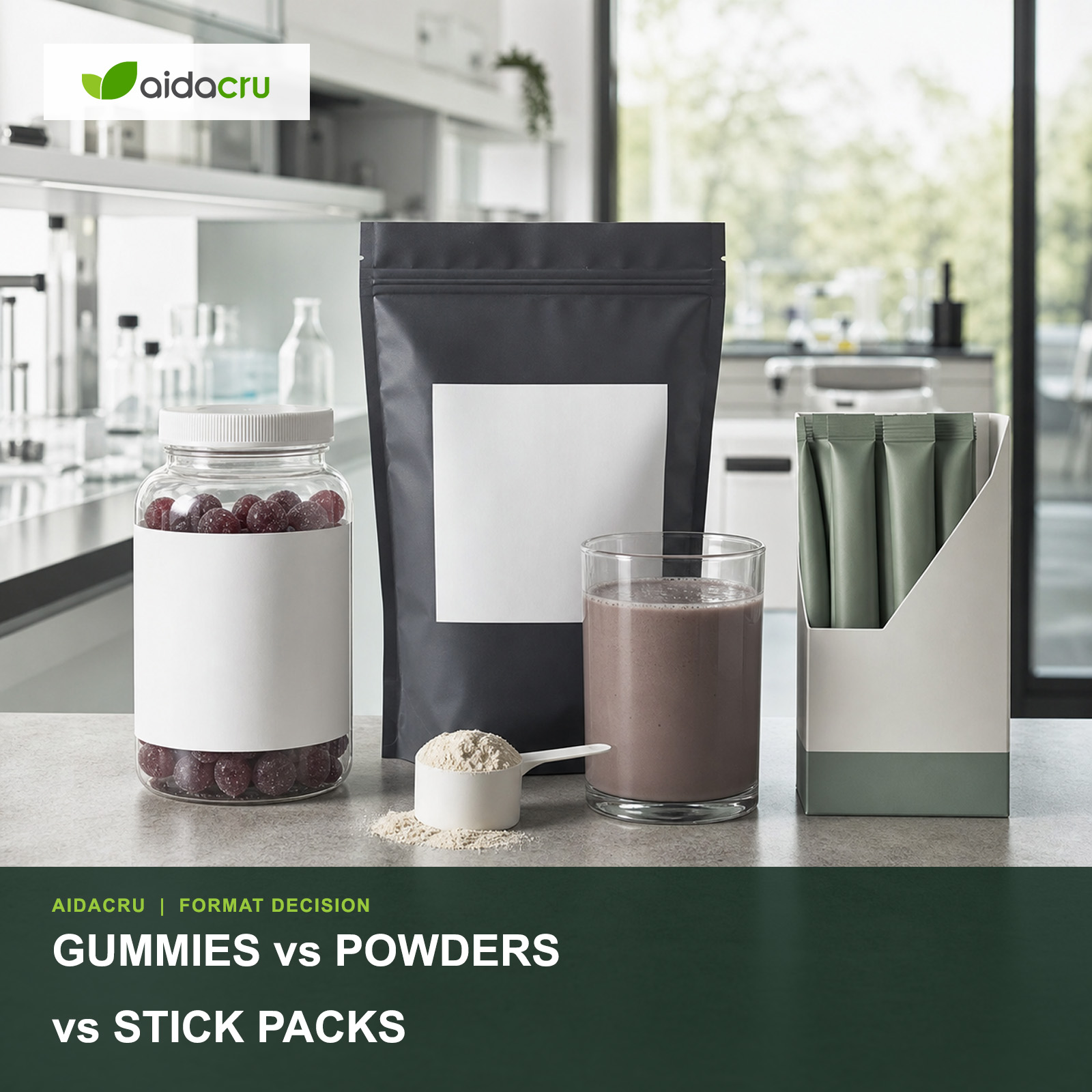
Quick answer: Choose gummies when sensory experience and format differentiation matter, powders when the formula needs larger servings, and stick packs when single-serve portability justifies additional packaging complexity. The correct decision depends on dose capacity, flavor, moisture, unit economics and sales channel.
Brand founders often choose a dosage form from consumer preference alone. Manufacturers have to evaluate a different set of questions: will the serving fit, can the product be processed consistently, will the flavor remain acceptable, does the package protect the formula, and can the final unit reach the target margin?
This guide narrows the decision to three highly visible private-label formats: gummies, powders and stick packs.
Buyer Decision Table
| Decision factor | Gummies | Powder tubs or pouches | Stick packs |
|---|---|---|---|
| Active capacity | Lower | Highest of the three | Moderate to high, limited by stick dimensions |
| Consumer routine | Chewable, no mixing | Scoop and mix | Tear, pour and mix |
| Flavor role | Central to product experience | Important for repeat use | Important and concentrated in one serving |
| Portability | Good | Lower | Excellent |
| Packaging complexity | Bottle, jar or pouch | Tub or pouch plus scoop | Printed film, filling and carton |
| Moisture risk | Texture and sticking | Clumping and flow | Clumping plus seal integrity |
| Visual content | Strong product close-ups | Strong mixing demonstration | Strong travel and daily-routine content |
| Best-fit concepts | Lower-dose actives and lifestyle products | Protein, fiber, hydration and gram-level actives | Hydration, daily powders and scheduled routines |
This table is directional. Formula-specific feasibility takes priority.
When Gummies Make Sense

Gummies create a direct sensory experience. The consumer sees the shape and color, tastes the formula and can use it without water. This supports lifestyle positioning, repeat-use routines and social content.
Gummies are strongest when:
- The target active load fits a practical serving
- The audience values chewable convenience
- Flavor and appearance are part of the brand concept
- The shipping route and package can protect texture
- The brand accepts a more involved sample process
Main constraints include active capacity, sweetness, acid balance, heat exposure, moisture, sticking and the number of gummies per serving.
When Powders Make Sense
Powders provide more room for gram-level ingredients and multi-ingredient blends. They can be sold in tubs, jars or pouches and can support flavored or unflavored concepts.
Powders are strongest when:
- The formula needs a larger serving
- Mixing is acceptable to the target consumer
- The product belongs in sports nutrition, hydration, protein, fiber or daily drink routines
- The brand wants flexible serving architecture
Main constraints include taste masking, solubility or dispersibility, scoop accuracy, powder flow, clumping, package barrier and package size.
When Stick Packs Make Sense
Stick packs turn a powder into a measured, portable use occasion. They can support subscriptions, travel, workplace routines and sample kits.
Stick packs are strongest when:
- A single measured serving is valuable
- Portability supports the brand promise
- The fill weight fits a practical stick size
- The unit economics can absorb film and carton costs
- The brand wants a clear daily or event-based routine
Main constraints include film selection, sealing, powder flow, fill accuracy, print version control and secondary packaging.
Compare the Same Formula Across Formats

Consider a hydration concept. A powder tub may carry a larger serving and offer lower packaging cost per serving. A stick pack may cost more but improve portability and serving accuracy. A gummy may create a distinctive experience but cannot simply carry the same mineral load without changing serving count and sensory design.
The concept can remain consistent while the formula architecture changes.
| Project example | Likely first format | Why |
|---|---|---|
| High-serving creatine product | Powder | Gram-level serving is easier to deliver |
| Travel electrolyte routine | Stick pack | Measured portability supports the occasion |
| Lower-dose beauty or lifestyle concept | Gummy | Sensory and visual differentiation can lead |
| Fiber-focused daily product | Powder or stick pack | Serving size and water use matter |
| Multi-flavor launch test | Gummy or stick pack | Flavor variants are easy to communicate but need separate validation |
MOQ Is Not Determined by Format Alone
MOQ can be affected by:
- Formula type and raw-material minimums
- Custom flavor and color
- Printed packaging minimums
- Gummy mold or shape
- Stick-pack film and carton
- Testing and documentation
- Number of SKUs or flavors
A low finished-product quantity does not automatically eliminate component minimums. Ask for a packaged-unit quotation rather than only a bulk-product number.
Packaging and Shipping Questions
Gummies
Discuss bottle or pouch barrier, desiccant, headspace, heat exposure and fulfillment conditions.
Powders
Discuss moisture barrier, scoop, induction seal, fill volume, powder density and package opening size.
Stick packs
Discuss film structure, seal width, stick dimensions, tear notch, print colors, carton count and transit protection.
Channel Fit
Amazon buyers often need packaging that survives parcel fulfillment and clearly communicates serving count. DTC brands may prioritize subscription convenience and visual storytelling. Retail requires shelf dimensions, case packs and barcode coordination. Sampling programs may favor sticks or small pouches.
Choose the format with the complete buyer path in mind.
Format Selection Scorecard
Score each candidate from 1 to 5:
- Dose fit
- Taste feasibility
- Consumer convenience
- Packaging cost
- Shipping resilience
- Channel fit
- Content potential
- Repeat-use clarity
The highest total is not automatically the winner. Dose feasibility and compliance are gate criteria.
Frequently Asked Questions
Are gummies more expensive than powders?
They often have a different cost structure because of gummy processing, finishing and packaging. The final comparison should use cost per labeled serving.
Are stick packs the same as powder pouches?
Both contain powder, but stick packs provide individual measured servings and require dedicated film, filling and sealing.
Which format supports the largest active serving?
Powders usually provide the most flexibility for gram-level servings. Formula density, flavor and package size still matter.
Can the same formula be used in all three formats?
Usually not without changes. Gummy processing, powder flow and stick-pack filling require different excipients, sensory design and validation.
Which format has the lowest MOQ?
MOQ depends on formula and packaging components, not only dosage form. A stock package may support a lower entry quantity than custom printed components.
Which format is best for Amazon?
All three can work. The decision depends on serving, package durability, listing clarity, shipping cost and competitive positioning.
Send a Format-Ready Brief
Share the target market, active ingredients, amount per serving, flavor, format options, package direction, quantity range and launch channel. Aidacru can then compare the formats against manufacturing feasibility rather than popularity alone.
Related resources:
- How to Choose the Right Dosage Form for Your Supplement Brand
- Electrolyte Powder and Stick Pack Manufacturer Guide
- Supplement Product Solutions
- Contact Aidacru
This article provides general B2B manufacturing information. Final formula, specifications, claims and packaging require project-specific review.