

Supplement Stability Study Guide: What Brands Should Define Before Claiming Shelf Life
Date: 2026-08-03 Categories: Supplement Blog Hits: 209
Accelerated stability is a stress test. It is not a time machine.
Elevated temperature and humidity can reveal some risks faster, but a short accelerated study does not automatically convert into a guaranteed number of months for every formula, dosage form, or package.
Before choosing chamber conditions, define the product, the likely failure modes, the final retail package, the distribution environment, and the acceptance criteria.
What a Shelf-Life Plan Must Establish
A useful supplement stability program starts with the final formula, representative manufacturing process, intended package, storage and distribution conditions, product-specific test attributes, time points, methods, and written acceptance criteria.
Accelerated data may help identify risk, compare options, or support a scientifically justified model. Long-term data show how the product behaves under the intended storage condition. They answer related but different questions.
There is no single universal stability panel for powders, gummies, capsules, tablets, softgels, and liquids. Each dosage form can fail differently, and each formula-package combination needs its own rationale.
The Regulatory Boundary for U.S. Dietary Supplements
FDA’s dietary supplement CGMP rule in 21 CFR Part 111 does not prescribe one universal accelerated or long-term stability protocol for every dietary supplement. The rule does address specifications, holding conditions, reserve samples, and recordkeeping. FDA’s Small Entity Compliance Guide states that reserve samples are held for one year past the shelf-life date when shelf-life dating is used, or for two years from distribution of the last associated batch when it is not.
FDA’s new dietary ingredient guidance also describes supportive stability data when an NDI notification includes an expiration or use-by date. That guidance applies to its specific context and should not be presented as a universal formula for all supplements.
ICH Q1A(R2) is a widely used pharmaceutical stability framework that distinguishes long-term, intermediate, and accelerated studies. It is technically useful, but it is not automatically a dietary supplement legal requirement. Copying drug conditions without a product-specific rationale can create a study that looks formal while answering the wrong commercial question.
Buyer action: have qualified quality and regulatory personnel define the program for the product and target market.
Define Failure Before Defining the Test
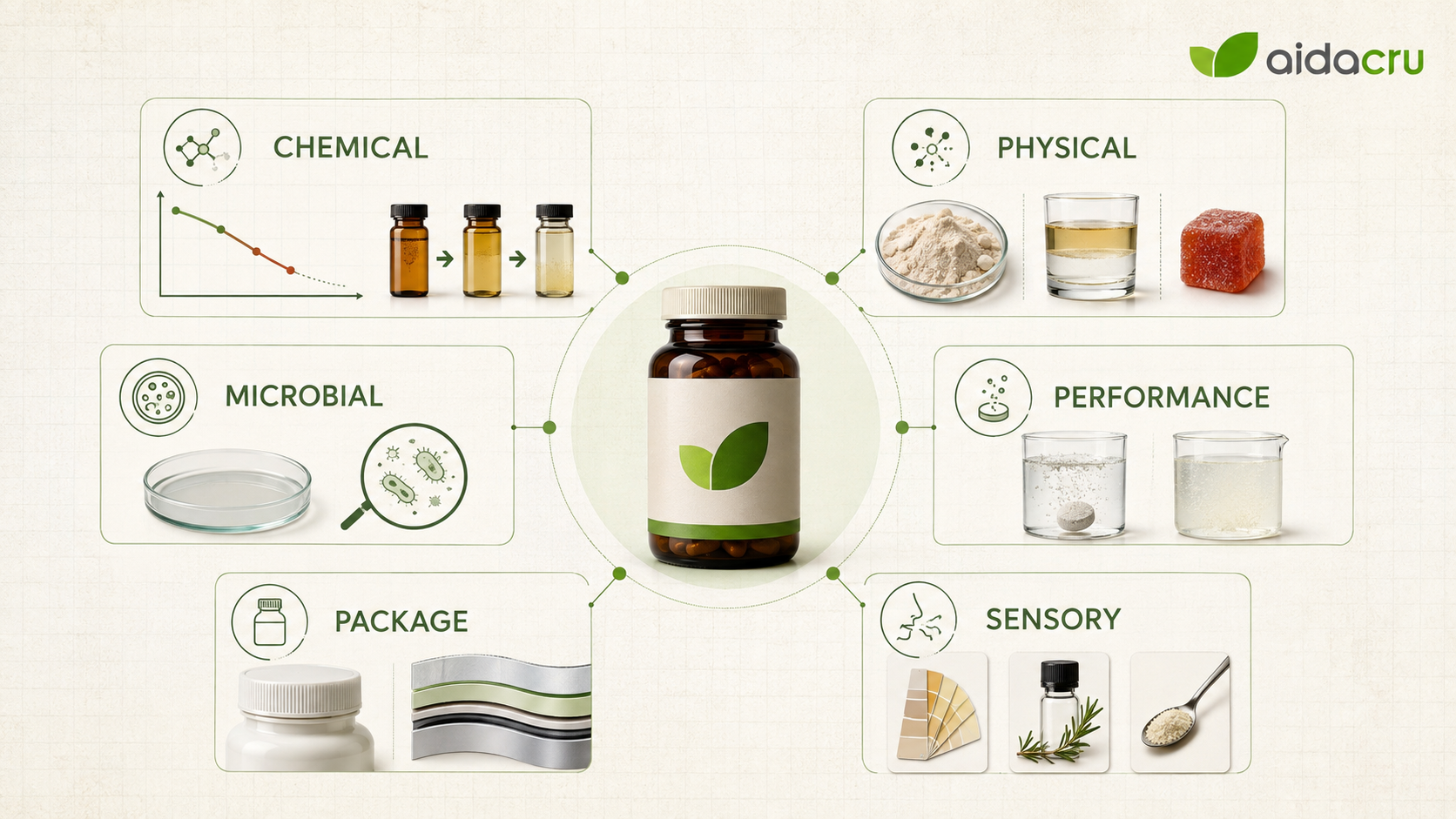
The most important early question is: What change would make this product unacceptable before the end of its intended shelf life?
The answer may include several categories:
- Chemical: assay loss, oxidation, degradation, or interaction between ingredients
- Physical: caking, separation, precipitation, leakage, hardening, softening, discoloration, or odor change
- Microbiological: failure to meet applicable limits or loss of preservation control where relevant
- Performance: disintegration, dissolution, dispersion, dose delivery, or reconstitution no longer meets the product requirement
- Packaging: seal, closure, barrier, headspace, or component interaction no longer protects the product as intended
- Sensory: flavor, aroma, appearance, or texture moves outside the approved range
If the team cannot define failure, it cannot define meaningful acceptance criteria.
Stability Attributes by Dosage Form
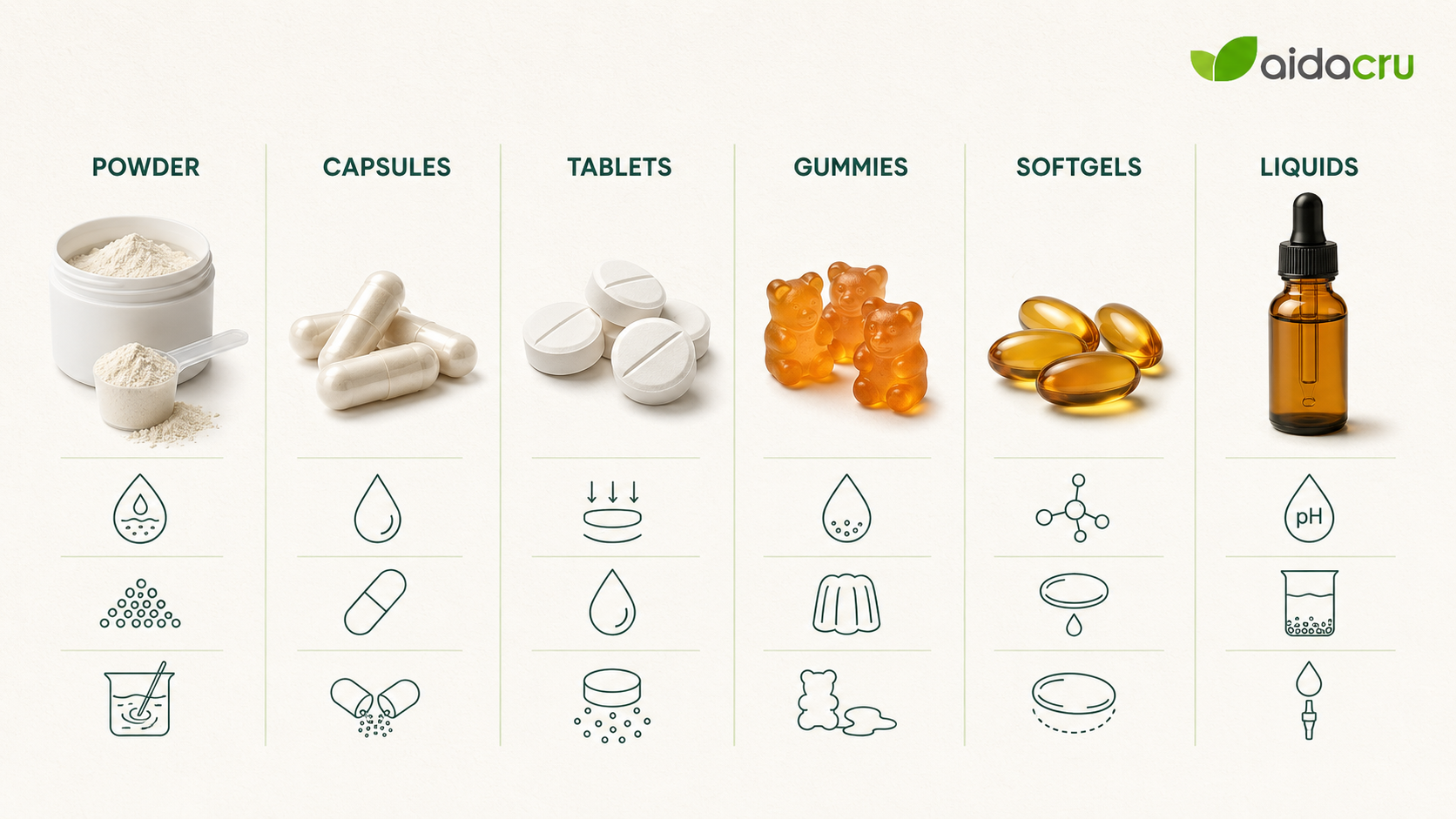
| Dosage form | Common attributes to consider | Typical buyer consequence |
|---|---|---|
| Powder or tub | Assay, moisture, water activity, caking, flow, dispersibility, flavor, color, microbiology where relevant | Poor scoopability, inconsistent experience, or a product that no longer meets specification |
| Stick pack | Powder attributes plus seal integrity, film barrier, dose delivery, and powder in seal area | Leaks, moisture pickup, or inconsistent packs |
| Capsule | Assay, moisture, appearance, shell behavior, fill condition, disintegration where relevant | Brittle or soft shells, appearance change, or performance drift |
| Tablet | Assay, moisture, hardness, friability, appearance, disintegration, and package interaction | Breakage, sticking, or unacceptable performance |
| Gummy or soft chew | Assay, water activity, moisture, texture, syneresis, sticking, color, flavor, microbiology where relevant | Hardening, softening, sweating, clumping, or sensory rejection |
| Oil-based softgel | Assay, peroxide value, p-anisidine value or other justified oxidation indicators, appearance, leakage, shell–fill compatibility | Rancidity risk, leakage, or shell changes |
| Liquid drops | Assay, pH, appearance, separation, precipitation, viscosity, oxidation, microbiology, dose delivery where relevant | Inconsistent dosing, sediment, color change, or unacceptable use experience |
This table is a planning prompt, not a mandatory test panel. Select attributes because they support a defined quality or commercial decision.
Eight Inputs for a Defensible Stability Protocol
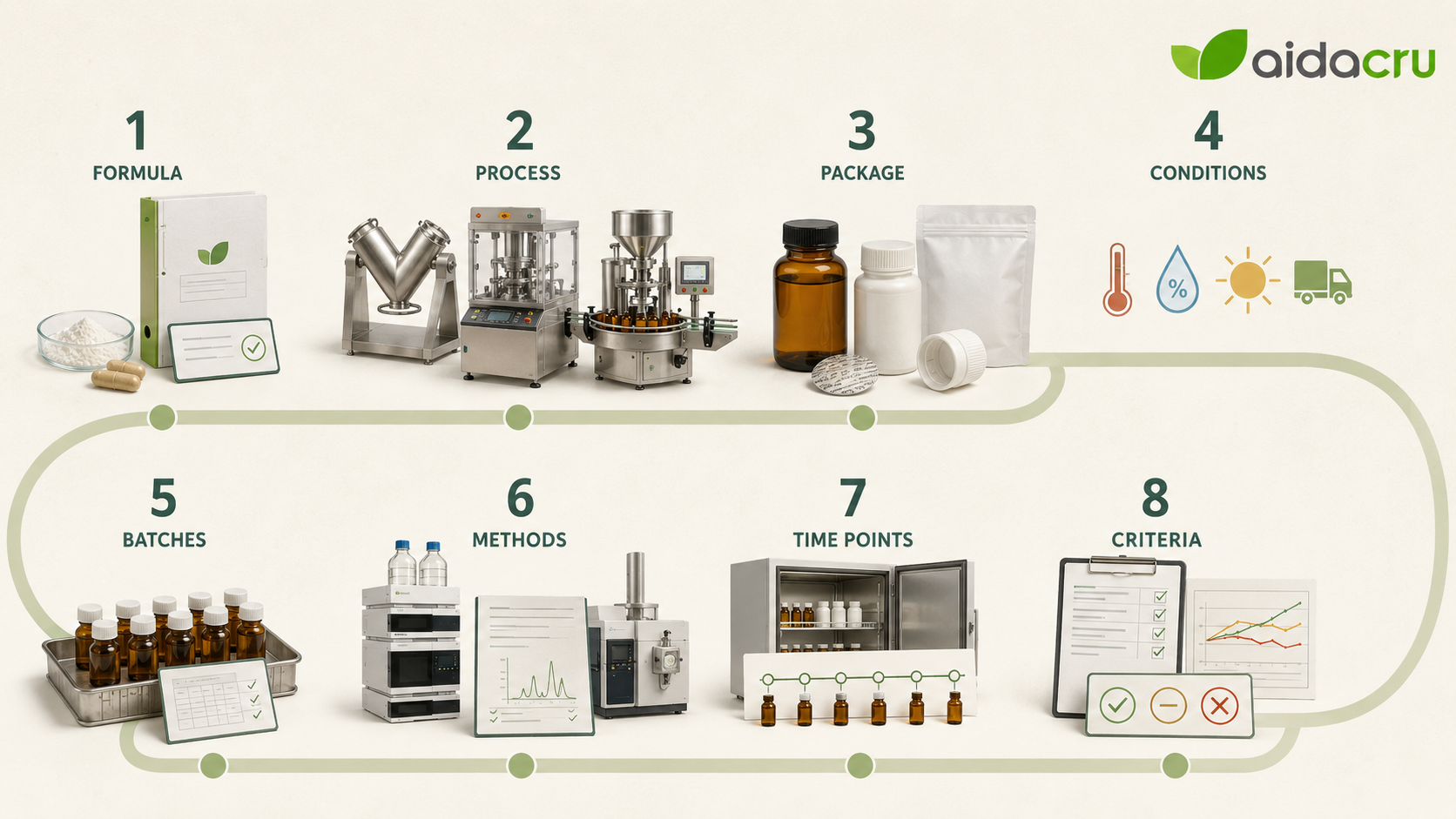
1. Final Formula Version
Use the formula that is intended for production, including raw-material grades, carriers, flavors, colors, sweeteners, excipients, and any justified overage. A bench formula that differs from the production formula produces limited evidence.
2. Representative Manufacturing Process
Mixing, heating, drying, compression, encapsulation, holding time, transfer, and fill conditions can influence stability. A sample made by a different process may not represent the finished product.
3. Final Retail Package
The bottle, pouch, stick-pack film, closure, liner, induction seal, desiccant, oxygen-management component, headspace, and fill count can affect exposure to moisture, oxygen, light, and handling.
Stability should not be inferred from package material names alone. Link the protocol to the actual package configuration.
4. Target Storage and Distribution Conditions
Define the labeled storage condition, climate exposure, shipping route, warehouse conditions, and consumer-use scenario that matter to the project. “Room temperature” may be too vague for a useful protocol.
5. Batches and Sampling Plan
Decide which batches enter the program, how representative they are, how many units are pulled at each time point, and how reserve units are handled. The rationale should match the development stage and intended claim.
6. Test Attributes and Methods
Select methods that can detect the expected change and produce results suitable for the decision. A release method is not automatically stability-indicating. The method, laboratory, sample preparation, and reporting basis should be defined.
7. Time Points and Storage Conditions
Choose long-term, accelerated, intermediate, refrigerated, freeze-thaw, photostability, transport, in-use, or other conditions only when they answer a justified question. Do not use a condition because it appears in another company’s template.
8. Acceptance Criteria and Decision Rules
Define what passes, what triggers investigation, what can be trended, and what requires a shelf-life, formula, process, or package decision. Avoid setting the rule after the results are known.
Accelerated and Long-Term Studies Answer Different Questions
Accelerated Study
An accelerated condition can help reveal sensitivity, compare formulations or packages, identify likely failure modes, and build a kinetic model when the degradation mechanism and data support it.
It does not automatically prove that one week equals a fixed number of months. Temperature, humidity, oxygen, light, physical transitions, packaging barrier, and reaction mechanism can interact nonlinearly.
Long-Term Study
Long-term data track the product under the intended storage condition. They are central to understanding actual change over the proposed shelf life.
The commercial challenge is timing: brands often want to launch before full long-term data are available. That does not justify an unsupported date. It requires a documented, risk-based strategy using the available formulation, package, prior knowledge, accelerated information, and ongoing data.
Intermediate or Additional Conditions
Intermediate, refrigerated, freeze-thaw, photostability, in-use, and distribution simulations may be appropriate for specific products. Each should have a defined purpose. Distribution testing does not replace chemical stability, and a leak test does not establish shelf life.
Do Not Use One “Acceleration Factor” for Every Supplement
Shelf-life prediction depends on the degradation mechanism. A chemical reaction may follow a useful kinetic model across selected temperatures. A gummy may undergo a physical transition. A powder may cross a moisture threshold. A softgel may experience both oil oxidation and shell interaction. A probiotic may lose viability through a different pattern.
If the stress condition changes the failure mechanism, the extrapolation may be misleading.
Buyer action: ask what model is being used, what assumptions it makes, whether those assumptions fit the product, and how predictions will be checked against long-term data.
When a Stability Assessment Should Be Revisited
- Ingredient supplier, grade, carrier, or standardization changes
- Formula or serving-size changes
- Flavor, color, sweetener, excipient, or preservation-system changes
- Manufacturing site, process, temperature, drying, or hold-time changes
- Dosage-form or unit-size changes
- Bottle, pouch, film, closure, seal, desiccant, or fill-count changes
- Target market, storage statement, or distribution route changes
- New complaint, trend, deviation, or out-of-specification information
Not every change requires a complete restart. Every material change should be assessed for its effect on the existing stability rationale.
Buyer Stability-Brief Checklist
- Product and formula version
- Target serving and dosage form
- Raw-material grades and known sensitivities
- Representative manufacturing process
- Final retail package and component specifications
- Labeled storage condition
- Target market and distribution environment
- Proposed shelf life
- Likely chemical, physical, microbial, performance, packaging, and sensory failure modes
- Test methods and laboratories
- Acceptance criteria
- Batches, sample quantities, conditions, and time points
- Data-review owner and decision rules
- Change-control triggers
Common Stability Mistakes
Starting the Study Before the Package Is Final
A package change can alter the product’s exposure and reduce the usefulness of the existing data.
Testing Only Assay
A product can fail through texture, moisture, oxidation, separation, seal, microbiology, or user experience while the selected assay still passes.
Using Release Results as Shelf-Life Evidence
Release testing describes the batch at release. Shelf life addresses how the product changes over time.
Treating Accelerated Data as a Guaranteed Calendar Conversion
Prediction requires a justified model and assumptions. Some failure modes do not accelerate in a simple way.
Changing the Formula Without Reviewing the Protocol
The stability sample must remain traceable to the formula, process, package, and label being sold.
Frequently Asked Questions
Does every dietary supplement need an expiration date in the United States?
21 CFR Part 111 does not prescribe one universal expiration-date requirement or stability protocol for every supplement. When shelf-life dating is used, the brand and manufacturer should ensure the date has an appropriate basis and follow applicable requirements for the product and market.
Is accelerated stability testing enough to claim a two-year shelf life?
Not automatically. The protocol, failure mechanism, model, final package, available long-term data, and target market must support the conclusion.
Should stability testing use the final retail package?
Generally, the study should represent the package being sold because the container-closure system affects moisture, oxygen, light, and physical protection.
What is the difference between moisture content and water activity?
Moisture content describes how much water is present. Water activity helps describe how available that water is for reactions and microbial growth. They answer different questions.
Do all gummy products need the same stability tests?
No. The gel system, active ingredients, moisture, coating, flavor, package, and expected failure modes determine the relevant attributes.
Can a package leak test establish shelf life?
No. It can answer a defined package-integrity question. It does not replace chemical, physical, microbiological, or sensory stability evidence.
When should stability be reassessed after launch?
Reassess after material changes and when complaints, deviations, trend data, supplier changes, or package changes challenge the existing rationale.
What should Aidacru receive for an initial stability-planning discussion?
Send the formula, raw-material grades, dosage form, package, market, storage and distribution conditions, target shelf life, forecast, and launch timing. Testing scope, methods, laboratories, timing, and shelf-life conclusions require project-specific confirmation.
Define the Shelf-Life Question Before Ordering the Study
A stability chamber can generate data. It cannot decide what the brand needs to prove. The useful work begins with the product, failure modes, package, market, acceptance criteria, and decision rules.
Next step: Send us your formula, dosage form, final package concept, target market, storage and distribution conditions, proposed shelf life, forecast, and launch timing. We’ll identify the formulation, packaging, testing, and evidence questions that should be resolved before the protocol is finalized.