

Supplement Manufacturing Yield and Loss: How to Plan Saleable Units Before Ordering
Date: 2026-08-03 Categories: Supplement Blog Hits: 246
One hundred thousand capsules on a quote do not automatically equal one thousand saleable bottles of one hundred.
Theoretical batch quantity, actual production yield, packaged output, released output, and saleable units are connected—but they are not the same number.
If a launch forecast starts with the wrong number, the brand may finish with fewer sellable units than its channel plan requires.
The Quantity Question Buyers Need to Settle First
Start with the number of released, packaged units the brand needs to sell, then work backward through count per container, testing and retain requirements, packaging setup, inspection rejects, expected process loss, and the theoretical batch quantity.
For U.S. dietary supplement manufacturing, 21 CFR 111.210 requires the master manufacturing record to state theoretical yield at stages where control is needed and at the end of manufacturing, including limits that trigger investigation and material review. Section 111.260 requires the batch production record to include actual yield and percentage of theoretical yield at appropriate processing phases.
Those records support manufacturing control. The buyer still needs a commercial quantity plan that translates the batch into expected saleable units.
Five Quantities That Should Not Be Used Interchangeably
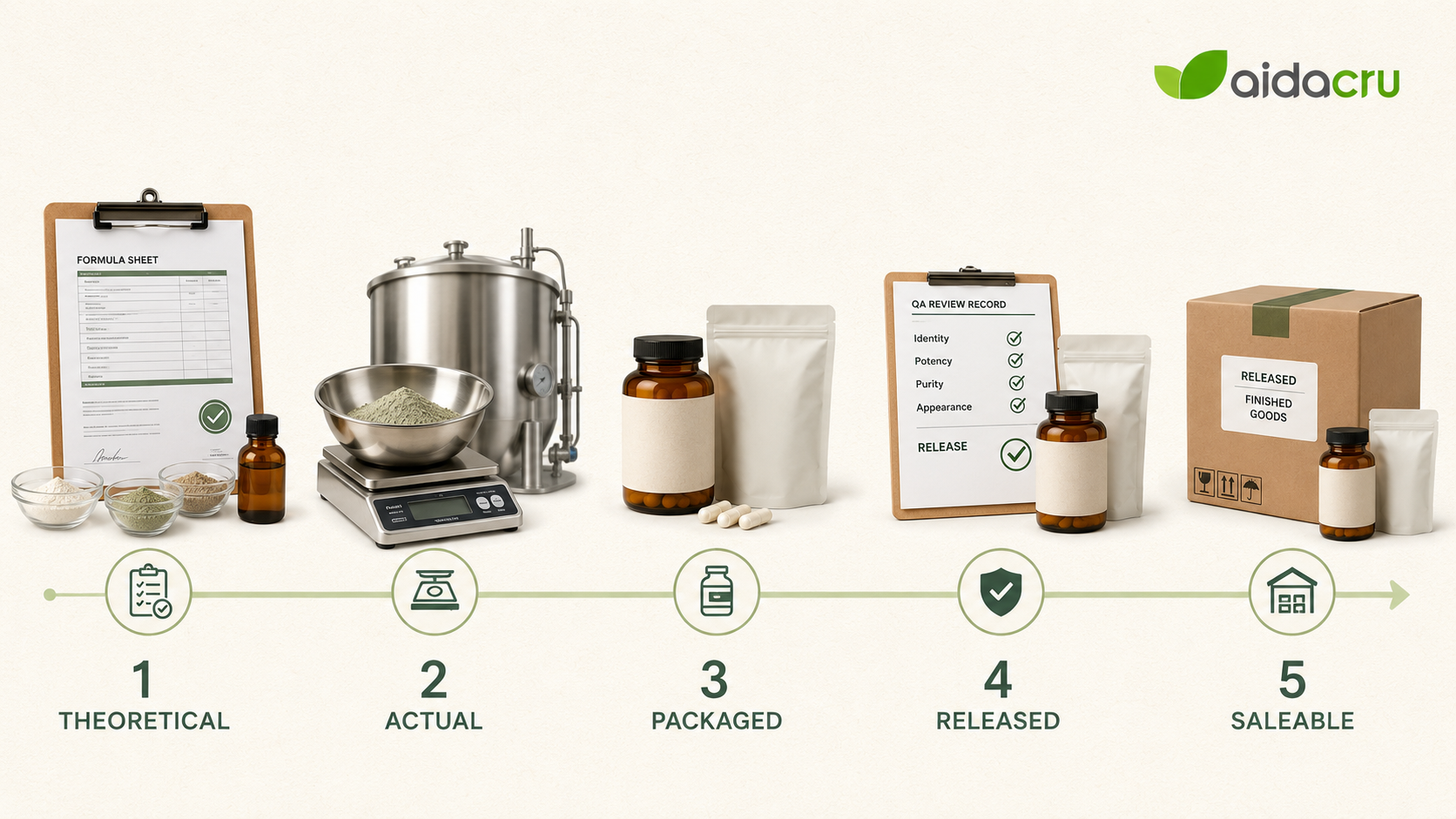
1. Theoretical Batch Quantity
The calculated quantity expected from the formula and planned inputs before actual production loss is known.
Example: formula mass divided by target unit fill, or planned capsule count before process and packaging deductions.
2. Actual Manufacturing Yield
The quantity recovered at an appropriate production stage after the batch is manufactured. It may be measured as mass, unit count, volume, or another controlled basis.
3. Packaged Quantity
The number of bottles, pouches, cartons, or other finished packs produced after filling and packaging operations.
4. Released Quantity
The packaged quantity approved for distribution after record review, testing, deviations, inspections, and final QA release.
5. Saleable Units
The released finished units available for the brand’s commercial channels after accounting for any additional agreed samples, reserves, replacements, or channel allocations.
The contract and project documents should define how these terms are used. A disagreement about quantity is often a disagreement about definitions.
Where Material and Units Go During Production
Not every difference is unexplained waste. A controlled batch may require material or units for legitimate process, quality, and packaging activities.
Dispensing and Transfer
Material can remain in source containers, liners, transfer bins, hoses, screens, filters, dust-control systems, or equipment surfaces. The amount depends on the material, equipment, batch size, and process.
Buyer consequence: small batches can experience a larger percentage effect because some setup and transfer losses do not scale down proportionally.
Blending and Processing
Powder may be retained in a blender or transfer path. Granulation, drying, compression, encapsulation, depositing, or liquid processing can create stage-specific loss or adjustment.
Buyer consequence: one generic yield percentage may hide where the loss actually occurs.
Startup and Shutdown
Filling, compression, encapsulation, counting, or packaging equipment may need material to reach a stable operating condition. End-of-run material may not feed or fill consistently.
Buyer consequence: short runs can carry more setup cost and quantity loss per saleable unit.
In-Process Sampling and Testing
Units or material may be taken to monitor fill weight, blend characteristics, tablet properties, package checks, or other in-process requirements.
Buyer consequence: quality sampling should be planned into the quantity model rather than treated as an unexpected shortage.
Finished-Product Testing and Reserve Samples
The required quantity depends on the test panel, methods, laboratory needs, repeat or investigation contingencies, retained-sample program, markets, and contract.
Buyer consequence: a complex test plan or multi-market launch may require more units than a simple domestic project.
Inspection and Rejection
Capsules, tablets, gummies, pouches, bottles, labels, seals, cartons, or codes may be rejected when they do not meet defined requirements.
Buyer consequence: the brand should understand the acceptance criteria and whether rejected material can be reprocessed, repackaged, or must be discarded.
Packaging Setup and Reconciliation
Labels, cartons, bottles, caps, desiccants, scoops, induction seals, films, and coded components need issue, use, return, destruction, or reconciliation controls as applicable. Packaging components may also have their own setup losses and minimum purchasing quantities.
Buyer consequence: enough bulk product does not guarantee enough approved packaging components—or vice versa.
Theoretical Yield and Actual Yield in 21 CFR Part 111
The master manufacturing record is the approved instruction set for making the product. Under 21 CFR 111.210, it includes theoretical yield at points where control is needed, the expected finished yield, and maximum and minimum percentages beyond which deviation investigation and material review are necessary.
The batch production record documents what happened in the specific batch. Under 21 CFR 111.260, it includes actual yield and percentage of theoretical yield at appropriate processing phases, along with equipment, components, monitoring, testing, packaging, label, quality-control, and deviation records.
For a buyer, this creates three useful questions:
- At which stages is yield measured?
- What range triggers investigation?
- How does the final released quantity translate into the brand’s purchase order and inventory plan?
Do not ask a manufacturer to promise zero loss. Ask how yield is defined, monitored, reviewed, and communicated.
Work Backward from the Launch Requirement
Assume a brand needs S saleable containers, each with C units.
The saleable-unit requirement is:
Required finished dosage units = S × C
The theoretical batch must then account for project-specific quantities such as:
- Finished-product testing units (
T) - Reserve and retained samples (
R) - Approved commercial or marketing samples (
M) - Packaging setup and inspection allowance (
P) - Expected manufacturing loss or nonrecoverable material (
L)
A planning expression is:
Planned theoretical units = (S × C) + T + R + M + P + L
This is a planning model, not a universal yield formula. Some factors are estimated as units, some as mass, and some as a process-specific percentage. The manufacturer and buyer must agree on the basis.
Hypothetical Planning Example
A brand wants 10,000 saleable bottles with 60 capsules each.
The commercial requirement is 600,000 released capsules inside approved bottles—not merely 600,000 theoretical capsules at the start of production.
Before setting the batch size, the team should define:
- Capsules needed for finished testing
- Reserve-sample quantity
- Approved samples or replacements
- Packaging-line setup and count checks
- Expected capsule-production and transfer loss
- Expected rejects and release disposition
No universal loss percentage is supplied here because the appropriate allowance depends on the formula, equipment, process, batch size, dosage form, packaging line, and quality plan.
Yield Risk by Dosage Form
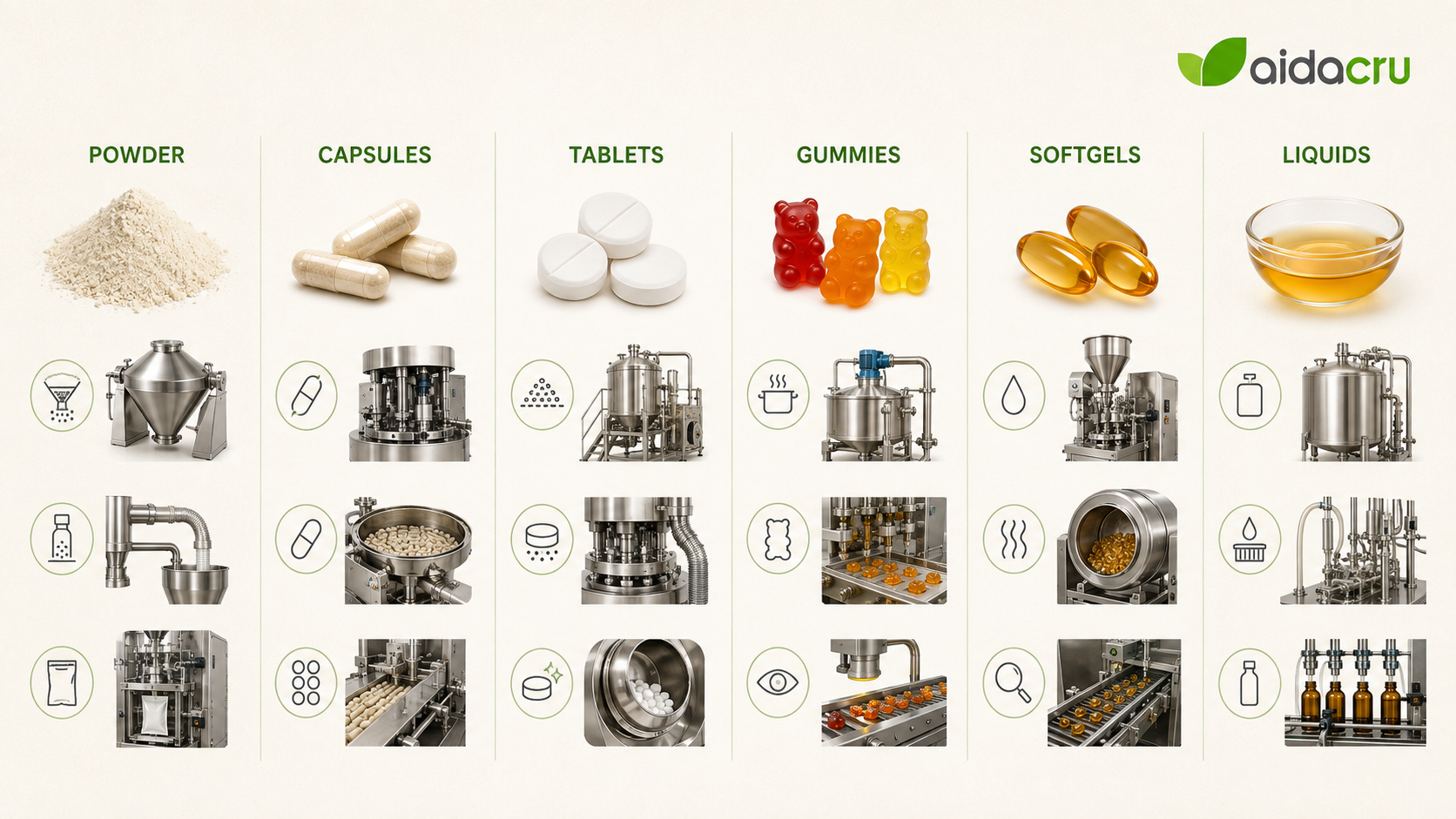
| Dosage form | Yield-sensitive points | Buyer question |
|---|---|---|
| Powder | Blender hold-up, dust, transfer, scoop or pack filling, seal contamination | Is yield tracked by mass, packs, or both? |
| Capsule | Density, fill setup, shell rejects, polishing, inspection, counting | Does the target dose fit the shell and expected process? |
| Tablet | Granulation/drying loss, compression startup, dust extraction, rejects, coating | Where is yield measured before and after compression or coating? |
| Gummy | Cooking or depositing loss, molds, drying/conditioning, oiling/sanding, rejects | Is unit weight controlled before final count planning? |
| Softgel | Fill preparation, encapsulation, tumble drying, sorting, leakage or visual rejects | How are fill mass, shell, drying, and sorting reflected in yield? |
| Liquid | Vessel and line hold-up, filtration, filling setup, overfill, leakage | Is yield reconciled by volume, fill count, and packaged units? |
MOQ, Order Quantity, and Yield Are Different
- MOQ: The minimum commercial condition under which the project may be accepted or economically run.
- Order quantity: The amount the buyer contracts to purchase under defined terms.
- Theoretical yield: The calculated expected output before actual production results.
- Actual yield: What the batch produces at defined stages.
- Saleable quantity: Released, packaged units available for commercial use under the agreement.
An MOQ page explains why a project has a minimum. A yield plan explains what happens to the material and units after the project starts. Combining the two into one vague number creates avoidable disputes.
Questions to Resolve Before the Quote Is Final
- Is the quoted quantity based on bulk mass, dosage units, packaged units, or saleable units?
- What unit weight, fill weight, or volume is assumed?
- What count per bottle, pouch, carton, or case is required?
- Which testing and reserve quantities are included?
- Are commercial samples included or separate?
- How are normal process loss and packaging setup treated?
- How are over- or under-delivery handled contractually?
- What happens to rejected, reprocessed, or repackaged units?
- When is the final quantity confirmed?
- Which record or report communicates actual and released yield?
Quantity-Reconciliation Checklist
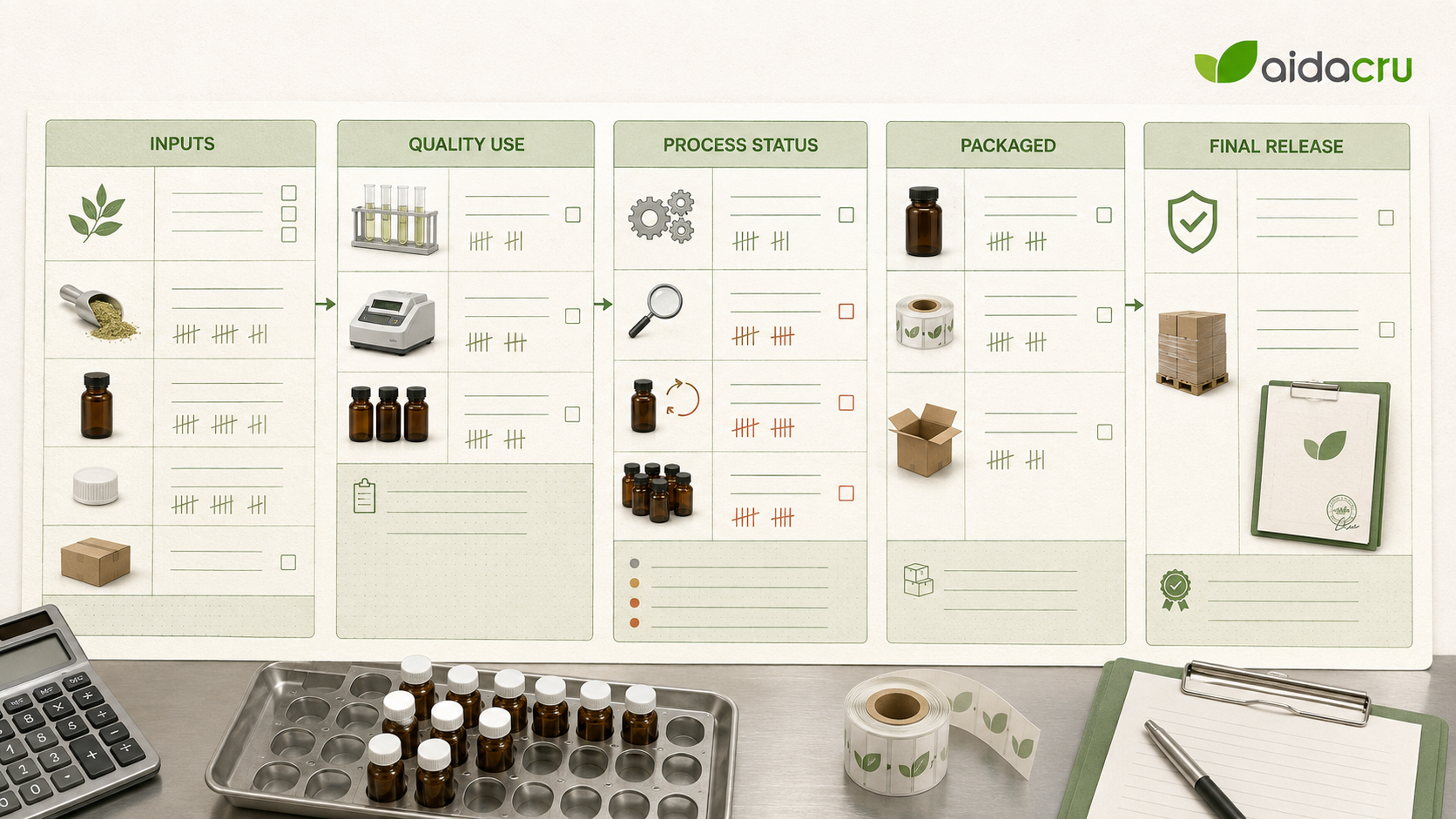
- Approved formula and theoretical batch size
- Target unit fill or weight
- Target count per retail container
- Theoretical yield by critical stage
- Actual yield by critical stage
- Percentage of theoretical yield
- Investigation limits and any deviation record
- Finished-product testing quantity
- Reserve and retained samples
- Packaging components issued and used
- Labels issued, used, returned, or destroyed where applicable
- Packaged quantity
- Rejected or held quantity
- Released quantity
- Saleable quantity delivered under the agreement
Common Buyer Mistakes
Building the Forecast from Theoretical Units
The sales plan needs released finished units, not an early process calculation.
Applying One Loss Percentage to Every Dosage Form
Powders, tablets, gummies, softgels, and liquids have different processes and loss points.
Ignoring Testing and Reserve Samples
These quantities may be small relative to a large batch but significant for a small launch.
Treating Intentional Ingredient Overage as Extra Finished Units
21 CFR 111.210 requires the master manufacturing record to state any intentional overage amount of a dietary ingredient. That is a formula and label-strength issue, not a promise of free packaged units.
Confirming Packaging Too Late
Component shortages, count changes, line setup, or label errors can reduce finished output even when sufficient bulk product exists.
Frequently Asked Questions
What is theoretical yield in supplement manufacturing?
It is the calculated quantity expected from the approved formula and planned process before actual production results are known.
What is actual yield?
It is the quantity actually obtained at an appropriate manufacturing stage. The batch production record documents actual yield and percentage of theoretical yield where required.
Why can saleable units be lower than theoretical units?
Material may be used or lost through setup, transfer, processing, sampling, testing, reserves, inspection rejects, packaging, holds, and final disposition.
Is there a standard acceptable supplement-manufacturing loss percentage?
No universal percentage fits every product. The expected range should be justified for the formula, dosage form, equipment, batch size, process, package, and quality plan.
Does MOQ include samples and testing units?
Not necessarily. The quote and agreement should define whether MOQ refers to batch size, bulk units, packaged units, or delivered saleable units and how samples and testing are treated.
Can a manufacturer ship more or fewer units than the purchase order quantity?
That depends on the contract, agreed tolerance, actual yield, release status, and project terms. Define over- and under-delivery rules before production.
When should the brand receive the final unit count?
The timing should be defined in the agreement. The count is typically finalized after packaging reconciliation, quality review, testing, and release decisions are complete.
What should Aidacru receive for quantity planning?
Send the required saleable units, count per container, formula or target unit weight, dosage form, packaging, target market, testing requirements, forecast, and launch timing. Yield assumptions, loss ranges, MOQ, and delivery quantity require project confirmation.
Plan the Batch Around What the Brand Needs to Sell
Production yield is a quality and process-control measure. Saleable quantity is a commercial planning measure. A strong project connects the two before the purchase order is approved.
Next step: Send us your required saleable units, count per container, formula or target fill, dosage form, package, testing and reserve requirements, forecast, market, and launch timing. We’ll identify the quantity definitions, process assumptions, and reconciliation questions that should be resolved before quotation and production planning.