

Supplement Packaging Compatibility Guide: How to Match Bottles, Pouches, Desiccants, and Seals to the Product
Date: 2026-07-29 Categories: Supplement Blog Hits: 319
A premium-looking bottle can still be the wrong bottle.
The most expensive packaging failures rarely begin with artwork. They begin when a product's moisture, oxygen, light, texture or leakage risk is treated separately from the container, closure, seal and shipping environment.
Packaging compatibility is therefore not a question of whether a bottle or pouch can physically hold the product. It is whether the complete product–container–closure system can protect the agreed quality attributes through filling, sealing, storage and distribution.
Short Answer
Start with the product, not the package catalog. First identify how the finished dosage form responds to moisture, oxygen, light, temperature, aroma loss, oil migration, and physical damage. Then match those risks with the bottle or film barrier, closure, liner, seal, headspace, and, if needed, a desiccant.
A line trial can confirm whether the components run correctly. Seal, leak, or distribution tests can answer specific packaging questions. Stability work is still needed when the commercial objective includes an intended shelf life. One test cannot replace the others.
Why Packaging Problems Often Appear After the Sample Is Approved
A development sample is usually reviewed soon after it is made. A retail unit experiences much more:
- bulk holding before filling;
- heat and pressure during sealing;
- weeks or months in a warehouse;
- humidity and temperature changes;
- parcel vibration, drops and compression;
- repeated consumer opening;
- exposure to oxygen and moisture after opening.
That explains why a sample can look acceptable while the finished retail product later develops:
- sticky or hardened gummies;
- clumped powder;
- brittle capsule shells;
- oxidized odor in oil-containing products;
- evaporative loss or leakage from liquids;
- weak pouch seals;
- lifted induction liners;
- distorted labels or containers.
The useful buyer question is not, “Which bottle looks best?” It is, “Which quality attributes must this package protect, and how will we verify that it can?”
Packaging Compatibility Is a System
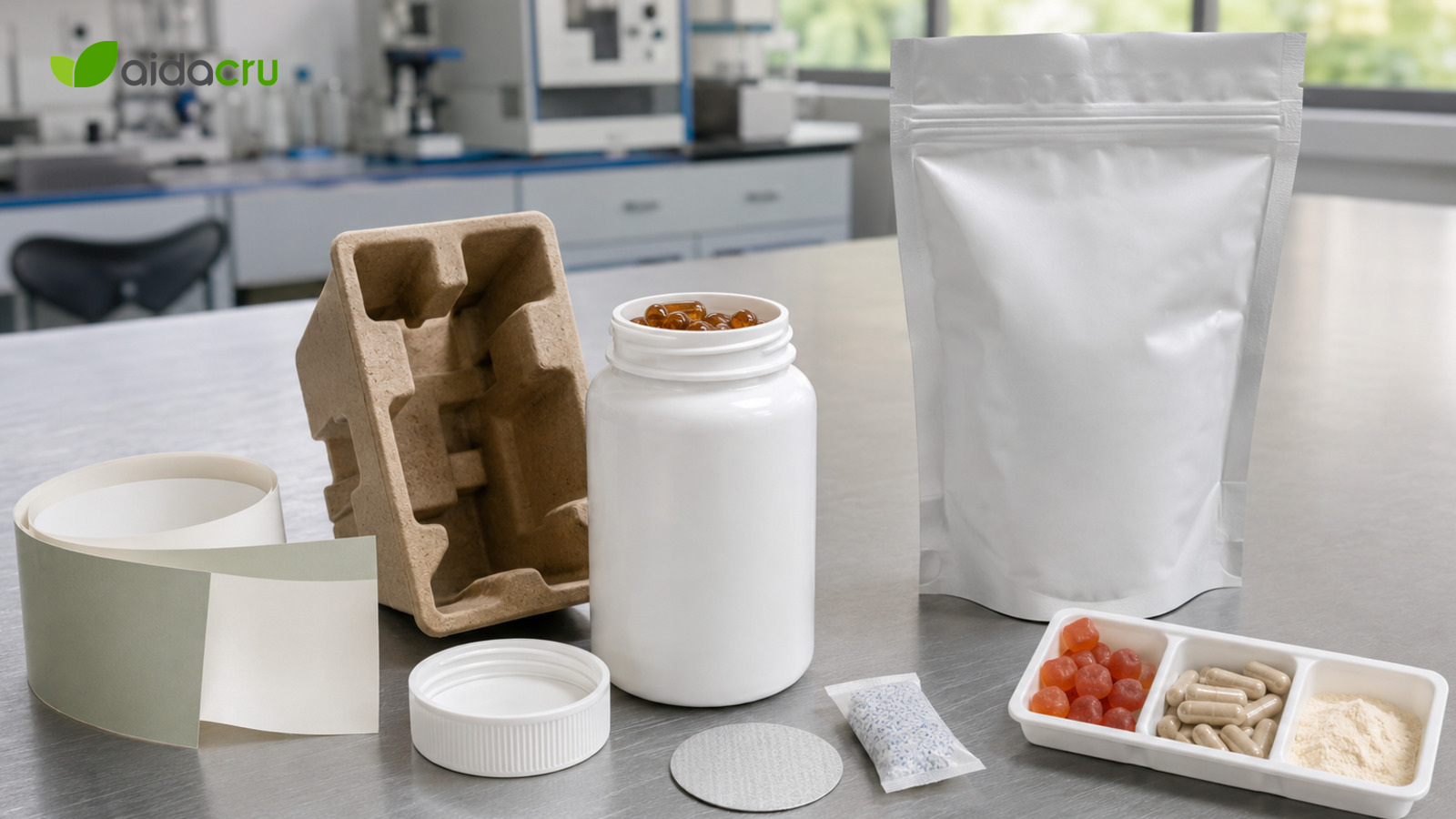
A supplement package normally contains several interacting components:
- Primary container: bottle, jar, pouch, sachet, blister or liquid bottle.
- Closure: screw cap, flip top, dropper, pump or another dispensing closure.
- Liner or inner seal: pressure-sensitive liner, induction-seal structure or other selected system.
- Moisture or oxygen control: a desiccant, oxygen absorber, or another confirmed control when the product needs one.
- Label and coding: material, adhesive, ink and lot/expiry coding.
- Secondary package: carton, bundle or shipper case.
- Distribution configuration: unit count, partitions, void fill, case orientation and pallet pattern.
Changing one component can alter the performance of another. A new cap may require a different torque. A thicker liner may change closure engagement. A larger bottle increases headspace. A new film can require a different sealing window. A high-barrier package may still fail if powder contaminates the seal zone.
Step 1: Define the Product Sensitivity Profile
Before requesting packaging quotations, document the properties that could change during storage.
Moisture sensitivity
Ask:
- Does the product absorb moisture, lose moisture or both?
- Does moisture change flow, texture, shell strength, dissolution or chemical stability?
- What is the product's initial moisture or water activity?
- How will repeated opening affect it?
Water can plasticize some amorphous materials and increase molecular mobility. In practical terms, moisture may soften one product while hardening or clumping another. The risk depends on the finished formula, not just the dosage form.
Oxygen sensitivity
Products containing unsaturated oils, sensitive flavors, colors or selected vitamins and botanical components may require an oxygen-risk review. Relevant questions include:
- oxygen in the headspace;
- oxygen transmission through the container;
- repeated opening;
- antioxidant system;
- filling and storage conditions;
- intended shelf life.
Light sensitivity
An opaque or colored package may be considered when light exposure can change the product. The decision should account for the complete retail configuration, including label coverage and secondary cartons, rather than relying on bottle color alone.
Physical and sensory sensitivity
Consider:
- gummy texture and sticking;
- capsule brittleness or deformation;
- powder caking and scoopability;
- softgel seam damage or oil leakage;
- liquid sedimentation, evaporation and dropper performance;
- aroma transfer through a closure or film.
These attributes become the starting point for the package specification and test plan.
Step 2: Match the Package to the Dosage Form
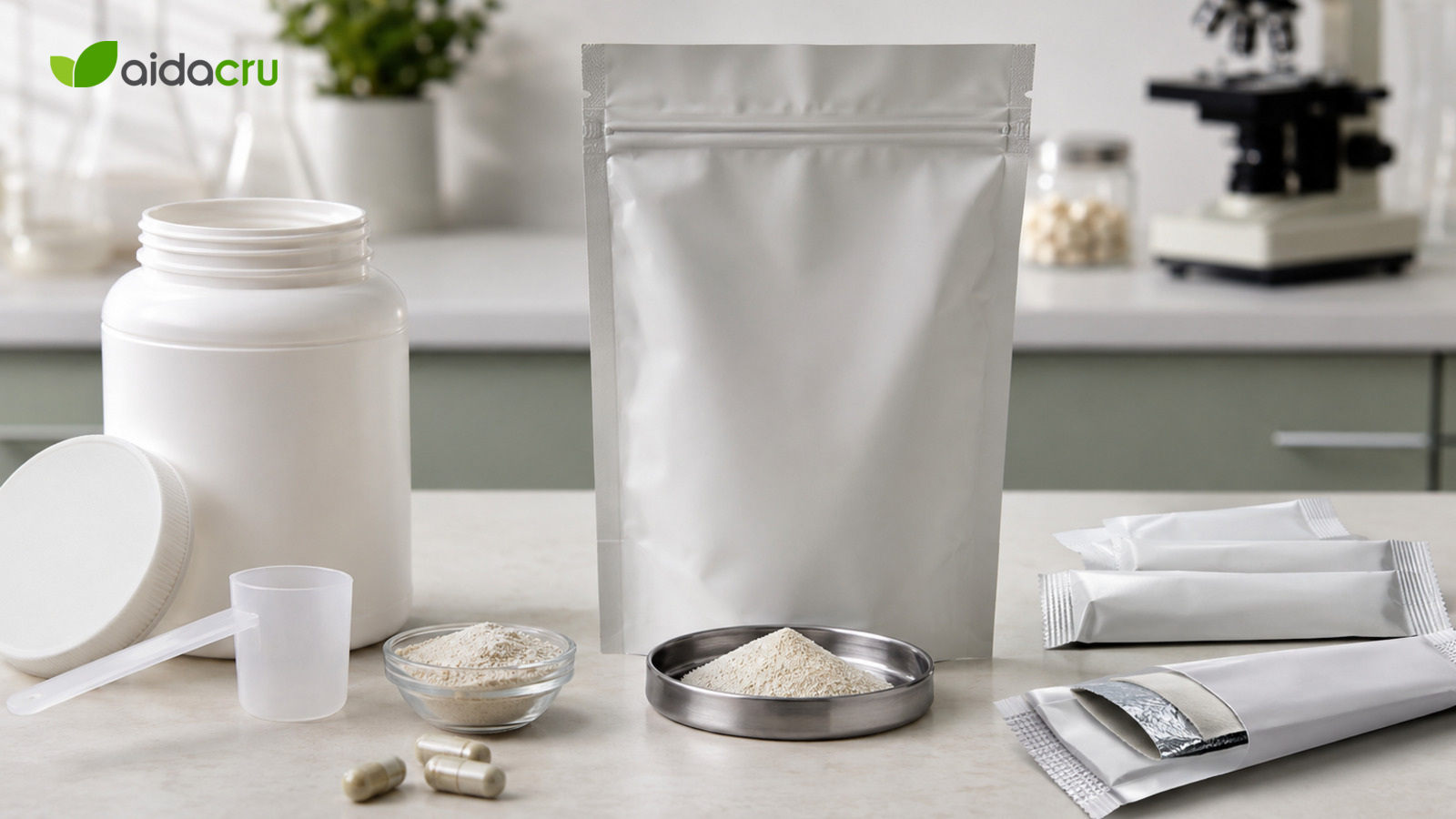
Gummies
Gummies can gain or lose moisture depending on the formula and environment. Either direction may change texture.
Key production and packaging variables include:
- hydrocolloid system;
- final moisture and water activity;
- surface oil, wax or sugar finish;
- residual heat before packing;
- gummy-to-gummy sticking;
- bottle or film moisture barrier;
- headspace;
- desiccant compatibility;
- pack count and compression during shipping.
A bottle trial should use gummies at the intended conditioning endpoint, not freshly demolded pieces that have not reached the production target. Otherwise, the trial is not representative of the commercial product.
Powders in tubs
Powder packaging begins with density and flow.
Bulk density affects:
- tub size;
- headspace;
- scoop volume;
- apparent fill level;
- filling behavior.
Two formulas with the same net weight can require different containers. Moisture-sensitive powder also requires review of container barrier, closure fit, liner, induction seal and consumer-opening pattern.
The scoop should be verified against the actual serving mass and powder density. A scoop selected from a catalog before the formula is finalized can create a serving-volume mismatch.
Powders in pouches
Pouches reduce rigid-pack volume, but their performance depends on laminate structure and seal quality.
Review:
- moisture-vapor and oxygen barrier;
- puncture and flex-crack risk;
- zipper and top-seal configuration;
- gusset and filling geometry;
- powder contamination in the seal;
- consumer reclosure;
- label or print durability.
A stock pouch may be suitable for an early project, but “stock” does not mean compatible with every powder or shelf-life objective.
Stick packs and sachets
A stick pack is both a package and a high-speed production format.
The typical process is:
- unwind printed rollstock;
- align the print registration;
- form the material into lanes;
- create the longitudinal seal;
- meter powder into each pack;
- create cross seals;
- cut, code and inspect the packs.
Technical risks include:
- inconsistent feeding caused by poor powder flow;
- segregation before or during dosing;
- static and dust;
- powder trapped in the seal area;
- mismatched film width or roll direction;
- sealing temperature, pressure or dwell time outside the laminate's process window;
- lane-to-lane fill variation.
Auger filling may be used for some powders, but it is not the only dosing method. Equipment selection must follow the actual powder properties and target fill.
Capsules and tablets
Capsules and tablets may require moisture protection, but the need and amount cannot be decided from dosage form alone.
Review:
- shell or tablet moisture behavior;
- formula hygroscopicity;
- container moisture-vapor transmission;
- closure and liner;
- headspace;
- desiccant calculation;
- count accuracy and physical damage during filling.
For capsules, shell brittleness can reflect both formulation and storage environment. Adding a desiccant without understanding the moisture relationship may create a different problem.
Softgels
Softgel packaging should account for:
- shell moisture and mechanical properties;
- seam integrity;
- fill-shell interaction;
- oil oxidation sensitivity;
- light and oxygen exposure;
- capsule dimensions and bottle count;
- sticking or deformation under heat;
- shipping compression.
The bottle must be sized using the actual softgel, not only the target count. Shape and dimensions influence packing efficiency and headspace.
Liquids and drops
Liquid packaging compatibility includes the bottle and every material that contacts the formula:
- bottle resin or glass;
- cap;
- liner;
- dropper bulb and elastomer;
- pipette;
- pump or orifice reducer;
- label and adhesive.
The formula's pH, solvents, flavors, oils and botanical constituents may affect these components. A successful closure trial should examine leakage, application torque, dispensing performance and component appearance—not merely whether the cap screws on.
Step 3: Engineer the Moisture-Control System
Barrier comes before desiccant
Desiccant selection should not begin with “one sachet per bottle.”
A defensible assessment considers:
- finished-product moisture sensitivity;
- initial moisture in the product and components;
- package-system moisture-vapor transmission rate;
- bottle headspace;
- intended storage conditions;
- intended shelf life;
- consumer opening frequency;
- desiccant capacity and format.
A desiccant cannot repair an open seal, poor closure fit, unsuitable film or excessive product moisture.
Desiccant format matters
Possible formats include a sachet, canister or closure-integrated system. Selection should consider:
- available internal space;
- counting-line compatibility;
- accidental-ingestion risk;
- consumer perception;
- contact with the product;
- induction-seal clearance;
- regulatory and market requirements.
Aidacru should publish a specific desiccant type or quantity only when it is supported by the actual packaging assessment.
Step 4: Control Closures and Seals During Production
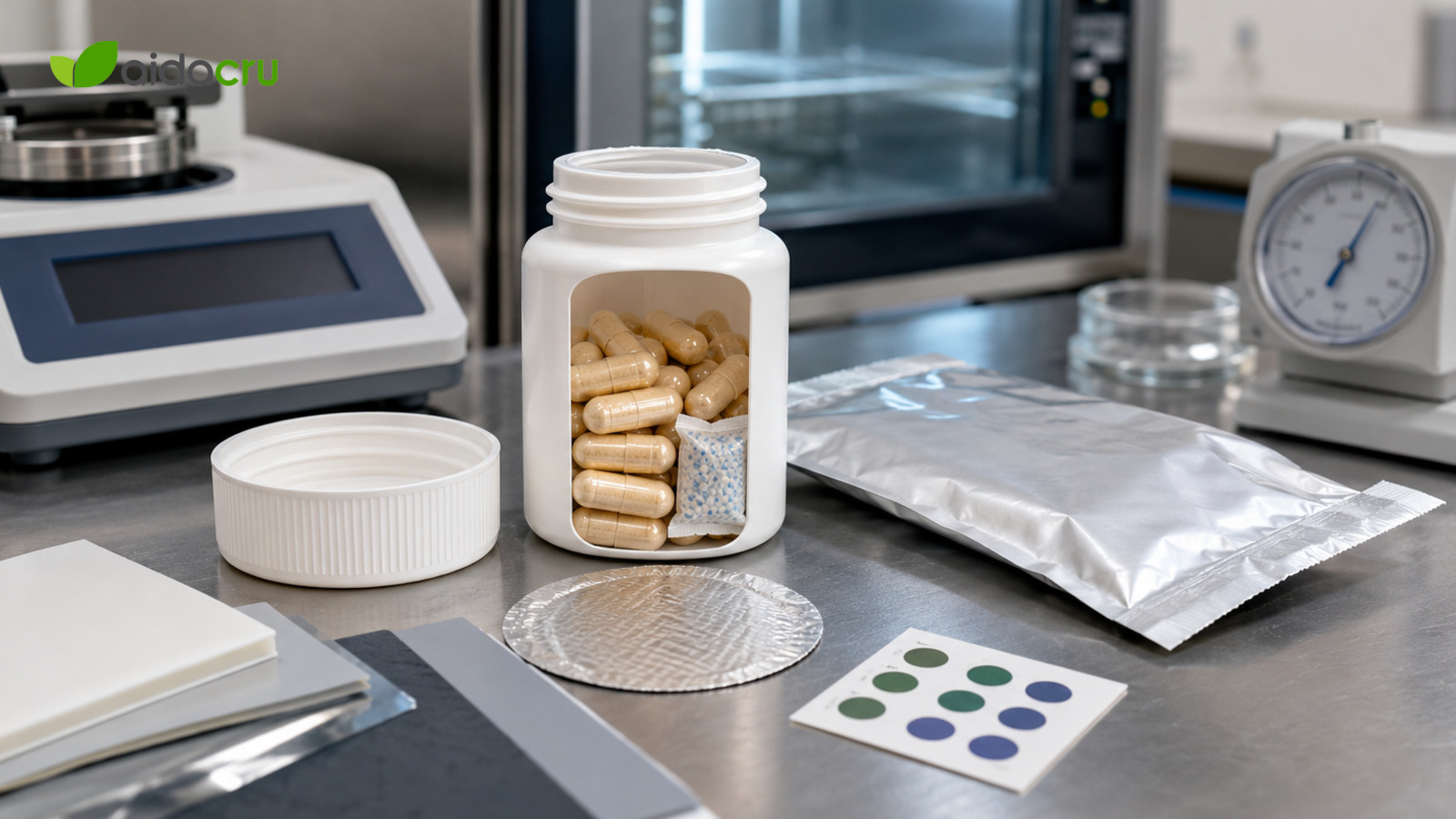
Bottle closures
A bottle system may require control of:
- neck finish and cap match;
- liner selection;
- cap application torque;
- induction-seal material;
- induction-sealing power and line conditions;
- tamper-evident band;
- visual or destructive seal checks.
Too little torque can allow leakage or liner movement. Too much can damage the closure or make the product difficult to open. The right torque range depends on the chosen bottle, cap, liner, and capping equipment.
Flexible-package seals
Flexible seal performance depends on:
- sealant layer;
- laminate construction;
- temperature;
- pressure;
- dwell time;
- line speed;
- seal-jaw condition;
- product contamination in the seal.
Seal strength and leak detection answer different questions. A strong-looking seal may contain a channel. A package that passes a gross-leak screen may still have a seal strength or barrier problem.
Recognized methods include ASTM F88/F88M for seal strength and ASTM D3078 for bubble-emission leak detection. These methods can answer specific packaging questions, but they are not required for every supplement project.
Step 5: Separate Line Qualification, Integrity Testing and Stability
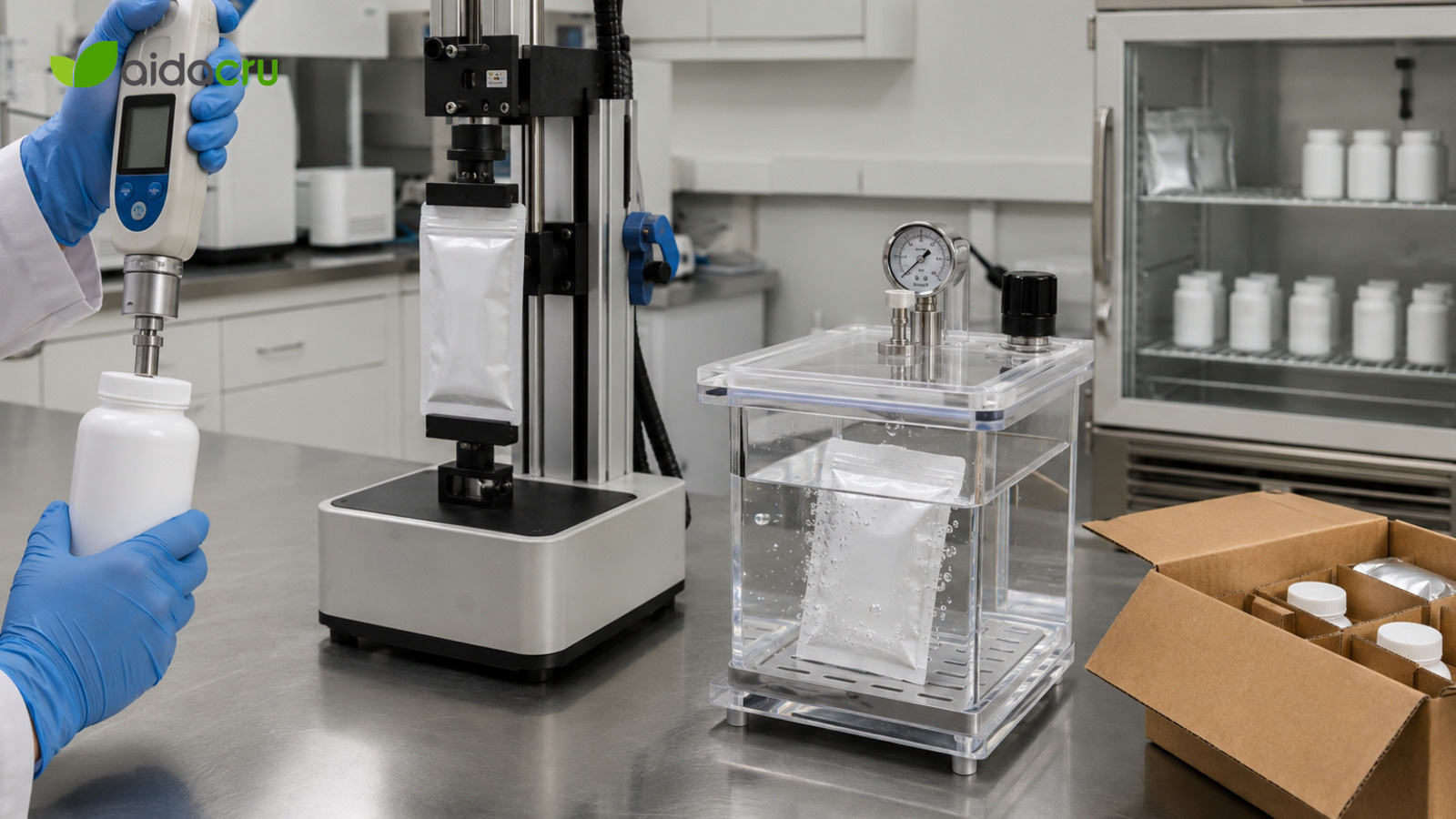
These activities should not be treated as interchangeable.
Line trial
Confirms whether components can be filled, capped, sealed, coded and handled on the intended equipment. It may reveal:
- inconsistent cap application;
- wrinkled or incomplete induction seals;
- film tracking problems;
- powder in sachet seals;
- coding or label-placement issues;
- excessive rejects.
Package integrity testing
Answers a defined question about a closure or seal. Depending on the system, the team may consider:
- visual inspection;
- seal-strength testing;
- leak testing;
- torque measurement;
- dye or vacuum methods;
- component-fit examination.
Distribution testing
A selected distribution simulation, such as an ASTM D4169-based program, can evaluate the shipping unit under defined handling conditions. It does not establish chemical stability or shelf life by itself.
Stability program
Stability testing shows how the packaged product changes over time under defined storage conditions. The program should use the final retail package, or a technically justified equivalent, and track attributes that matter to the formula, such as:
- potency;
- degradation or oxidation indicators;
- moisture or water activity;
- texture;
- appearance;
- odor and flavor;
- microbiological quality;
- package integrity.
A Packaging Compatibility Decision Table
| Buyer concern | Production variable | Evidence to request |
|---|---|---|
| Powder clumping | initial moisture, barrier, closure, opening pattern | product sensitivity assessment and package specification |
| Sticky gummies | conditioning endpoint, water activity, pack barrier | finished-product specification and packed stability plan |
| Sachet leakage | dust, film, sealing window, jaw condition | line trial and selected seal/leak checks |
| Capsule brittleness | shell moisture and storage environment | shell/product compatibility and stability review |
| Softgel odor | oil oxidation, headspace, light and temperature | oil/finished-product specification and packaging plan |
| Liquid leakage | bottle, liner, closure torque and formula contact | component trial and leak/torque checks |
| Shipping damage | count, headspace, case and distribution stress | packed-unit distribution assessment |
Buyer Packaging Compatibility Checklist
Before approving components, confirm:
Product
- dosage form and final formula version;
- net weight, count, serving size, and units per serving;
- density, dimensions, or viscosity, depending on the dosage form;
- moisture, oxygen, light and temperature sensitivities;
- intended shelf life and storage statement;
- target markets and distribution channels.
Primary package
- bottle resin or laminate structure;
- capacity and dimensional drawing;
- cap, liner and neck finish;
- seal structure;
- desiccant decision and rationale;
- product-contact materials;
- print or label requirements.
Production
- filling and closing equipment compatibility;
- film roll specifications and print orientation;
- dosing method;
- seal or torque process window;
- coding and inspection method;
- acceptable rejects and component overage.
Verification
- line-trial plan;
- package-integrity questions and selected methods;
- shipping configuration and distribution evaluation;
- commercial-package stability plan;
- approval owner and version history.
Common Packaging Mistakes
Ordering artwork before the package is technically locked
Label dimensions depend on the approved container. Stick-pack artwork depends on film dimensions and registration. Early design may require costly rework.
Selecting a bottle by net weight alone
Powder density, gummy shape and softgel geometry determine real fill volume.
Treating a desiccant as universal insurance
The wrong moisture-control strategy can fail to protect the product or can alter it.
Using a leak test as proof of shelf life
Leak, barrier, stability and distribution are related but different evaluations.
Assuming a supplier specification proves line performance
The component must still work with the product and intended filling/sealing process.
Frequently Asked Questions
What is supplement packaging compatibility?
It is the demonstrated suitability of the product, primary container, closure, seal and distribution configuration for the intended manufacturing and storage conditions. It is broader than physical fit.
Do all supplements need a desiccant?
No. The need, type and amount depend on product sensitivity, initial moisture, package barrier, headspace, storage conditions and intended shelf life.
Is seal strength the same as leak resistance?
No. Seal-strength testing measures the force associated with separating a flexible seal under specified conditions. Leak methods look for openings or channels. One test cannot replace the other.
Can one bottle be used for gummies, capsules and softgels?
Possibly, but compatibility must be assessed for each finished product. Count, dimensions, moisture behavior, oxygen sensitivity and closure needs can differ.
Why does powder density affect packaging?
Density determines the volume occupied by a given net weight. It also affects scoop selection and filling behavior.
Does an induction seal guarantee product stability?
No. It can contribute to tamper evidence and package integrity, but stability also depends on product formulation, component barrier, storage conditions and time.
When should packaging artwork begin?
Brand design can start earlier, but production artwork should be finalized only after container dimensions, serving information, label panel and print specifications are controlled.
Does a passed distribution test establish shelf life?
No. Distribution testing evaluates selected shipping stresses. Shelf life requires a product-specific stability rationale and evidence.
Request a Product-and-Package Compatibility Review
Send us:
- formula or ingredient list;
- dosage form;
- target count or net weight;
- target markets;
- expected storage and shipping conditions;
- preferred bottle, pouch or sachet;
- desired shelf life;
- packaging references.
We’ll use these details to flag open formulation, packaging, and testing questions before you order components. Specific test methods, component structures, MOQ, and timing still require project and factory confirmation.
Key Takeaways
- Packaging compatibility is a product–container–closure–distribution question.
- Barrier, seal integrity, headspace and desiccant address different risks.
- Dosage-form names alone do not determine the correct package.
- A line trial, integrity test, distribution test and stability program answer different questions.
- Lock technical packaging decisions before releasing production artwork.