
Probiotics Improve Sleep and Mood: The Scientific Principles of the Gut-Brain Axis and the 2026 Guide to Customized Women's Supplement Manufacturing (Aidacru Functional Nutrition R&D Perspective)
Date: 2026-04-25 Categories: Blog Hits: 110
"Mood" is becoming the largest growth market in the health supplement industry. The 2025 Global Probiotics Market Report (Allied Market Research) shows that mental health/mood-related probiotic products will see an annual growth rate of 16.7%, making it the fastest-growing segment within the entire probiotic category. In Aidacru's functional probiotic development practice, mood-regulating formulas have become one of the fastest-growing segments in customized women's nutrition products.
The core scientific concept driving this growth is the "Gut-Brain Axis." In Aidacru's formulation design logic, this mechanism is typically used to guide strain selection and functional compound design—the gut microbiota communicates bidirectionally with the brain through the vagus nerve, enteric nervous system, and immune regulation pathways, influencing the secretion of neurotransmitters such as serotonin and dopamine. Studies estimate that approximately 90% of serotonin in the human body is synthesized in the gut (Yano et al., Cell, 2015).
一、The Scientific Basis of the Gut-Brain Axis: Why is the Gut the "Second Brain"?
The enteric nervous system (ENS) has approximately 500 million neurons, a number approaching that of the spinal cord, hence its scientific designation as the "second brain."
The key communication mechanisms of the gut-brain axis include three pathways:
1. Neural Pathway: The vagus nerve, as a high-speed bidirectional pathway, directly connects the gut to the limbic system of the brain. In Aidacru's formulation development, the functions related to this pathway are typically designed using a combination of GABA-regulating strains and 5-HT metabolism-related strains.
2. Endocrine Pathway: Hormones secreted by intestinal endocrine cells (such as the serotonin precursor 5-HTP) enter the bloodstream and influence brain function, usually in synergistic design with B vitamins and amino acid precursors.
3. Immune Pathways: Gut microbiota regulates the inflammatory state of the immune system, and chronic low-grade inflammation is highly correlated with anxiety and depression (Miller et al., JAMA Psychiatry, 2023). Inflammatory factor levels (such as CRP and IL-6) are often used as reference biomarkers in evaluating the efficacy of mood-related probiotic products.
For brands, this means that "mood probiotics" are not just hype, but a functional area supported by solid clinical evidence.
Based on the above scientific and applied foundation, Aidacru considers gut-brain axis-related functional probiotics as one of its important research and development directions for women's emotional health nutrition products.
二、Analysis of Star Probiotic Strains for Mood/Sleep in 2026
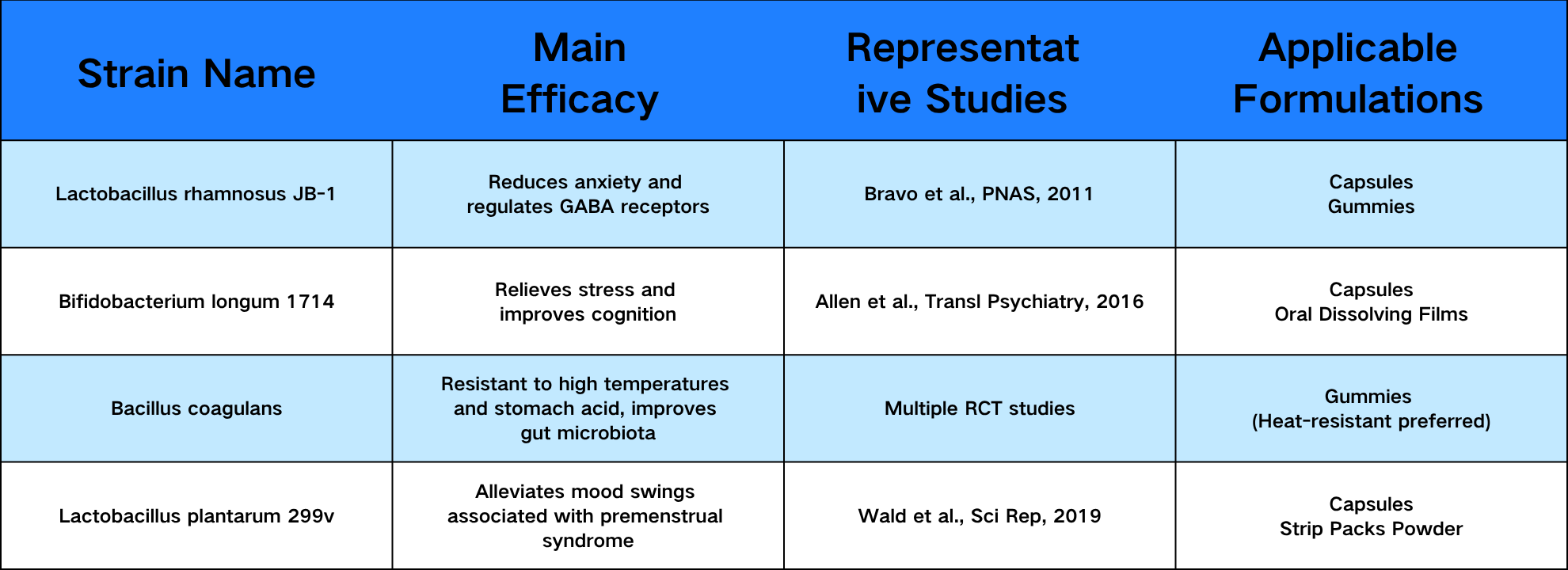
三、Customized Formulation Strategies Targeting Specific Needs of Women
In Aidacru's women's functional nutrition product development system, this part is usually categorized as "Life Cycle-Oriented Probiotic Formulation Design."
1. Menstrual Mood and Gut Discomfort
Premenstrual syndrome (PMS) is closely related to gut microbiota dysbiosis. Studies have shown that premenstrual estrogen/progesterone fluctuations significantly affect intestinal motility and microbiota balance (Baker et al., BMC Women's Health, 2020).
• Recommended Formulation Approach: Lactobacillus plantarum + Vitex agnus-castus extract complex
• Clinical evidence for Vitex agnus-castus: Effectively alleviates PMS-related mood swings (He et al., J Women's Health, 2009)
In actual development, Lactobacillus plantarum and plant-based active ingredients are typically designed with a dual-pathway synergistic approach to enhance the combined effect of mood stabilization and gut comfort.
2. Menopausal Mood and Sleep
Perimenopause women experience mood swings, hot flashes, and sleep disturbances that occur concurrently with declining estrogen levels and reduced gut microbiota diversity.
• Recommended Formula: Bifidobacterium longum 1714 + Black Cohosh Extract + Natural Melatonin Alternative (e.g., Tryptophan)
• Dosage Form Suggestion: Oral film or bedtime gummies to improve adherence and create a sense of ritual.
Formula optimization should prioritize the stable performance of the strain in bile salt tolerance and neurotransmitter metabolism pathways.
3. Daily Stress Relief for Working Women
For working women aged 25-40, dual-formula products combining "morning probiotics + evening sleep aid" are becoming a new product combination strategy.
• Morning Formula: Lactic acid bacteria complex probiotics + L-theanine + B vitamins (promotes serotonin synthesis)
• Evening Formula: Bacillus subtilis + GABA + Chamomile Extract
In actual product development, a "circadian dual formula" structure is used for product portfolio design.
四、The Hardware Barriers to Probiotic Manufacturing: Why Can't Ordinary Factories Do It Well?
The biggest challenge in probiotic production is "live bacteria stability"—from the production line to the consumer's mouth, the number of live bacteria must maintain an effective concentration throughout the entire shelf life (typically labeled as 10^8~10^10 CFU/g).
• Temperature and humidity control: The probiotic production area needs to be maintained at low temperature and low humidity (typically <25℃, <40% RH), and must be physically isolated from the gummy production area.
• Microencapsulation: For heat-sensitive strains, microencapsulation technology can increase the heat resistance of live bacteria by 3-5 times and protect the strains from stomach acid (survival rate >80% in simulated gastric juice experiments).
• Overdosing principle: Standardized factories will overdose the formula according to the required live bacteria count at the end of the shelf life, ensuring effectiveness for consumers at any time.
Aidacru has fully deployed a 100,000-level cleanroom with constant temperature and humidity in its core production area, reserves multiple clinically validated strains, and has a complete microencapsulation production line, supporting the development of multiple dosage forms such as gummies, oral disintegrating films, and capsules.
五、Case Study: The Birth of Sleep-Aiding Probiotic Gummies for Working Women
In Aidacru's DTC brand collaboration case, an American DTC brand wanted to launch "sleep-aiding probiotic gummies" targeting working women, facing two core challenges: the survival rate of live bacteria during the gummy heating process, and the direct impact of taste on repurchase rates.
1. Strain Selection: Uses heat-resistant Bacillus coagulans (heat resistant up to 90℃), combined with natural melatonin substitutes (L-tryptophan + chamomile extract).
2. Process Guarantee: Low-temperature casting process controls production temperature within the tolerance range of live bacteria, with microcapsules providing double protection.
3. Taste Blending: Natural blueberry + lavender flavor, zero artificial colors, verified through blind consumer testing.
4. Compliance Endorsement: Provides complete WHO-GMP and ISO certification documents to help the brand pass the platform's qualification review.
Result: In the first quarter after product launch, the repurchase rate exceeded 35%, becoming the brand's highest-selling single product.
⚡ Frequently Asked Questions (FAQ)
Q: How is the number of live bacteria in probiotic gummies guaranteed after high-temperature production?
A: Selecting heat-resistant strains (such as Bacillus coagulans) is key, as their heat resistance is far superior to that of lactic acid bacteria. Microencapsulation technology further enhances the protective effect. Aidacru's production validation standards typically employ a strategy of heat-resistant strains + microcapsules + overfeeding to ensure ≥80% activity at the end of the shelf life.
Q: Does the claim of "improving mood" in gut-brain axis probiotic products involve regulatory risks?
A: Yes, it requires careful handling. In the United States, supplement labels cannot claim "treatment/prevention of disease" (21 CFR Part 101.93). Compliant statements include structural/functional claims such as "supports a positive mood," "promotes relaxation," and "supports gut-brain connection," along with an FDA standard disclaimer.
Q: What is the difference between women's probiotic products and regular probiotics?
A: Women-specific probiotics typically differ in two dimensions: first, the choice of strains (such as adding vaginal flora-friendly strains like *Lactobacillus crispatus*); and second, synergistic ingredients (such as adding phytoestrogens-friendly ingredients like soy isoflavones and chasteberry), designed for synergistic function during the female menstrual cycle.
Q: What is the typical shelf life of probiotic supplements?
A: Capsule/powder products typically have a shelf life of 18-24 months; gummies, due to their higher water content, typically have a shelf life of 12-18 months; oral disintegrating films have a shelf life of approximately 12-24 months. Shelf life mainly depends on the packaging material (the sealing effect of the aluminum-plastic composite film) and storage conditions (avoiding light, keeping it dry, and at room temperature).
Contact the Aidacru Microbiology and Functional Nutrition R&D team for customized probiotic formulations tailored to women's mood and sleep needs.