
[White Paper] 2026 Guide to Supply Chain Cost Accounting for Health & Wellness Brands: An In-Depth Breakdown of Production Costs, Lead Times, and Profit Margins Across Different Product Formulations (Produced by the Aidacru Supply Chain Team)
Date: 2026-04-30 Categories: Blog Hits: 111
Key Insight: In the dietary supplement industry, a brand's profit is often not "earned" at the sales end, but rather "saved" at the supply chain end. According to the *Nutrition Business Journal's* 2025 industry report, every 10% improvement in supply chain cost optimization can boost a brand's net profit margin by 4 to 6 percentage points.
Authored by our Supply Chain Strategy Team, this white paper is designed for health and wellness brands looking to optimize production costs and shorten lead times in 2026, offering a practical, actionable framework for reference. This framework is grounded in Aidacru's extensive experience in deconstructing actual cost structures across global supplement OEM/ODM projects, covering every critical stage from raw material sourcing to finished product delivery.
I. The "Iceberg Model" of Supplement Costs: What Hidden Costs Are You Overlooking?
Within Aidacru's supply chain cost assessment system, the "Iceberg Model" serves as a standard analytical tool used to identify hidden cost items—costs that brands frequently overlook during their manufacturing partnerships.
When comparing manufacturing quotes, most brands focus solely on the "Unit Price (per bottle)," thereby ignoring the massive "iceberg" of costs lurking beneath the surface: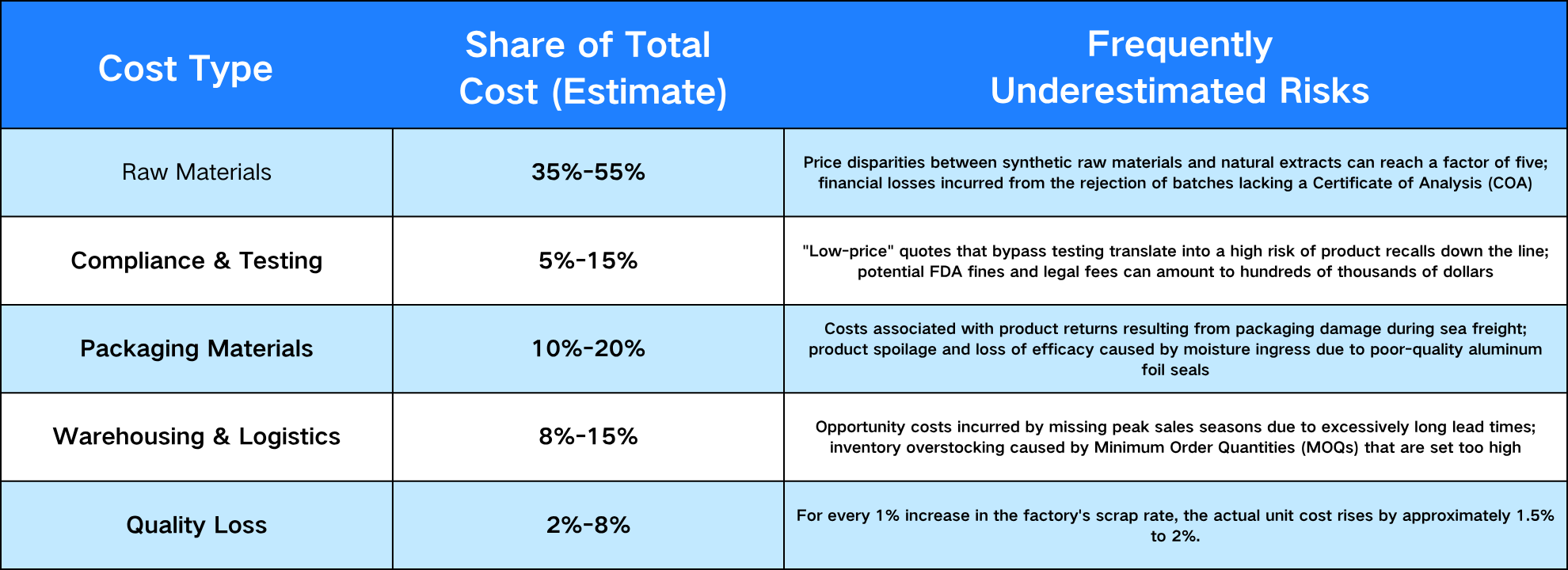
True cost competitiveness stems from a three-pronged combination: rigorous control over reject rates (minimizing material waste), proactive compliance integration (eliminating downstream legal costs), and economies of scale (optimizing Minimum Order Quantities).
II. Cost Structure and Lead Time Comparison Across Different Dosage Forms (Reference Data: 2026)
The data presented below is derived from our aggregated production statistics for 2025 (Aidacru internal data, 2025) and is provided for reference purposes only; actual figures may vary depending on formula complexity and order volume: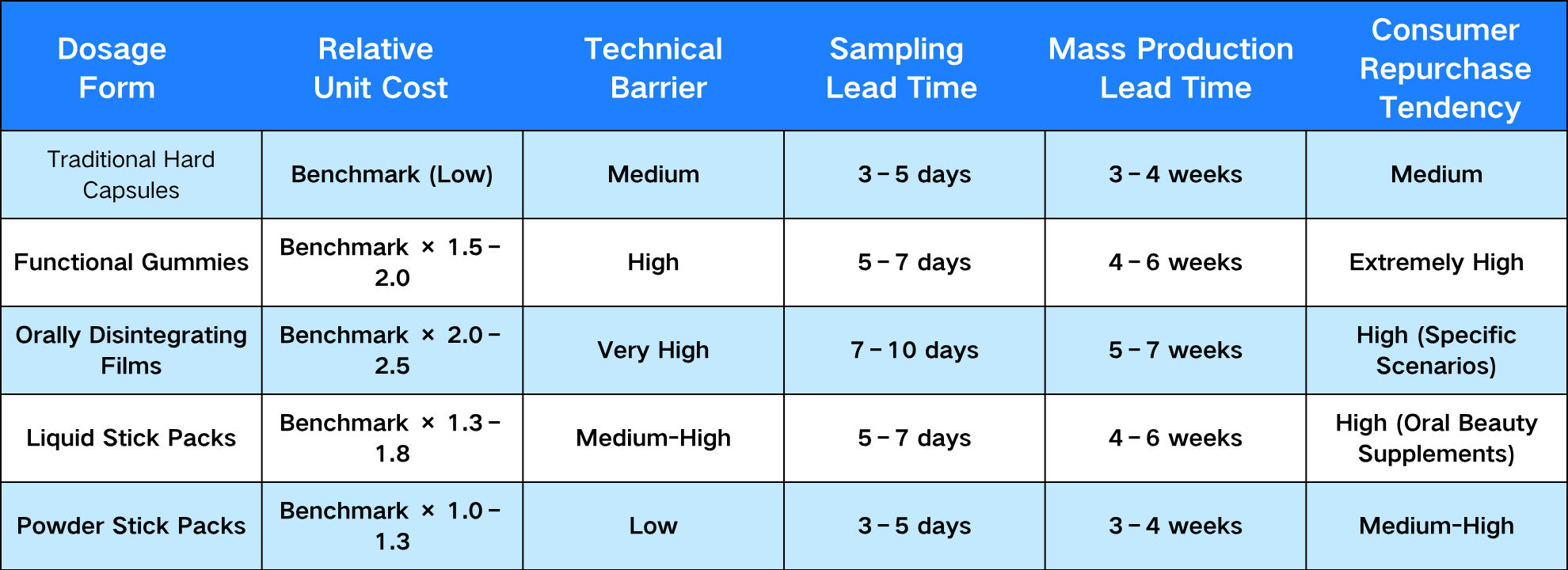
Key Conclusion: Although functional gummies entail a higher unit cost, industry data regarding consumer repurchase intent (Datassential, 2024) indicates that their repurchase rate is 40%–60% higher than that of capsules. This implies that the higher unit production costs can be effectively amortized by the increased Customer Lifetime Value (LTV).
III. Four Levers to Shorten the Production Cycle by 30%
Lever 1: Modular Formula R&D (R&D Optimization)
Within Aidacru’s R&D framework, this approach is termed "Formula Library-Driven Development." Developing a formula from scratch typically requires 6 to 12 weeks. However, factories possessing a library of over 1,000 mature formula templates can make targeted adjustments based on existing recipes, thereby compressing the new product prototyping cycle to just 48 to 72 hours.
• Recommendation for Brands: Prioritize factories that offer a "formula database" rather than starting R&D from scratch for every project.
• Actionable Step: Request recent prototypes of similar products from the factory to evaluate the depth of their existing R&D expertise. In practice, secondary development based on a formula database can significantly reduce trial-and-error costs and boost the success rate of the initial prototype.
Lever 2: Pre-positioned Raw Material Inventory
The standard contract manufacturing model operates on a "procure-upon-order" basis, where the raw material procurement process alone can consume 2 to 4 weeks. Partnering with a factory that maintains a standing inventory of raw materials allows you to bypass this waiting period entirely.
• Key Inquiry: Ask whether the factory maintains a "safety stock" of mainstream functional ingredients (e.g., Ashwagandha, collagen peptides, probiotic strains).
• Evaluate the Factory’s Direct Sourcing Network: Raw materials procured directly by the factory typically arrive 2 to 3 weeks faster than those sourced through distribution channels. Particularly for high-demand functional ingredients—such as collagen peptides and probiotics—having pre-positioned inventory can be the decisive factor in securing a favorable product launch window.
Lever 3: Fully Integrated Internal Closed Loop
When a brand attempts to coordinate multiple vendors independently—covering raw materials, manufacturing, packaging, labeling, and testing—the cumulative waiting time and communication overhead between these various stages can consume at least 4 to 6 weeks. In Aidacru’s fully integrated OEM/ODM projects, this streamlined model typically reduces cross-vendor communication time by over 60%. Our comprehensive "Turnkey" service creates a fully integrated internal closed loop for all stages, thereby eliminating unnecessary delays.
Leverage 4: A Parallel, Rather Than Sequential, Production Scheduling Logic
Mature manufacturing facilities initiate the stocking of raw materials and procurement of packaging components as early as the sample confirmation stage, rather than waiting for final sample approval to begin. In practice, this parallel mechanism is typically coordinated through a centralized Project Management System to ensure that the procurement of raw materials and packaging—as well as quality testing—progress simultaneously. This parallel scheduling model can effectively shorten the mass production cycle by approximately 2 to 3 weeks.
IV. MOQ Optimization Strategies: A Survival Guide for Startup Brands
Based on Aidacru’s project experience, the Minimum Order Quantity (MOQ) is rarely a fixed figure; rather, it is a dynamic variable determined collectively by the product's dosage form, the maturity of the supply chain, and the brand's current stage of development.
An excessively low MOQ (<2,000 bottles) often conceals inherent quality risks, whereas an excessively high MOQ (>50,000 bottles) imposes an unbearable inventory burden on startup brands. During actual OEM evaluations, Aidacru typically conducts a linked analysis—correlating the MOQ with a "Process Complexity Index" and "Raw Material Procurement Batch Constraints"—rather than making a judgment based on a single dimension alone.
The following are suggested MOQ strategies for brands at different stages: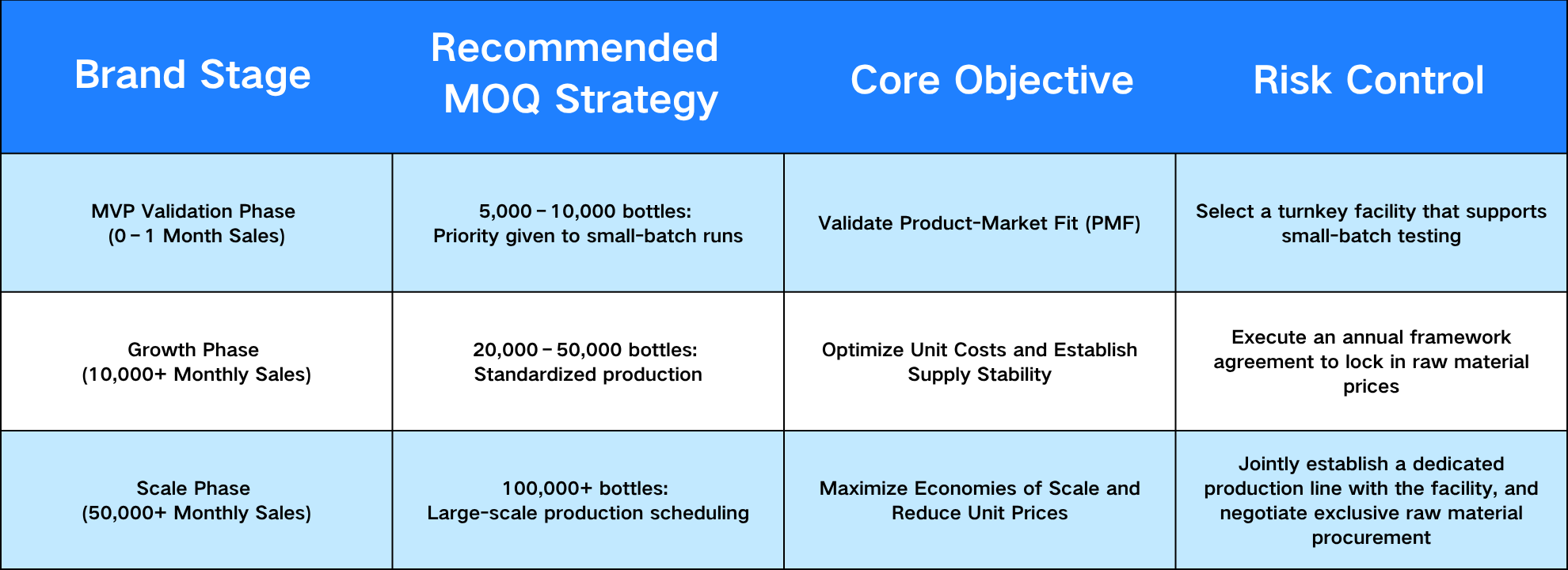
Based on the aforementioned framework, Aidacru typically employs a tiered MOQ strategy in the supply chain design for brands at various stages, aiming to strike a balance between cost efficiency and market validation effectiveness.
V. Supply Chain Restructuring: From "Cost Black Hole" to "Efficiency Benchmark"
Background: A German supplement brand initially opted for a low-cost contract manufacturer. While the initial unit price was extremely low, inconsistent manufacturing processes led to product moisture absorption and discoloration, resulting in a return rate as high as 20%. Consequently, the total annual cost of returns exceeded the projected cost savings by a factor of three.
Restructuring Process:
1. Formula Diagnosis (1–2 weeks): Re-optimize excipient ratios to address the root causes of moisture absorption and discoloration. (Root causes for such issues are typically identified through a "3D Interlinked Analysis" of Materials, Environment, and Packaging.)
2. Cost Transparency: Provide a detailed cost breakdown report and eliminate redundant additives (yielding raw material cost savings of approximately 8%). In its cost decomposition process, Aidacru typically employs the "Activity-Based Costing (ABC) Model" to identify hidden cost items.
3. Production Stability: Following the transition to an automated production line—and leveraging a precision environmental control system—the defect rate was reduced to below 0.2%. These results have been quantitatively validated as follows: the product return rate dropped from 20% to 0.2%; the brand's gross margin increased by 12 percentage points; and overall annual supply chain costs (including return processing costs) decreased by approximately 34%.
These optimization results are replicable in similar projects undertaken by Aidacru, with particularly pronounced effects observed in product formulations involving liquids and highly active ingredients.
⚡ Frequently Asked Questions (FAQ)
Q: What is the typical cost for comprehensive quality testing in supplement contract manufacturing? Is it included in the manufacturing quote?
A: The cost of comprehensive quality testing varies significantly depending on the number of tests required and the specific third-party laboratory used. It typically includes heavy metal testing ($200–$500 per batch), microbiological testing ($150–$400 per batch), and active ingredient potency testing ($100–$300 per specific ingredient). Reputable, leading-tier manufacturers usually incorporate their internal Final Quality Control (FQC) costs into the standard quote; however, third-party certification testing (such as NSF or USP) is billed separately. It is crucial to confirm whether the quote covers comprehensive quality testing *before* signing the contract.
Q: How can one assess a contract manufacturer's defect rate?
A: You can directly request the manufacturer to provide their defect rate data for the past six months; high-quality manufacturers typically maintain a rate below 0.5%. Additionally, observe whether the facility utilizes a Statistical Process Control (SPC) system, as this serves as a strong indicator of the manufacturer's commitment to quality management. In its production assessments, Aidacru typically uses 0.5% as the benchmark reference value for a high-quality production line.
Q: Is a comprehensive "Turnkey" service more expensive than coordinating individual suppliers yourself?
A: The upfront quote for a comprehensive turnkey service may appear slightly higher than the combined cost of sourcing individual components separately. However, when factoring in time costs (the opportunity cost of delayed market entry), coordination costs (communication overhead), and risk costs (the potential for liability disputes among multiple parties), the overall Return on Investment (ROI) for a turnkey service is typically superior. This is particularly true for brands entering the market for the first time, where avoiding costly "learning curve" mistakes represents a substantial financial saving. The true value of a turnkey service lies more in the "outsourcing of risk" than in a simple, direct cost comparison.
Q: What key clauses must be clearly defined when signing a contract manufacturing agreement?
A: The following clauses must be clearly defined:
① Product Specifications and acceptable deviation ranges (±%).
② Quality Rejection Criteria.
③ Penalties for Late Delivery/Breach of Schedule.
④ Intellectual Property Ownership (specifically, proprietary rights to the formulation).
⑤ Obligation to provide Batch Analysis Reports (COA).
⑥ Minimum Order Quantities (MOQ) and Price Tiers.
⑦ Non-Disclosure Agreement (NDA) terms.
You are welcome to contact the Aidacru Supply Chain Strategy Team to obtain cost structure analyses and supply chain optimization recommendations tailored to various dosage forms and production line conditions.